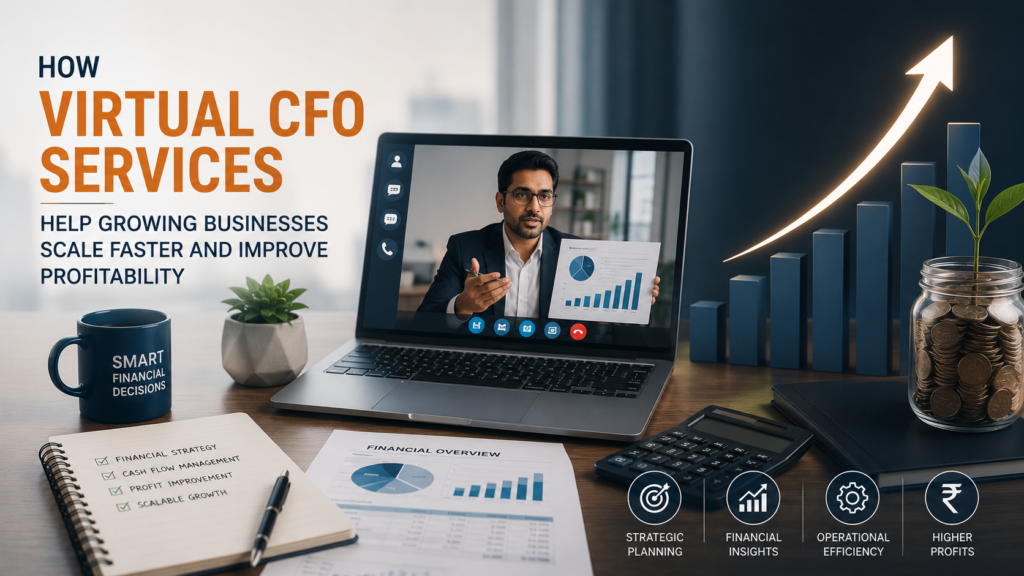
How Virtual CFO Services Help Growing Businesses Scale Faster and Improve Profitability
TL;DR Virtual CFO services help growing businesses make better financial decisions without hiring a full-time CFO. They support cash flow management, budgeting, forecasting, MIS reporting, profitability analysis, cost control, compliance, investor reporting and scalable growth planning. For startups, SMEs and expanding businesses, the real benefit is not only better accounting. The real benefit is CFO-level financial clarity. A Virtual CFO helps business owners answer critical questions: Are we growing profitably? Where is cash getting blocked? Which products or clients are most profitable? Can we afford expansion? Are we ready for funding? Are our financial controls strong enough? Why Growing Businesses Need CFO-Level Thinking Many businesses grow faster than their finance systems. At an early stage, basic bookkeeping may be enough. But once revenue increases, vendors multiply, GST filings become complex, employees increase, debtors grow, and management needs better reports, basic accounting starts falling short. This is where businesses begin to feel the gap. Common signs include: Profit appears on paper, but cash is always tight Reports come late or are difficult to understand Expenses are increasing faster than revenue GST, TDS or statutory compliance creates stress Business owners do not know exact margins Pricing decisions are based on guesswork Funding documents are not ready Banks or investors ask for structured financials The finance team records data but does not provide insights A Virtual CFO solves this gap by bringing strategic finance leadership into the business. What Are Virtual CFO Services? Virtual CFO services provide senior-level financial leadership on an outsourced or part-time basis. Instead of hiring a full-time CFO, a business gets expert support for financial planning, controls, reporting and decision-making. A Virtual CFO typically helps with: Financial strategy Cash flow management Budgeting and forecasting Profitability analysis MIS reporting Cost control Working capital planning Investor reporting Funding readiness Compliance monitoring Audit preparation Internal controls Business performance review CA Rohit Jain’s Virtual CFO service focuses on strategic financial stewardship, investor reporting, burn-rate metrics, unit economics, AI-assisted workflows and improved financial efficiency for startups and growing businesses. Virtual CFO vs Accountant vs Full-Time CFO Role Main Focus Best For Accountant Recording transactions, bookkeeping, basic reports Routine compliance and data entry Tax Consultant / CA Tax filing, GST, audit, compliance, advisory Compliance accuracy and tax planning Virtual CFO Strategy, cash flow, profitability, MIS, growth planning Growing businesses needing senior finance guidance Full-Time CFO Complete in-house finance leadership Large companies with complex operations A Virtual CFO does not replace accounting. Instead, they convert accounting data into actionable financial intelligence. For example, an accountant may prepare a profit and loss statement. A Virtual CFO explains why profit margins dropped, which cost category is hurting the business, and what action is needed. How Virtual CFO Services Help Businesses Scale Faster 1. Better Cash Flow Visibility Cash flow is one of the biggest reasons growing businesses struggle. A company may be profitable on paper but still unable to pay salaries, taxes, vendors or loan EMIs on time. This usually happens because money is blocked in receivables, inventory, delayed billing or poor working capital planning. A Virtual CFO helps by tracking: Cash inflows and outflows Receivables ageing Vendor payment cycles Monthly burn rate Tax payment obligations Loan repayment schedules Working capital gaps Seasonal cash pressure With this visibility, business owners can plan ahead instead of reacting at the last minute. For example, if a business expects a GST payment, salary cycle and major vendor payment in the same week, the Virtual CFO can prepare cash flow planning in advance. This prevents emergency borrowing and protects vendor relationships. 2. Stronger Budgeting and Forecasting Scaling without budgeting is risky. Many businesses increase expenses before understanding whether revenue can support them. They hire too quickly, expand too early, increase marketing spends without tracking ROI or buy assets without checking payback. A Virtual CFO creates structured budgets for: Revenue targets Department-wise expenses Marketing spend Payroll cost Compliance cost Capital expenditure Loan obligations Profit targets Cash reserves Forecasting helps business owners see the future impact of today’s decisions. For example, if a company plans to open a new branch, a Virtual CFO can model expected revenue, fixed cost, break-even point, working capital need and risk scenarios before the decision is made. 3. Profitability Tracking by Product, Client or Segment Revenue growth is not the same as profitable growth. A business may have high revenue but low margins because some clients, products or service lines are not profitable. A Virtual CFO helps analyse profitability by: Product Service line Customer segment Branch Project Sales channel Region Team or department This allows better decisions on pricing, discounts, customer focus and cost allocation. For example, a company may discover that one high-revenue client consumes too much team time and delivers poor margins. Another smaller client segment may generate better profit with lower effort. This type of analysis directly improves profitability. 4. MIS Reporting for Faster Decisions Management Information System reports, or MIS reports, help business owners make faster and better decisions. A Virtual CFO can design monthly dashboards covering: Revenue growth Gross margin Net profit Cash flow Receivables ageing Payables ageing Inventory movement Expense trends GST and TDS liabilities Budget vs actual performance Key business ratios Good MIS reports should not be complicated. They should answer practical business questions. For example: Are sales increasing but margins falling? Are receivables crossing safe limits? Which expenses are rising unexpectedly? Are we meeting monthly profit targets? Do we have enough cash for the next 60 days? When business owners receive reliable MIS reports every month, decisions become faster and less emotional. 5. Cost Control and Margin Improvement Many businesses do not lose money because of one large mistake. They lose money through small leakages repeated every month. Examples include: Untracked discounts High vendor costs Poor inventory control Low-margin clients Unused subscriptions Excessive overtime Delayed billing High interest cost Weak procurement controls Inefficient tax planning A Virtual CFO reviews these leakages and creates cost-control systems. This may include: Vendor negotiation review Expense approval process Budget limits Monthly variance analysis Gross
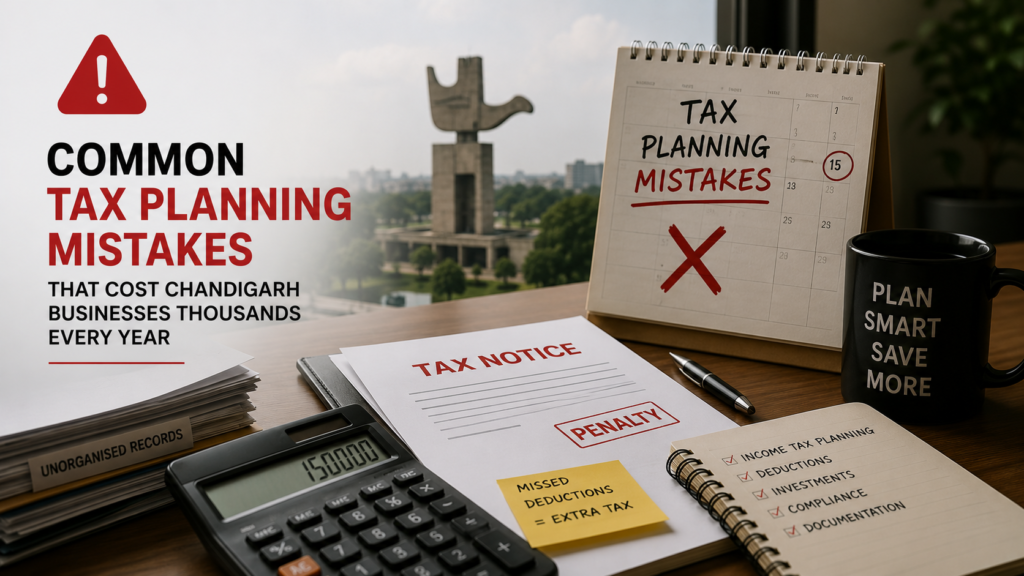
Common Tax Planning Mistakes That Cost Chandigarh Businesses Thousands Every Year
TL;DR Most tax losses do not happen because businesses earn more profit. They happen because tax planning starts too late, records are incomplete, advance tax is miscalculated, TDS is missed, GST data does not match books, or major business decisions are taken without CA review. For Chandigarh businesses, tax planning should be a year-round process. A structured tax plan helps reduce avoidable interest, penalties, disallowances, cash flow pressure and compliance notices. Why Tax Planning Is Not a Year-End Activity Many business owners think tax planning means calculating tax in March or filing returns before the due date. That is not real tax planning. Real tax planning begins at the start of the financial year and continues every month. Every invoice, vendor payment, salary structure, loan, capital purchase, GST return, TDS deduction and cash transaction can affect tax liability. A business that reviews tax only at year-end usually faces three problems: Too little time to correct errors Higher risk of missed deductions or disallowances Sudden cash flow pressure due to unpaid tax liability For SMEs, startups, traders, consultants and service businesses in Chandigarh, proactive tax planning can directly protect profitability. Mistake 1: Waiting Until March to Think About Tax This is one of the most expensive mistakes businesses make. By March, most business decisions are already done. Expenses are incurred, invoices are issued, payments are made, assets are purchased and compliance deadlines may already be missed. Last-minute tax planning creates problems such as: Rushed investment decisions Incorrect expense booking Missed advance tax instalments Poor cash flow planning Incomplete documentation Higher interest liability Better approach: review tax position quarterly. A CA-led quarterly review helps estimate profits, check tax liability, review GST/TDS compliance and plan payments before they become stressful. Mistake 2: Not Estimating Advance Tax Correctly Advance tax is a major area where businesses lose money through interest. If tax liability is expected beyond the prescribed threshold, advance tax must be paid in instalments during the year. Businesses often miss this because they do not track profit regularly. Common advance tax mistakes include: Not estimating quarterly profit Ignoring seasonal income spikes Forgetting non-business income Not considering capital gains Underestimating tax liability Paying tax only near year-end For FY 2026–27, advance tax planning needs regular review of books, income, deductions and projected profitability. Presumptive taxation taxpayers may follow different advance tax timing, so classification must be reviewed carefully. Mistake 3: Ignoring TDS and TCS Compliance TDS errors can become costly because they affect both the payer and recipient. Businesses may need to deduct TDS on payments such as: Professional fees Contractor payments Rent Interest Commission Salary Certain purchases or specified transactions Common TDS mistakes include: Not deducting TDS Deducting at the wrong rate Deducting but not depositing on time Filing incorrect TDS returns Not issuing TDS certificates PAN mismatch in TDS returns TDS and advance tax are both important collection mechanisms, and timely compliance helps avoid interest, penalties and mismatch issues. Mistake 4: Mixing Personal and Business Expenses Many small businesses lose tax efficiency because personal and business expenses are mixed. Examples include: Personal travel booked as business travel Family expenses paid from business account Personal vehicle expenses without business justification Unsupported cash withdrawals Mixed-use phone and internet bills without proper allocation This creates two risks. First, genuine business expenses may not be properly documented. Second, personal expenses claimed as business expenses may be disallowed during scrutiny. Better approach: Maintain separate business bank accounts Keep proper invoices Define expense approval rules Record owner withdrawals separately Keep business-purpose documentation Clean separation improves both tax planning and audit readiness. Mistake 5: Poor Bookkeeping and Missing Documents Tax planning fails when bookkeeping is weak. A business may be eligible for deductions, but without proper records, claims become risky. Missing invoices, vague expense entries, cash payments without proof and unreconciled ledgers can increase taxable income. Poor bookkeeping can lead to: Disallowed expenses Wrong profit calculation GST mismatch TDS mismatch Inaccurate advance tax Audit queries Weak loan documentation A monthly bookkeeping review is one of the simplest ways to prevent tax leakage. Important records to maintain: Sales invoices Purchase bills Expense vouchers Bank statements GST returns TDS challans Salary records Loan statements Fixed asset invoices Agreements and contracts Mistake 6: Claiming Deductions Without Proper Eligibility Every deduction is not automatically available to every business. Businesses often make mistakes while claiming: Depreciation Preliminary expenses Interest expense Employee welfare expenses Travel expenses Repairs and maintenance Bad debts Donations Professional fees Capital vs revenue expenditure Some expenses may be deductible, but only if properly classified and supported. For example, certain preliminary expenses may be deductible over a period subject to conditions. The mistake is not claiming deductions. The mistake is claiming them without verifying eligibility, documentation and tax treatment. Mistake 7: Ignoring GST and Income Tax Turnover Mismatch GST data and income tax data should tell a consistent financial story. Problems arise when: GST turnover differs from books Sales invoices are missed Credit notes are not adjusted correctly Advances are treated inconsistently Exempt and taxable sales are mixed GSTR-1 and books do not match Income tax return turnover differs from GST returns GST reporting errors can include underreporting sales, incorrect purchase reporting, transaction misclassification and wrong reporting periods. For businesses in Chandigarh, GST-income tax reconciliation should be done before finalising accounts and filing returns. Mistake 8: Not Reviewing Cash Transactions Cash transactions need careful review because tax laws place restrictions and reporting requirements on certain cash payments, receipts and loans. Common mistakes include: Large cash expenses without proper proof Cash payments to vendors above permitted limits Cash loans or repayments Unexplained cash deposits Poor cash book maintenance Personal cash mixed with business cash Cash errors can increase scrutiny and may lead to disallowance or penalty exposure. Better approach: Keep a daily cash book Prefer banking channels Avoid unsupported cash payments Maintain payment proof Review cash transactions monthly Mistake 9: Choosing the Wrong Business Structure The structure of a business affects taxation, compliance, liability, funding options and long-term planning. Many businesses
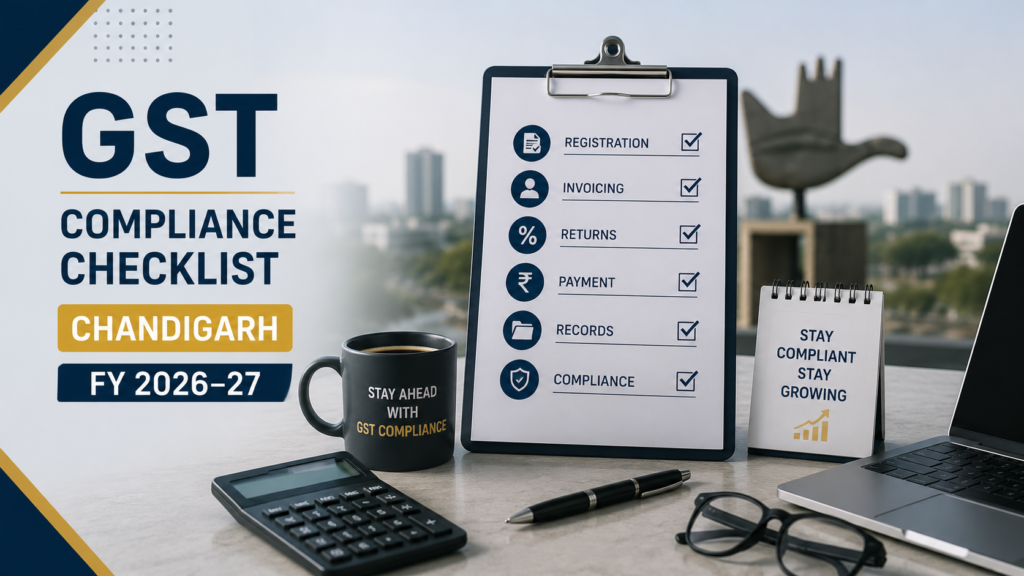
The Complete GST Compliance Checklist for Businesses in Chandigarh for FY 2026–27
TL;DR GST compliance is not just about filing returns before the due date. For businesses in Chandigarh, FY 2026–27 requires a structured monthly process covering invoices, GSTR-1, GSTR-3B, GSTR-2B reconciliation, input tax credit, e-invoicing, reverse charge, records and CA-led review. A missed invoice, wrong GST rate, delayed vendor filing or incorrect ITC claim can affect cash flow, trigger notices and create unnecessary compliance pressure. This checklist helps business owners stay organised throughout the year. Why GST Compliance Needs Monthly Discipline Many businesses treat GST as a monthly filing task. That approach is risky. GST compliance is a continuous process. Every sale invoice, purchase bill, debit note, credit note, vendor filing and tax payment affects the final return. If businesses wait until the last few days of the month, errors become harder to correct. For Chandigarh-based SMEs, traders, consultants, startups and service providers, the real goal should be simple: accurate records, timely filings and clean reconciliation. A strong GST system helps businesses: Avoid late fees and interest Protect eligible input tax credit Reduce mismatch-related notices Maintain better vendor discipline Improve cash flow planning Prepare for audit and assessment Build stronger financial credibility GST Compliance Checklist for FY 2026–27 1. Verify GST Registration Details Start FY 2026–27 by checking whether all GST registration details are updated. Review: Legal business name Trade name Principal place of business Additional places of business Bank account details Authorised signatory details Email and mobile number Nature of business HSN/SAC code mapping If the business has added a new branch, warehouse, service line or business vertical, update the GST registration details on time. Incorrect registration details can create issues during notices, refunds, e-way bills, e-invoicing and customer/vendor verification. 2. Confirm GST Filing Frequency Businesses must confirm whether they are monthly filers or covered under the QRMP scheme. Under the QRMP scheme, eligible taxpayers file GSTR-1 and GSTR-3B quarterly while paying tax monthly. Monthly filers generally file GSTR-1 and GSTR-3B every month. Check: Turnover in the previous financial year QRMP eligibility Whether monthly filing is better for cash flow Whether customers require regular invoice reflection Vendor/customer reconciliation needs For B2B businesses, monthly filing may sometimes be better because customers expect invoices to appear on time for ITC claims. 3. Maintain Correct GST Tax Invoices GST compliance starts at the invoice level. Every invoice should include: GSTIN of supplier GSTIN of customer, where applicable Invoice number and date Correct place of supply HSN/SAC code Taxable value GST rate CGST/SGST/IGST split Reverse charge applicability, if any E-invoice IRN and QR code, where applicable Common invoice-level errors include wrong GST rate, incorrect place of supply, missing GSTIN, duplicate invoice number and incorrect HSN/SAC classification. These errors may look small, but they can create major reconciliation issues later. 4. Reconcile GSTR-1, GSTR-3B and Books Businesses should not file GST returns only from accounting software data without reconciliation. Every month, compare: Record What to Check Sales register Invoice value, GST rate, customer GSTIN GSTR-1 Outward supplies reported GSTR-3B Tax liability and ITC summary Books of accounts Actual accounting entries E-invoice portal IRN and invoice data, if applicable The goal is to ensure that sales reported in GSTR-1 match the tax liability discharged in GSTR-3B and books. Mismatch between GSTR-1 and GSTR-3B can lead to notices, additional queries and unnecessary compliance burden. 5. Review GSTR-2B Before Claiming ITC Input tax credit is one of the most important parts of GST compliance. Before claiming ITC, review GSTR-2B carefully. Check: Whether supplier invoices are reflected Whether GSTIN and invoice values match Whether tax amount matches books Whether supplier has filed returns Whether ITC is eligible Whether blocked credit under GST law is excluded Whether duplicate ITC is avoided Do not claim ITC only because an invoice is available in books. Vendor filing status and GSTR-2B reflection are important. Businesses should maintain an ITC reconciliation sheet every month. 6. Check E-Invoicing Applicability E-invoicing applicability depends on turnover thresholds and government rules. Businesses should review whether they are covered based on aggregate turnover. If applicable, ensure: E-invoice is generated before issuing invoice IRN is available QR code is printed Accounting software is integrated Cancelled e-invoices are tracked E-invoice data matches GSTR-1 Staff understands the workflow If a business crosses the applicable threshold and continues issuing normal invoices without e-invoicing, it can create compliance risk. 7. Track Reverse Charge Mechanism Reverse Charge Mechanism, or RCM, is often missed by businesses. RCM may apply in selected cases where the recipient pays GST instead of the supplier. Review RCM on: Legal services Goods transport agency services Import of services Director sitting fees, where applicable Sponsorship services Other notified supplies Businesses should maintain a separate RCM register and pay liability correctly through cash ledger. ITC treatment should also be reviewed carefully. 8. Maintain GST Documentation GST compliance is not complete without proper records. Maintain: Sales invoices Purchase invoices Debit notes Credit notes E-way bills E-invoices Payment proofs Vendor confirmations GSTR-1 filings GSTR-3B filings GSTR-2B reconciliation ITC working RCM working GST challans Notices and replies Digital storage should be structured month-wise and vendor-wise. Poor documentation can weaken the business position during scrutiny or audit. 9. Monitor GST Due Dates Businesses should maintain a GST compliance calendar. Typical GST compliance due dates include: Return / Compliance General Frequency Common Due Date Pattern GSTR-1 Monthly 11th of next month GSTR-1 under QRMP Quarterly 13th after quarter end GSTR-3B Monthly 20th of next month GSTR-3B under QRMP Quarterly 22nd or 24th, depending on state category CMP-08 Quarterly 18th after quarter end GSTR-4 Annual Usually 30th June after financial year GSTR-9 Annual Usually 31st December after financial year, if applicable Due dates may change through official notifications. Always verify before filing. 10. Conduct Monthly CA Review A CA-led monthly review helps identify problems before they become notices. A monthly GST review should cover: Sales vs GSTR-1 GSTR-3B liability ITC as per books vs GSTR-2B Blocked credit review RCM liability E-invoice errors Vendor mismatch Credit notes and debit notes Pending returns Cash ledger and credit ledger balance Notices
CA in Chandigarh vs Online Accounting Platforms: Which Option Delivers Better Business Results?
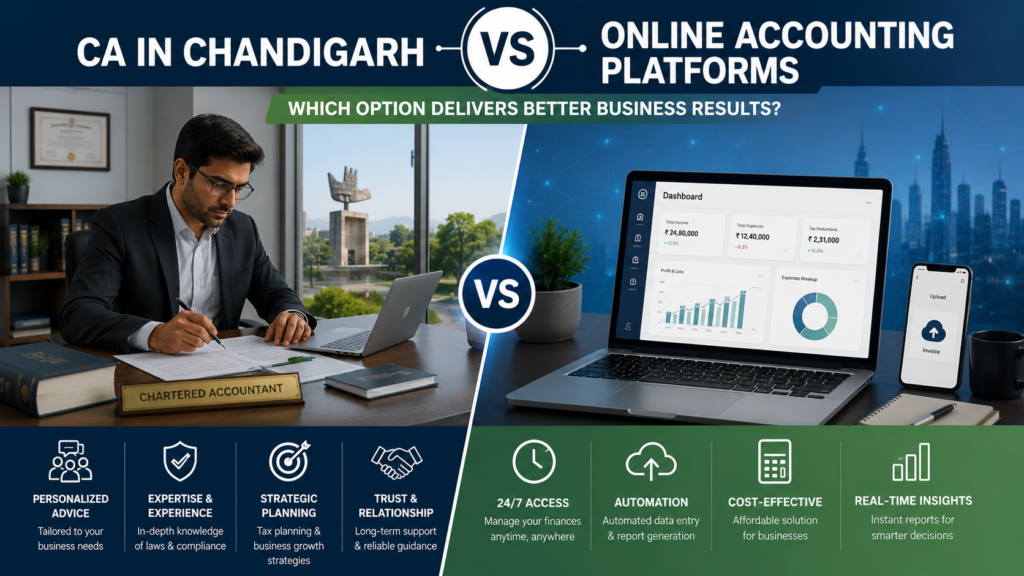
TL;DR Online accounting platforms are useful for billing, bookkeeping, invoice tracking, basic GST reports and day-to-day financial recording. But they cannot fully replace the judgment, compliance understanding and advisory role of a professional CA in Chandigarh. For small businesses, startups, traders, consultants and growing companies, the best option is not “CA vs software.” The better model is “CA-led accounting supported by technology.” Software can process data. A Chartered Accountant can interpret it, review compliance risks, plan taxes, guide business decisions and represent the business when issues arise. Why This Comparison Matters for Chandigarh Businesses Business owners in Chandigarh are dealing with a more digital and compliance-heavy environment than before. GST returns, e-invoicing, input tax credit reconciliation, income tax filings, TDS, audit requirements, ROC compliance and business financial reporting all require accuracy. At the same time, online accounting platforms have become popular because they offer convenience. Many platforms promise simple billing, automated reports, cloud access and easy GST filing. This creates a common question: Should a business hire a CA in Chandigarh or rely on an online accounting platform? The answer depends on the business size, transaction volume, compliance complexity, tax risk and need for advisory. A freelancer with limited invoices may manage basic records through software. But a growing business with GST, vendors, staff, loans, audit requirements or expansion plans needs more than automated entries. Accounting is not only about recording numbers. It is about protecting the business, reducing tax risk, improving cash flow and supporting smarter decisions. What Does a CA in Chandigarh Actually Do? A Chartered Accountant does much more than bookkeeping or return filing. A CA works as a compliance advisor, tax planner, financial reviewer and business decision-support professional. A professional CA in Chandigarh can help with: GST registration and filing GSTR-1, GSTR-3B and GSTR-2B reconciliation Input tax credit review Income tax return filing Tax planning TDS compliance Accounting and bookkeeping review Audit and assurance Corporate services Business advisory Financial reporting Representation before tax authorities NRI taxation support Compliance risk management The key value of a CA lies in interpretation. Software may show a mismatch. A CA understands whether it creates a tax exposure, documentation issue, ITC risk or filing correction requirement. What Do Online Accounting Platforms Offer? Online accounting platforms are digital tools that help businesses manage financial records. They are useful for automating repetitive tasks and improving visibility. Common features include: GST invoicing Sales and purchase entry Expense recording Inventory tracking Bank reconciliation Customer and vendor ledgers Basic financial reports Tax summaries Cloud data access Mobile billing E-invoicing support in some platforms These tools are helpful because they reduce manual paperwork and make data easier to access. However, a platform follows the instructions, settings and data provided by the user. If the data is wrong, the output can also be wrong. If a GST rate is selected incorrectly, if an invoice is misclassified, or if ITC eligibility is misunderstood, the software may not solve the underlying compliance issue. That is where CA review becomes important. CA vs Online Accounting Platform: Quick Comparison Table Factor CA in Chandigarh Online Accounting Platform Bookkeeping Reviews accuracy and structure Records and organises data GST filing Interprets compliance and reconciles risk Generates reports and return data Tax planning Provides strategy and professional advice Gives basic tax summaries Audit readiness Reviews records, ledgers and documentation Stores and exports data Business advisory Offers decision-making support Limited to reports and dashboards Tax notices Can represent and respond professionally Cannot handle authority representation independently Customisation Based on business model and risk Based on platform features Cost Higher professional value Lower entry cost Best for Compliance-heavy and growing businesses Simple and routine accounting tasks Where Online Accounting Platforms Work Well Online platforms are useful when the business has simple transactions and limited compliance complexity. They work well for: Basic invoice generation Daily sales and purchase recording Expense tracking Customer payment reminders Basic GST summaries Cloud access to financial records Inventory-linked billing Simple business dashboards For example, a small service provider with limited monthly invoices may use software to maintain records efficiently. A retail shop may use billing software to manage inventory and GST invoices. A freelancer may use an online platform to track expenses and income. In these cases, software helps create discipline. But even then, periodic CA review is useful because accounting errors often remain hidden until filing, assessment or audit. Where a CA Delivers Stronger Business Results 1. GST Compliance and ITC Reconciliation GST is one of the biggest areas where businesses need professional guidance. It is not enough to simply generate invoices and file returns. Businesses must ensure: Sales data matches GSTR-1 Tax liability matches GSTR-3B Purchase register matches GSTR-2B Input tax credit is eligible Vendors have filed correctly Reverse charge is checked Credit notes and debit notes are handled properly Wrong claims are avoided An online platform can help generate reports. But a CA can review the legal and compliance impact. For example, if ITC is visible in purchase records but not reflected in GSTR-2B, software may flag a mismatch. A CA will decide whether the credit should be claimed, deferred, followed up with the vendor, or corrected through documentation. That decision can directly affect cash flow and tax risk. 2. Tax Planning and Advisory Online platforms can show taxable income or tax summaries. But tax planning requires understanding the business, future goals, cash flow, deductions, investments, compliance history and legal structure. A CA in Chandigarh can guide businesses on: Advance tax planning Expense classification Deduction eligibility Business structure planning Tax-efficient profit management Capital expenditure decisions Loan and interest treatment Salary vs profit planning HNI and NRI taxation matters Software gives numbers. A CA gives interpretation. For growing businesses, this difference matters because tax planning should happen throughout the year, not only during return filing. 3. Audit Readiness If a business is subject to statutory audit, tax audit or internal review, software alone is not enough. Audit readiness requires: Proper ledger scrutiny Supporting documents Reconciled bank statements GST reconciliation TDS
Expert Insights: How AI-Powered Accounting Is Transforming Businesses in Chandigarh in 2026Expert Insights: How AI-Powered Accounting Is Transforming Businesses in Chandigarh in 2026
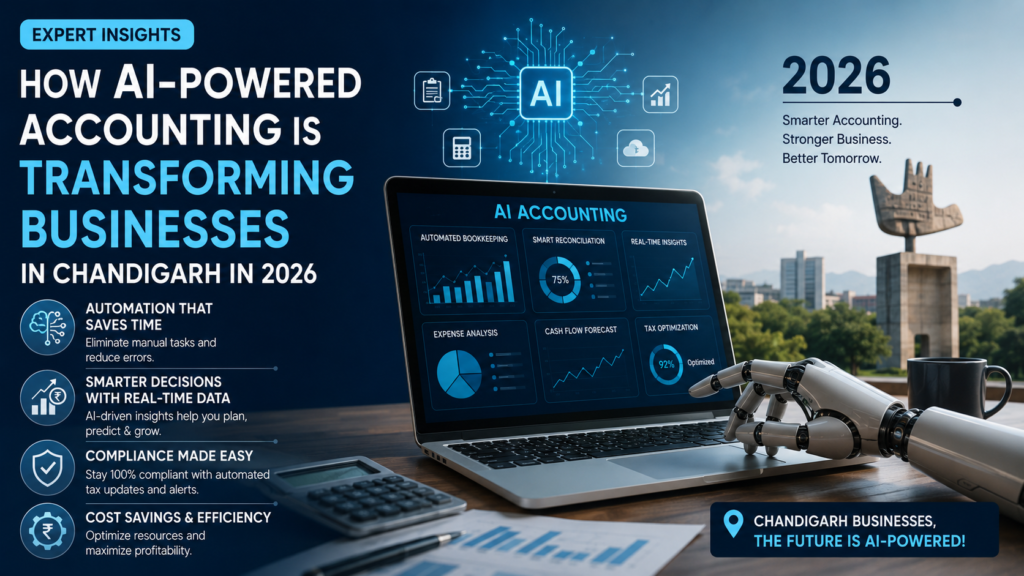
TL;DR AI-powered accounting in Chandigarh is no longer just a technology trend. It is becoming a practical business advantage for companies that want faster reporting, stronger GST compliance, better cash flow tracking and fewer manual accounting errors. For SMEs, startups, professionals and growing businesses across Chandigarh and Tricity, AI can help automate repetitive finance tasks. However, AI works best when supported by expert Chartered Accountant review. Software may process data, but professional judgment is still essential for compliance, tax planning, audit readiness and strategic decisions. Why AI-Powered Accounting Matters for Chandigarh Businesses Business owners in Chandigarh are operating in a more compliance-driven and data-driven environment than ever before. GST filings, e-invoicing, vendor reconciliation, TDS, income tax reporting, payroll records and audit documentation all require accuracy, speed and traceability. Traditional accounting systems often depend heavily on manual entry, delayed reporting and reactive problem-solving. By the time an error is found, the GST return may already be filed, a vendor mismatch may have affected input tax credit, or management may have made a decision using outdated financial data. This is where AI-powered accounting in Chandigarh is creating a shift. AI-enabled accounting systems can help businesses: Capture invoices faster Categorize transactions automatically Detect duplicate or unusual entries Match GST data with purchase records Generate real-time dashboards Forecast cash flow patterns Highlight compliance risks early Reduce repetitive manual work But the real value is not only automation. The real value is better decision-making. What Is AI-Powered Accounting? AI-powered accounting refers to the use of artificial intelligence, automation, machine learning and data analytics to manage accounting tasks more intelligently. Instead of only recording transactions after they happen, AI-enabled accounting tools can analyse data patterns, identify exceptions and help finance teams act faster. For example, AI can: Read invoice data using OCR Match purchase invoices with GST portal data Identify unusual expense patterns Predict payment delays Flag missing documentation Create automated reports Assist in audit preparation In simple terms, AI reduces repetitive accounting work and improves financial visibility. However, AI is not a replacement for a Chartered Accountant. It is a support system that helps CAs and finance teams deliver better accuracy, speed and advisory value. Traditional Accounting vs AI-Powered Accounting Area Traditional Accounting AI-Powered Accounting Data entry Manual and time-consuming Automated capture and classification GST reconciliation Often done periodically Can be tracked more frequently Error detection Found after review Flagged earlier through rules and patterns Reporting Monthly or delayed Near real-time dashboards Cash flow Based on past reports Predictive and forward-looking Audit preparation Document-heavy and reactive More structured and traceable Advisory value Limited by manual workload More time for analysis and planning The biggest difference is timing. Traditional accounting often tells businesses what happened. AI-powered accounting helps businesses understand what is happening and what may happen next. Key Areas Where AI Is Transforming Business Finance 1. Bookkeeping Automation Bookkeeping is the foundation of every financial system. But for many small and medium businesses, bookkeeping becomes messy because invoices, bank statements, bills, receipts and payment records are handled manually. AI can automate several bookkeeping functions: Bank transaction categorization Invoice data extraction Expense tagging Vendor ledger updates Duplicate entry detection Document matching This reduces manual errors and gives business owners cleaner books throughout the year. For Chandigarh-based businesses dealing with multiple vendors, branches or service lines, automated bookkeeping can save significant time and improve reporting discipline. 2. GST Reconciliation and E-Invoicing GST compliance is one of the strongest use cases for AI accounting in India. Businesses must regularly match purchase records with supplier filings, check input tax credit eligibility, verify invoice details and ensure accurate return filing. AI can help with: GSTR-2B reconciliation Input tax credit mismatch detection Invoice validation GSTIN verification Vendor compliance tracking E-invoice data checks Missing invoice identification For businesses where GST mismatches affect working capital, early detection is critical. AI can highlight issues before they become notices, blocked credits or filing errors. Still, final review should always involve a qualified CA because GST interpretation, eligibility, classification and advisory decisions require professional expertise. 3. Real-Time Financial Reporting Many business owners receive financial reports after the month ends. Sometimes, reports are delayed even further because records are incomplete. AI-powered systems can help generate faster dashboards showing: Revenue trends Expense categories Receivables ageing Payables position Profit margins Cash balance GST liability TDS obligations This is especially useful for startups, SMEs and service businesses in Chandigarh that need timely decisions on hiring, expansion, pricing, vendor payments and working capital. A business that tracks finances weekly is better prepared than one that reviews numbers only during filing season. 4. Cash Flow Forecasting Profit and cash flow are not the same. A business may show profit on paper but still struggle to pay vendors, salaries or taxes on time. AI can analyse historical payment patterns and help predict: Expected collections Delayed receivables Upcoming tax payments Vendor payment pressure Seasonal cash gaps Working capital requirements For growing businesses, this is one of the biggest advantages of AI-powered accounting. Better cash flow visibility helps owners avoid last-minute borrowing, missed payments and poor financial planning. 5. Audit Readiness and Risk Detection Audit preparation becomes stressful when documents are incomplete, ledgers are inconsistent, or reconciliations are pending. AI can support audit readiness by: Organising transaction trails Identifying unusual entries Highlighting missing invoices Detecting duplicate payments Checking ledger inconsistencies Supporting documentation review This does not remove the need for audit judgment. But it gives auditors and business owners better-quality data to work with. For businesses subject to statutory audit, tax audit or internal review, AI can improve preparedness and reduce year-end pressure. Why AI Cannot Replace a Chartered Accountant A common concern is whether AI will replace accountants or Chartered Accountants. The practical answer is no. AI can process data. A Chartered Accountant interprets it. AI can flag a mismatch. A CA determines the compliance impact. AI can create reports. A CA explains what the numbers mean for tax, business planning and risk management. AI cannot fully replace professional judgment in areas