TL;DR
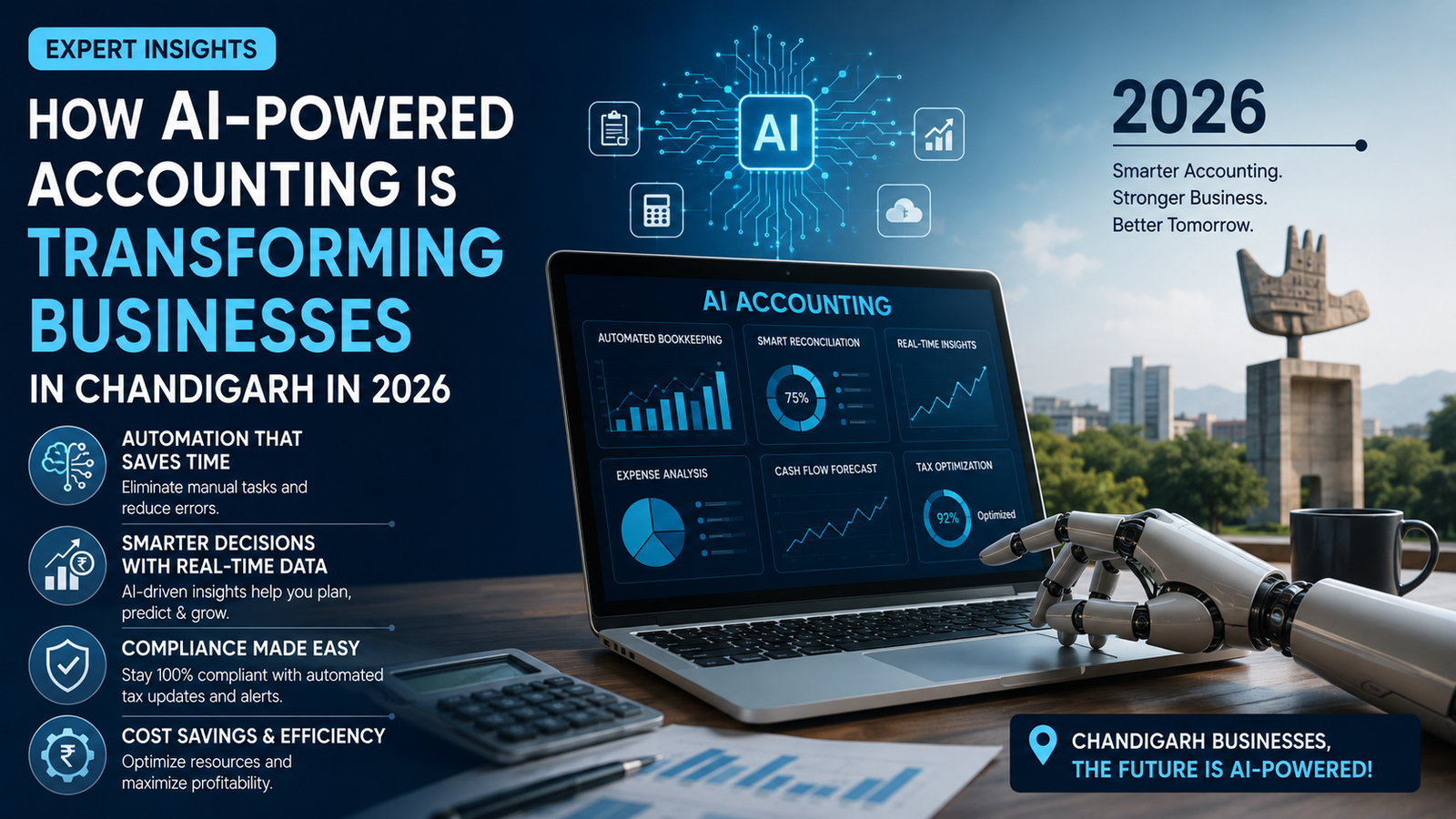
AI-powered accounting in Chandigarh is no longer just a technology trend. It is becoming a practical business advantage for companies that want faster reporting, stronger GST compliance, better cash flow tracking and fewer manual accounting errors.
For SMEs, startups, professionals and growing businesses across Chandigarh and Tricity, AI can help automate repetitive finance tasks. However, AI works best when supported by expert Chartered Accountant review. Software may process data, but professional judgment is still essential for compliance, tax planning, audit readiness and strategic decisions.
Why AI-Powered Accounting Matters for Chandigarh Businesses
Business owners in Chandigarh are operating in a more compliance-driven and data-driven environment than ever before. GST filings, e-invoicing, vendor reconciliation, TDS, income tax reporting, payroll records and audit documentation all require accuracy, speed and traceability.
Traditional accounting systems often depend heavily on manual entry, delayed reporting
and reactive problem-solving. By the time an error is found, the GST return may already be filed,
a vendor mismatch may have affected input tax credit, or management may have made a decision using outdated financial data.
This is where AI-powered accounting in Chandigarh is creating a shift.
AI-enabled accounting systems can help businesses:
- Capture invoices faster
- Categorize transactions automatically
- Detect duplicate or unusual entries
- Match GST data with purchase records
- Generate real-time dashboards
- Forecast cash flow patterns
- Highlight compliance risks early
- Reduce repetitive manual work
But the real value is not only automation. The real value is better decision-making.
What Is AI-Powered Accounting?
AI-powered accounting refers to the use of artificial intelligence, automation, machine learning and data analytics to manage accounting tasks more intelligently.
Instead of only recording transactions after they happen, AI-enabled accounting tools can analyse data patterns, identify exceptions and help finance teams act faster.
For example, AI can:
- Read invoice data using OCR
- Match purchase invoices with GST portal data
- Identify unusual expense patterns
- Predict payment delays
- Flag missing documentation
- Create automated reports
- Assist in audit preparation
In simple terms, AI reduces repetitive accounting work and improves financial visibility.
However, AI is not a replacement for a Chartered Accountant. It is a support system that helps CAs and finance teams deliver better accuracy, speed and advisory value.
Traditional Accounting vs AI-Powered Accounting
| Area | Traditional Accounting | AI-Powered Accounting |
|---|---|---|
| Data entry | Manual and time-consuming | Automated capture and classification |
| GST reconciliation | Often done periodically | Can be tracked more frequently |
| Error detection | Found after review | Flagged earlier through rules and patterns |
| Reporting | Monthly or delayed | Near real-time dashboards |
| Cash flow | Based on past reports | Predictive and forward-looking |
| Audit preparation | Document-heavy and reactive | More structured and traceable |
| Advisory value | Limited by manual workload | More time for analysis and planning |
The biggest difference is timing. Traditional accounting often tells businesses what happened. AI-powered accounting helps businesses understand what is happening and what may happen next.
Key Areas Where AI Is Transforming Business Finance
1. Bookkeeping Automation
Bookkeeping is the foundation of every financial system. But for many small and medium businesses, bookkeeping becomes messy because invoices, bank statements, bills, receipts and payment records are handled manually.
AI can automate several bookkeeping functions:
- Bank transaction categorization
- Invoice data extraction
- Expense tagging
- Vendor ledger updates
- Duplicate entry detection
- Document matching
This reduces manual errors and gives business owners cleaner books throughout the year.
For Chandigarh-based businesses dealing with multiple vendors, branches or service lines, automated bookkeeping can save significant time and improve reporting discipline.
2. GST Reconciliation and E-Invoicing
GST compliance is one of the strongest use cases for AI accounting in India.
Businesses must regularly match purchase records with supplier filings, check input tax credit eligibility, verify invoice details and ensure accurate return filing.
AI can help with:
- GSTR-2B reconciliation
- Input tax credit mismatch detection
- Invoice validation
- GSTIN verification
- Vendor compliance tracking
- E-invoice data checks
- Missing invoice identification
For businesses where GST mismatches affect working capital, early detection is critical. AI can highlight issues before they become notices, blocked credits or filing errors.
Still, final review should always involve a qualified CA because GST interpretation, eligibility, classification and advisory decisions require professional expertise.
3. Real-Time Financial Reporting
Many business owners receive financial reports after the month ends. Sometimes, reports are delayed even further because records are incomplete.
AI-powered systems can help generate faster dashboards showing:
- Revenue trends
- Expense categories
- Receivables ageing
- Payables position
- Profit margins
- Cash balance
- GST liability
- TDS obligations
This is especially useful for startups, SMEs and service businesses in Chandigarh that need timely decisions on hiring, expansion, pricing, vendor payments and working capital.
A business that tracks finances weekly is better prepared than one that reviews numbers only during filing season.
4. Cash Flow Forecasting
Profit and cash flow are not the same. A business may show profit on paper but still struggle to pay vendors, salaries or taxes on time.
AI can analyse historical payment patterns and help predict:
- Expected collections
- Delayed receivables
- Upcoming tax payments
- Vendor payment pressure
- Seasonal cash gaps
- Working capital requirements
For growing businesses, this is one of the biggest advantages of AI-powered accounting.
Better cash flow visibility helps owners avoid last-minute borrowing, missed payments and poor financial planning.
5. Audit Readiness and Risk Detection
Audit preparation becomes stressful when documents are incomplete, ledgers are inconsistent, or reconciliations are pending.
AI can support audit readiness by:
- Organising transaction trails
- Identifying unusual entries
- Highlighting missing invoices
- Detecting duplicate payments
- Checking ledger inconsistencies
- Supporting documentation review
This does not remove the need for audit judgment. But it gives auditors and business owners better-quality data to work with.
For businesses subject to statutory audit, tax audit or internal review, AI can improve preparedness and reduce year-end pressure.
Why AI Cannot Replace a Chartered Accountant
A common concern is whether AI will replace accountants or Chartered Accountants. The practical answer is no.
AI can process data. A Chartered Accountant interprets it.
AI can flag a mismatch. A CA determines the compliance impact.
AI can create reports. A CA explains what the numbers mean for tax, business planning and risk management.
AI cannot fully replace professional judgment in areas such as:
- Tax planning
- GST classification
- Audit opinion
- Business structuring
- Regulatory interpretation
- Financial advisory
- Compliance strategy
- Risk assessment
For Chandigarh businesses, the ideal model is not “AI vs CA”. It is “AI-enabled CA advisory”.
When technology handles repetitive work, Chartered Accountants can spend more time on strategy, compliance quality and business decision support.
Step-by-Step AI Accounting Adoption Roadmap
Step 1: Assess Current Accounting Gaps
Before adopting AI tools, businesses should identify existing issues:
- Are books updated regularly?
- Are GST reconciliations delayed?
- Are invoices stored properly?
- Are reports available on time?
- Are receivables tracked weekly?
- Are tax deadlines monitored?
This helps decide which areas need automation first.
Step 2: Clean Existing Financial Data
AI works best with clean data. If ledgers are poorly maintained, vendor names are inconsistent or past reconciliations are incomplete, automation may produce unreliable results.
Businesses should first clean:
- Vendor ledgers
- Customer ledgers
- Bank entries
- Expense heads
- GST records
- Opening balances
- Outstanding receivables and payables
A CA-led review at this stage is highly recommended.
Step 3: Choose the Right Accounting Automation Stack
Not every business needs expensive software. The right system depends on business size, transaction volume, GST applicability and reporting needs.
A small service firm may need basic bookkeeping automation. A trading business may need GST reconciliation, inventory integration and e-invoicing support. A growing company may need MIS dashboards and virtual CFO reporting.
Selection should be based on:
- Business model
- Number of transactions
- GST complexity
- Integration with existing tools
- Data security
- Reporting needs
- Cost-benefit ratio
Step 4: Automate Repetitive Tasks First
Businesses should begin with tasks that are repetitive and time-consuming:
- Invoice capture
- Bank reconciliation
- GST matching
- Expense categorization
- Receivables tracking
- Report generation
This creates quick efficiency gains without disrupting the entire finance function.
Step 5: Add Review Controls
Automation without review can be risky. Every AI-powered accounting process should include human checks.
Important review controls include:
- CA review of GST returns
- Periodic ledger scrutiny
- Monthly MIS review
- Exception report checks
- Tax position review
- Compliance calendar tracking
AI improves speed, but review improves reliability.
Step 6: Use Reports for Business Decisions
The final goal is not only compliance. The final goal is better business decisions.
AI-powered accounting should help owners answer:
- Which customers delay payments?
- Which expense heads are rising?
- Is gross margin improving or falling?
- Are GST credits being fully captured?
- Is cash flow enough for expansion?
- Are tax liabilities planned in advance?
When accounting becomes decision-focused, it becomes a growth tool.
Common Mistakes Businesses Should Avoid
Mistake 1: Treating AI as a Complete Replacement for Professional Advice
AI tools are useful, but they cannot understand every business context. Tax laws, GST treatment, audit risk and compliance decisions still need expert review.
Mistake 2: Automating Messy Data
If old data is inaccurate, automation will only process inaccurate information faster. Clean records are essential.
Mistake 3: Ignoring Data Security
Financial data is sensitive. Businesses should use secure systems, access controls and proper backup practices.
Mistake 4: Not Training Internal Teams
Even the best software fails when staff do not know how to use it properly. Training is important.
Mistake 5: Reviewing Reports Too Late
AI dashboards are useful only when reviewed regularly. Monthly or weekly review meetings should become part of the finance process.
Conclusion
AI-powered accounting in Chandigarh is changing how businesses manage finance, compliance and decision-making. It helps reduce manual work, improve GST accuracy, speed up reporting and create stronger financial visibility.
But technology alone is not enough.
The best results come when AI automation is combined with professional CA review, compliance expertise and practical business advisory. For SMEs, startups, service firms, traders and growing businesses in Chandigarh, this combination can improve accuracy, reduce stress and support smarter growth.
CTA:
Looking to modernize your accounting, GST compliance or financial reporting system? CA Rohit Jain can help businesses in Chandigarh and Tricity build more accurate, compliant and decision-ready finance processes with expert Chartered Accountant guidance.
FAQ SECTION
1. What is AI-powered accounting?
AI-powered accounting uses automation, artificial intelligence and data analytics to simplify accounting tasks such as invoice processing, bookkeeping, GST reconciliation, reporting and cash flow tracking. It helps businesses reduce manual work and improve financial accuracy.
2. Is AI accounting useful for small businesses in Chandigarh?
Yes. Small businesses can use AI accounting to automate invoice entry, track receivables, reconcile GST data and generate faster reports. It is especially useful for businesses that want better control without building a large in-house finance team.
3. Can AI replace a Chartered Accountant?
No. AI can automate repetitive tasks, but a Chartered Accountant is still required for tax interpretation, GST advisory, audit judgment, compliance review, financial planning and business-specific decision-making.
4. How does AI help in GST compliance?
AI helps by matching purchase records with GST portal data, identifying mismatches, validating invoices, tracking input tax credit and highlighting missing vendor filings. This reduces filing errors and improves compliance readiness.
5. What are the risks of AI-powered accounting?
The main risks include poor data quality, overdependence on software, weak review controls, data security issues and incorrect interpretation of automated outputs. Businesses should combine AI tools with expert CA supervision.
6. How can businesses start using AI accounting?
Businesses should first clean their financial data, identify repetitive accounting tasks, choose suitable automation tools, train staff and set up periodic CA review for reports, GST filings and compliance decisions.
7. Is AI accounting expensive?
The cost depends on business size, transaction volume and software features. For many SMEs, the savings from reduced manual work, fewer errors and better reporting can justify the investment.