TL;DR
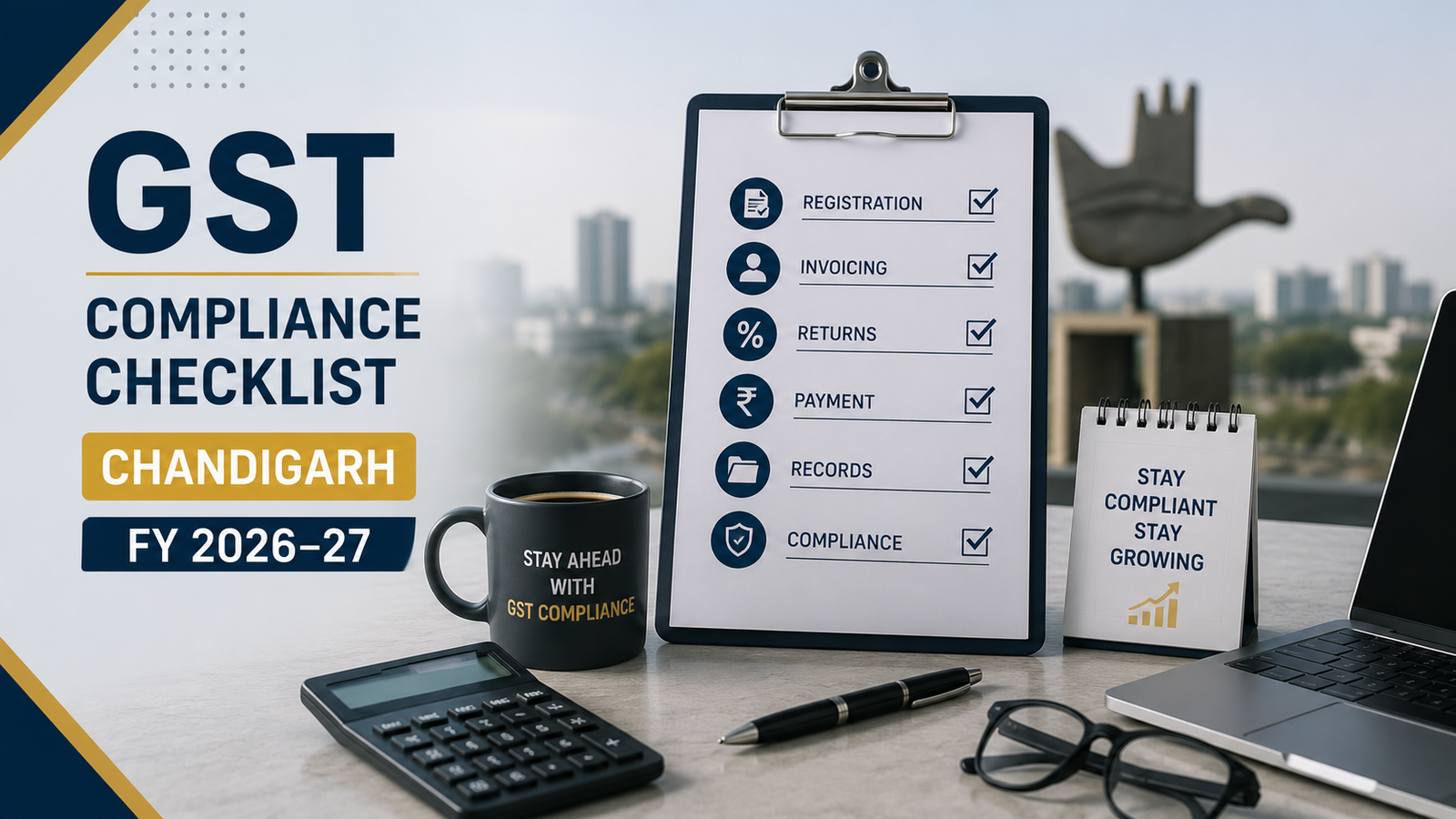
GST compliance is not just about filing returns before the due date. For businesses in Chandigarh, FY 2026–27 requires a structured monthly process covering invoices, GSTR-1, GSTR-3B, GSTR-2B reconciliation, input tax credit, e-invoicing, reverse charge, records and CA-led review.
A missed invoice, wrong GST rate, delayed vendor filing or incorrect ITC claim can affect cash flow, trigger notices and create unnecessary compliance pressure. This checklist helps business owners stay organised throughout the year.

Why GST Compliance Needs Monthly Discipline
Many businesses treat GST as a monthly filing task. That approach is risky.
GST compliance is a continuous process. Every sale invoice, purchase bill, debit note, credit note, vendor filing and tax payment affects the final return. If businesses wait until the last few days of the month, errors become harder to correct.
For Chandigarh-based SMEs, traders, consultants, startups and service providers, the real goal should be simple: accurate records, timely filings and clean reconciliation.
A strong GST system helps businesses:
- Avoid late fees and interest
- Protect eligible input tax credit
- Reduce mismatch-related notices
- Maintain better vendor discipline
- Improve cash flow planning
- Prepare for audit and assessment
- Build stronger financial credibility
GST Compliance Checklist for FY 2026–27
1. Verify GST Registration Details
Start FY 2026–27 by checking whether all GST registration details are updated.
Review:
- Legal business name
- Trade name
- Principal place of business
- Additional places of business
- Bank account details
- Authorised signatory details
- Email and mobile number
- Nature of business
- HSN/SAC code mapping
If the business has added a new branch, warehouse, service line or business vertical, update the GST registration details on time.
Incorrect registration details can create issues during notices, refunds, e-way bills, e-invoicing and customer/vendor verification.
2. Confirm GST Filing Frequency
Businesses must confirm whether they are monthly filers or covered under the QRMP scheme.
Under the QRMP scheme, eligible taxpayers file GSTR-1 and GSTR-3B quarterly while paying tax monthly. Monthly filers generally file GSTR-1 and GSTR-3B every month.
Check:
- Turnover in the previous financial year
- QRMP eligibility
- Whether monthly filing is better for cash flow
- Whether customers require regular invoice reflection
- Vendor/customer reconciliation needs
For B2B businesses, monthly filing may sometimes be better because customers expect invoices to appear on time for ITC claims.
3. Maintain Correct GST Tax Invoices
GST compliance starts at the invoice level.
Every invoice should include:
- GSTIN of supplier
- GSTIN of customer, where applicable
- Invoice number and date
- Correct place of supply
- HSN/SAC code
- Taxable value
- GST rate
- CGST/SGST/IGST split
- Reverse charge applicability, if any
- E-invoice IRN and QR code, where applicable
Common invoice-level errors include wrong GST rate, incorrect place of supply, missing GSTIN, duplicate invoice number and incorrect HSN/SAC classification.
These errors may look small, but they can create major reconciliation issues later.
4. Reconcile GSTR-1, GSTR-3B and Books
Businesses should not file GST returns only from accounting software data without reconciliation.
Every month, compare:
| Record | What to Check |
|---|---|
| Sales register | Invoice value, GST rate, customer GSTIN |
| GSTR-1 | Outward supplies reported |
| GSTR-3B | Tax liability and ITC summary |
| Books of accounts | Actual accounting entries |
| E-invoice portal | IRN and invoice data, if applicable |
The goal is to ensure that sales reported in GSTR-1 match the tax liability discharged in GSTR-3B and books.
Mismatch between GSTR-1 and GSTR-3B can lead to notices, additional queries and unnecessary compliance burden.
5. Review GSTR-2B Before Claiming ITC
Input tax credit is one of the most important parts of GST compliance.
Before claiming ITC, review GSTR-2B carefully.
Check:
- Whether supplier invoices are reflected
- Whether GSTIN and invoice values match
- Whether tax amount matches books
- Whether supplier has filed returns
- Whether ITC is eligible
- Whether blocked credit under GST law is excluded
- Whether duplicate ITC is avoided
Do not claim ITC only because an invoice is available in books. Vendor filing status and GSTR-2B reflection are important.
Businesses should maintain an ITC reconciliation sheet every month.
6. Check E-Invoicing Applicability
E-invoicing applicability depends on turnover thresholds and government rules. Businesses should review whether they are covered based on aggregate turnover.
If applicable, ensure:
- E-invoice is generated before issuing invoice
- IRN is available
- QR code is printed
- Accounting software is integrated
- Cancelled e-invoices are tracked
- E-invoice data matches GSTR-1
- Staff understands the workflow
If a business crosses the applicable threshold and continues issuing normal invoices without e-invoicing, it can create compliance risk.
7. Track Reverse Charge Mechanism
Reverse Charge Mechanism, or RCM, is often missed by businesses.
RCM may apply in selected cases where the recipient pays GST instead of the supplier.
Review RCM on:
- Legal services
- Goods transport agency services
- Import of services
- Director sitting fees, where applicable
- Sponsorship services
- Other notified supplies
Businesses should maintain a separate RCM register and pay liability correctly through cash ledger. ITC treatment should also be reviewed carefully.
8. Maintain GST Documentation
GST compliance is not complete without proper records.
Maintain:
- Sales invoices
- Purchase invoices
- Debit notes
- Credit notes
- E-way bills
- E-invoices
- Payment proofs
- Vendor confirmations
- GSTR-1 filings
- GSTR-3B filings
- GSTR-2B reconciliation
- ITC working
- RCM working
- GST challans
- Notices and replies
Digital storage should be structured month-wise and vendor-wise. Poor documentation can weaken the business position during scrutiny or audit.
9. Monitor GST Due Dates
Businesses should maintain a GST compliance calendar.
Typical GST compliance due dates include:
| Return / Compliance | General Frequency | Common Due Date Pattern |
|---|---|---|
| GSTR-1 | Monthly | 11th of next month |
| GSTR-1 under QRMP | Quarterly | 13th after quarter end |
| GSTR-3B | Monthly | 20th of next month |
| GSTR-3B under QRMP | Quarterly | 22nd or 24th, depending on state category |
| CMP-08 | Quarterly | 18th after quarter end |
| GSTR-4 | Annual | Usually 30th June after financial year |
| GSTR-9 | Annual | Usually 31st December after financial year, if applicable |
Due dates may change through official notifications. Always verify before filing.
10. Conduct Monthly CA Review
A CA-led monthly review helps identify problems before they become notices.
A monthly GST review should cover:
- Sales vs GSTR-1
- GSTR-3B liability
- ITC as per books vs GSTR-2B
- Blocked credit review
- RCM liability
- E-invoice errors
- Vendor mismatch
- Credit notes and debit notes
- Pending returns
- Cash ledger and credit ledger balance
- Notices or portal alerts
This review is especially important for businesses with high transaction volume, multiple vendors, B2B supplies, e-commerce sales, branch operations or export transactions.
GST Compliance Calendar Snapshot for FY 2026–27
Businesses should follow a monthly rhythm:
Before 5th of Every Month
- Collect all sales and purchase data
- Verify invoices and expense bills
- Check missing vendor invoices
Before 8th of Every Month
- Reconcile sales register
- Review purchase register
- Check GSTR-2B data
- Identify ITC mismatches
Before Filing GSTR-1
- Confirm B2B invoices
- Verify GSTINs
- Review credit/debit notes
- Confirm place of supply
Before Filing GSTR-3B
- Finalise tax liability
- Review eligible ITC
- Check RCM
- Confirm cash payment requirement
- Review ledger balances
Monthly After Filing
- Save acknowledgements
- Update compliance tracker
- Follow up with defaulting vendors
- Prepare working papers
Common GST Mistakes Businesses Should Avoid
Mistake 1: Claiming ITC Without GSTR-2B Review
ITC should not be claimed blindly from books. Always match eligible credit with GSTR-2B and review vendor filing status.
Mistake 2: Filing GSTR-3B Without Matching GSTR-1
Sales reported in GSTR-1 and tax paid in GSTR-3B must be aligned. Differences should be explained and corrected.
Mistake 3: Ignoring Vendor Compliance
If vendors delay filing, your ITC may be affected. Maintain vendor follow-up as part of monthly GST discipline.
Mistake 4: Using Wrong GST Rates
Incorrect rate classification can create tax short payment, excess collection or refund issues.
Mistake 5: Missing RCM Liability
RCM is commonly missed because the supplier may not charge GST. Businesses must identify applicable expenses separately.
Mistake 6: Poor Record Keeping
GST notices often require supporting documents. If records are scattered, response preparation becomes difficult.
Mistake 7: Waiting Until the Due Date
Last-minute filing increases the risk of portal issues, data mistakes and missed reconciliation.
Conclusion
GST compliance for FY 2026–27 requires more than filing returns. Businesses in Chandigarh need a structured monthly process covering invoices, GSTR-1, GSTR-3B, GSTR-2B, ITC, e-invoicing, RCM, documentation and review.
A well-maintained GST system protects cash flow, reduces notices and improves business confidence.
The best approach is simple: maintain accurate records, reconcile every month and get professional CA review before issues become costly.
CTA:
If your business needs reliable GST filing, reconciliation, ITC review or compliance support in Chandigarh, CA Rohit Jain can help you build a cleaner, safer and more organised GST compliance system for FY 2026–27.
FAQ SECTION
1. What is a GST compliance checklist?
A GST compliance checklist is a structured list of tasks businesses must follow to stay compliant with GST laws. It includes invoice review, return filing, ITC reconciliation, e-invoicing, RCM, documentation and due date tracking.
2. What GST returns should businesses file?
Most regular taxpayers file GSTR-1 and GSTR-3B either monthly or quarterly, depending on eligibility and filing frequency. Composition taxpayers follow separate compliance requirements.
3. How often should GST reconciliation be done?
GST reconciliation should ideally be done every month. Monthly reconciliation helps identify mismatches early and reduces the risk of ITC loss, notices and filing errors.
4. What is GSTR-2B reconciliation?
GSTR-2B reconciliation means comparing purchase records in books with ITC reflected on the GST portal. It helps businesses verify eligible input tax credit before claiming it in GSTR-3B.
5. What happens if GST returns are filed late?
Late filing may result in late fees, interest, blocked compliance activity and increased scrutiny. Repeated non-filing can also create serious registration and business continuity issues.
6. Is e-invoicing mandatory for all businesses?
No. E-invoicing applies based on notified turnover thresholds. Businesses should review applicability every financial year based on aggregate turnover and current GST rules.
7. Why should businesses hire a CA for GST compliance?
A CA helps with correct filing, ITC review, GST reconciliation, tax interpretation, notice response and compliance planning. This reduces risk and improves accuracy.