TL;DR
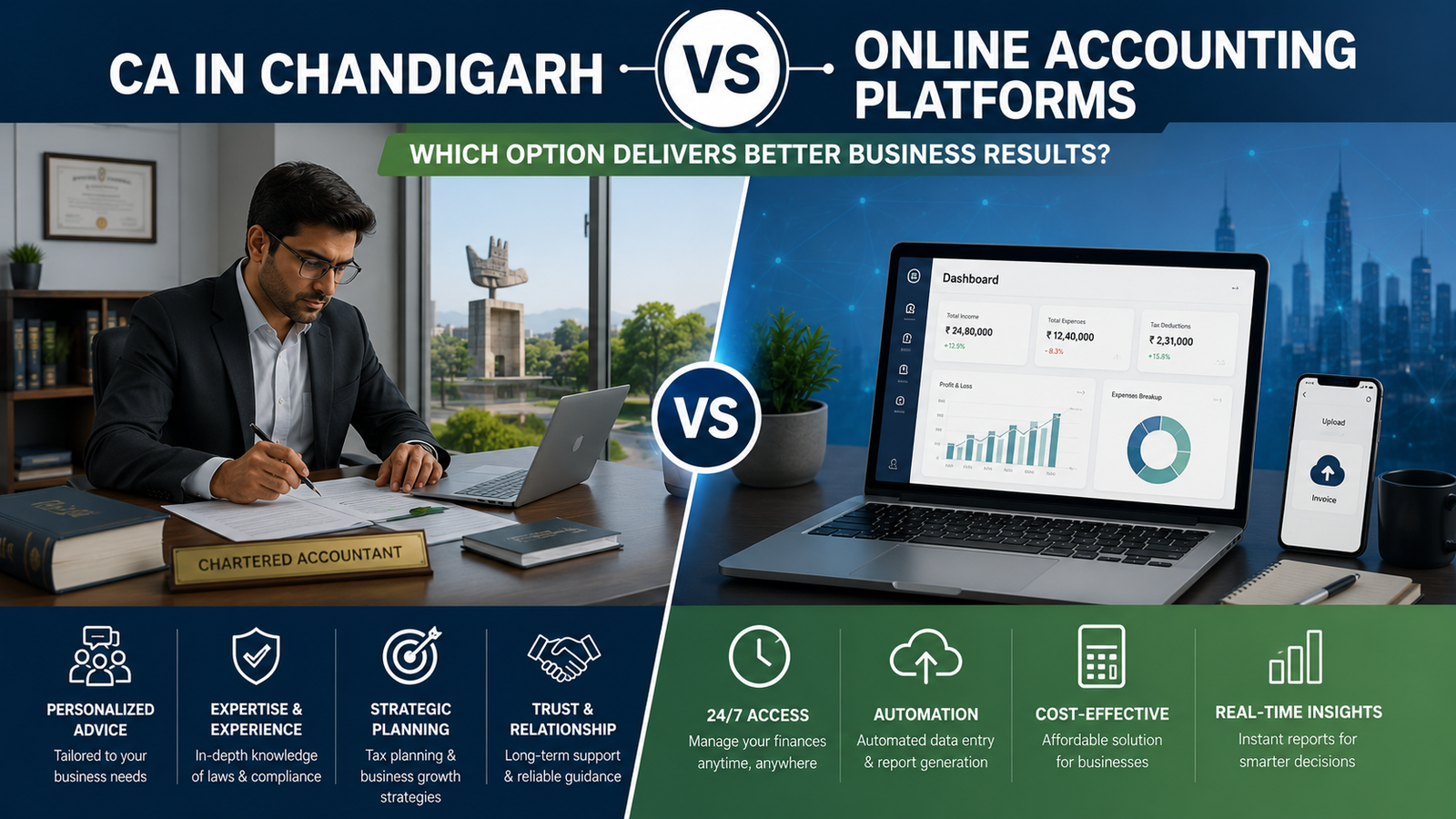
Online accounting platforms are useful for billing, bookkeeping, invoice tracking, basic GST reports and day-to-day financial recording. But they cannot fully replace the judgment, compliance understanding and advisory role of a professional CA in Chandigarh.
For small businesses, startups, traders, consultants and growing companies, the best option is not “CA vs software.” The better model is “CA-led accounting supported by technology.”
Software can process data. A Chartered Accountant can interpret it, review compliance risks, plan taxes, guide business decisions and represent the business when issues arise.
Why This Comparison Matters for Chandigarh Businesses
Business owners in Chandigarh are dealing with a more digital and compliance-heavy environment than before. GST returns, e-invoicing, input tax credit reconciliation, income tax filings, TDS, audit requirements, ROC compliance and business financial reporting all require accuracy.
At the same time, online accounting platforms have become popular because they offer
convenience. Many platforms promise simple billing, automated reports, cloud access and easy GST filing.
This creates a common question:
Should a business hire a CA in Chandigarh or rely on an online accounting platform?
The answer depends on the business size, transaction volume, compliance complexity, tax risk and need for advisory. A freelancer with limited invoices may manage basic records through software. But a growing business with GST, vendors, staff, loans, audit requirements or expansion plans needs more than automated entries.
Accounting is not only about recording numbers. It is about protecting the business, reducing tax risk, improving cash flow and supporting smarter decisions.
What Does a CA in Chandigarh Actually Do?
A Chartered Accountant does much more than bookkeeping or return filing. A CA works as a compliance advisor, tax planner, financial reviewer and business decision-support professional.
A professional CA in Chandigarh can help with:
- GST registration and filing
- GSTR-1, GSTR-3B and GSTR-2B reconciliation
- Input tax credit review
- Income tax return filing
- Tax planning
- TDS compliance
- Accounting and bookkeeping review
- Audit and assurance
- Corporate services
- Business advisory
- Financial reporting
- Representation before tax authorities
- NRI taxation support
- Compliance risk management
The key value of a CA lies in interpretation. Software may show a mismatch. A CA understands whether it creates a tax exposure, documentation issue, ITC risk or filing correction requirement.
What Do Online Accounting Platforms Offer?
Online accounting platforms are digital tools that help businesses manage financial records. They are useful for automating repetitive tasks and improving visibility.
Common features include:
- GST invoicing
- Sales and purchase entry
- Expense recording
- Inventory tracking
- Bank reconciliation
- Customer and vendor ledgers
- Basic financial reports
- Tax summaries
- Cloud data access
- Mobile billing
- E-invoicing support in some platforms
These tools are helpful because they reduce manual paperwork and make data easier to access.
However, a platform follows the instructions, settings and data provided by the user. If the data is wrong, the output can also be wrong. If a GST rate is selected incorrectly, if an invoice is misclassified, or if ITC eligibility is misunderstood, the software may not solve the underlying compliance issue.
That is where CA review becomes important.
CA vs Online Accounting Platform: Quick Comparison Table
| Factor | CA in Chandigarh | Online Accounting Platform |
|---|---|---|
| Bookkeeping | Reviews accuracy and structure | Records and organises data |
| GST filing | Interprets compliance and reconciles risk | Generates reports and return data |
| Tax planning | Provides strategy and professional advice | Gives basic tax summaries |
| Audit readiness | Reviews records, ledgers and documentation | Stores and exports data |
| Business advisory | Offers decision-making support | Limited to reports and dashboards |
| Tax notices | Can represent and respond professionally | Cannot handle authority representation independently |
| Customisation | Based on business model and risk | Based on platform features |
| Cost | Higher professional value | Lower entry cost |
| Best for | Compliance-heavy and growing businesses | Simple and routine accounting tasks |
Where Online Accounting Platforms Work Well
Online platforms are useful when the business has simple transactions and limited compliance complexity.
They work well for:
- Basic invoice generation
- Daily sales and purchase recording
- Expense tracking
- Customer payment reminders
- Basic GST summaries
- Cloud access to financial records
- Inventory-linked billing
- Simple business dashboards
For example, a small service provider with limited monthly invoices may use software to maintain records efficiently. A retail shop may use billing software to manage inventory and GST invoices. A freelancer may use an online platform to track expenses and income.
In these cases, software helps create discipline.
But even then, periodic CA review is useful because accounting errors often remain hidden until filing, assessment or audit.
Where a CA Delivers Stronger Business Results
1. GST Compliance and ITC Reconciliation
GST is one of the biggest areas where businesses need professional guidance. It is not enough to simply generate invoices and file returns.
Businesses must ensure:
- Sales data matches GSTR-1
- Tax liability matches GSTR-3B
- Purchase register matches GSTR-2B
- Input tax credit is eligible
- Vendors have filed correctly
- Reverse charge is checked
- Credit notes and debit notes are handled properly
- Wrong claims are avoided
An online platform can help generate reports. But a CA can review the legal and compliance impact.
For example, if ITC is visible in purchase records but not reflected in GSTR-2B, software may flag a mismatch. A CA will decide whether the credit should be claimed, deferred, followed up with the vendor, or corrected through documentation.
That decision can directly affect cash flow and tax risk.
2. Tax Planning and Advisory
Online platforms can show taxable income or tax summaries. But tax planning requires understanding the business, future goals, cash flow, deductions, investments, compliance history and legal structure.
A CA in Chandigarh can guide businesses on:
- Advance tax planning
- Expense classification
- Deduction eligibility
- Business structure planning
- Tax-efficient profit management
- Capital expenditure decisions
- Loan and interest treatment
- Salary vs profit planning
- HNI and NRI taxation matters
Software gives numbers. A CA gives interpretation.
For growing businesses, this difference matters because tax planning should happen throughout the year, not only during return filing.
3. Audit Readiness
If a business is subject to statutory audit, tax audit or internal review, software alone is not enough.
Audit readiness requires:
- Proper ledger scrutiny
- Supporting documents
- Reconciled bank statements
- GST reconciliation
- TDS verification
- Expense validation
- Fixed asset checks
- Loan confirmations
- Debtor and creditor review
- Compliance documentation
Online platforms may store data, but a CA evaluates whether the records are reliable and audit-ready.
This helps reduce year-end pressure and prevents last-minute correction work.
4. Business Structuring and Compliance
Many Chandigarh businesses start small and later expand into partnerships, LLPs, private limited companies, multi-location operations or multi-state transactions.
At this stage, decisions become more complex.
A CA can advise on:
- Business registration structure
- GST registration requirements
- ROC compliance
- Accounting system setup
- Tax impact of expansion
- Financial reporting process
- Internal control systems
- Working capital planning
An online platform cannot independently recommend the most suitable structure for legal, tax and commercial outcomes.
5. Representation During Notices
When a business receives a GST notice, income tax notice or compliance query, the issue is no longer just accounting. It becomes a representation matter.
A CA can help with:
- Notice analysis
- Document preparation
- Response drafting
- Reconciliation support
- Legal position review
- Representation before authorities
- Follow-up and compliance closure
An accounting platform cannot replace professional representation.
This is one of the strongest reasons businesses should not depend only on software for compliance-heavy areas.
Best Approach: CA-Led Accounting with Technology Support
The strongest model for most businesses is a hybrid approach.
Use online accounting tools for speed and record-keeping. Use a CA for review, compliance, tax strategy and decision-making.
This approach gives the business both efficiency and expert control.
A CA-led technology model can include:
- Software-based bookkeeping
- Automated GST reports
- Periodic CA review
- Monthly financial reporting
- Quarterly tax planning
- Annual audit preparation
- Compliance calendar tracking
- Management advisory
This ensures that automation improves productivity without increasing hidden compliance risk.
For businesses in Chandigarh and Tricity, this is especially useful because many SMEs want modern finance systems but still need local professional accountability.
Step-by-Step Decision Framework
Step 1: Check Your Transaction Volume
If your business has only a few invoices per month, an online platform may help with basic recordkeeping. If you have frequent purchases, sales, vendors, employees, GST filings and receivables, you need CA supervision.
Step 2: Review GST Complexity
Ask these questions:
- Do you claim input tax credit?
- Do you deal with multiple vendors?
- Do you have interstate sales?
- Do you issue e-invoices?
- Do you face GST mismatches?
- Do you need regular reconciliation?
If yes, a CA-led process is safer.
Step 3: Assess Tax Risk
Businesses with high-value transactions, loans, multiple income sources, property dealings, exports, imports or NRI-related matters should not depend only on software.
Tax decisions need professional review.
Step 4: Evaluate Reporting Needs
If you only need invoices, software may be enough. If you need profit analysis, cash flow planning, margin tracking, tax forecasting and management reports, a CA can add significant value.
Step 5: Consider Future Growth
If the business is planning expansion, funding, new registration, partnership changes, private limited conversion or audit readiness, professional CA advisory becomes important.
Common Mistakes to Avoid
Mistake 1: Assuming Software Means Compliance
Software helps prepare data. It does not guarantee legal correctness. Compliance depends on classification, documentation, reconciliation and expert review.
Mistake 2: Filing GST Without Reconciliation
Many businesses file GST based on sales and purchase data without properly matching GSTR-2B. This can create ITC issues later.
Mistake 3: Ignoring Professional Review Until Year-End
Waiting until year-end creates pressure and increases the risk of errors. Monthly or quarterly CA review is more effective.
Mistake 4: Choosing Software Only Based on Price
The cheapest platform may not support GST complexity, inventory, branch management, reports or integrations needed by the business.
Mistake 5: Not Maintaining Supporting Documents
Even if entries are recorded digitally, invoices, agreements, payment proofs and reconciliations must be properly maintained.
Conclusion
Online accounting platforms are useful tools. They improve billing, recordkeeping, reporting and day-to-day financial visibility. But they are not complete replacements for a Chartered Accountant.
A CA in Chandigarh delivers stronger business results where professional judgment, tax planning, GST reconciliation, audit readiness, compliance strategy and authority representation are required.
For most businesses, the best solution is not choosing one over the other. The best solution is using technology under expert CA supervision.
This gives business owners speed, accuracy, compliance confidence and better financial decisions.
CTA:
If your business wants accurate accounting, GST compliance, tax planning and financial reporting with expert CA review, CA Rohit Jain can help you build a smarter, technology-supported finance system for long-term business growth.
FAQ SECTION
1. Is an online accounting platform enough for my business?
An online accounting platform may be enough for basic billing and bookkeeping if your business has simple transactions. However, if you deal with GST, ITC, tax planning, audits or compliance notices, CA review is strongly recommended.
2. Can accounting software replace a CA?
No. Accounting software can automate data entry, reports and basic calculations, but it cannot replace a CA’s judgment in tax planning, GST interpretation, audit review, business structuring or representation before authorities.
3. Which is better for GST filing: CA or online accounting platform?
For simple data preparation, online platforms are useful. For accurate GST filing, ITC reconciliation, mismatch review and compliance risk management, a CA provides stronger protection.
4. Why should I hire a CA in Chandigarh?
Hiring a CA in Chandigarh gives your business local professional support for GST, accounting, tax filing, audit, compliance and advisory. A local CA can understand regional business needs and provide direct review.
5. Are online accounting platforms safe?
Most reputed platforms are useful and secure, but safety also depends on correct data entry, access control and professional review. Incorrect classification or missed compliance checks can still create risk.
6. What is the best option for small businesses?
Small businesses should use software for daily records and a CA for periodic review, GST filing, tax planning and compliance guidance. This hybrid approach is practical and cost-effective.
7. When should a business move from software-only accounting to CA-led accounting?
A business should move to CA-led accounting when GST complexity increases, revenue grows, transactions multiply, notices arise, audit becomes applicable, or management needs better financial reports.