
TL;DR
What Business Owners Need to Know
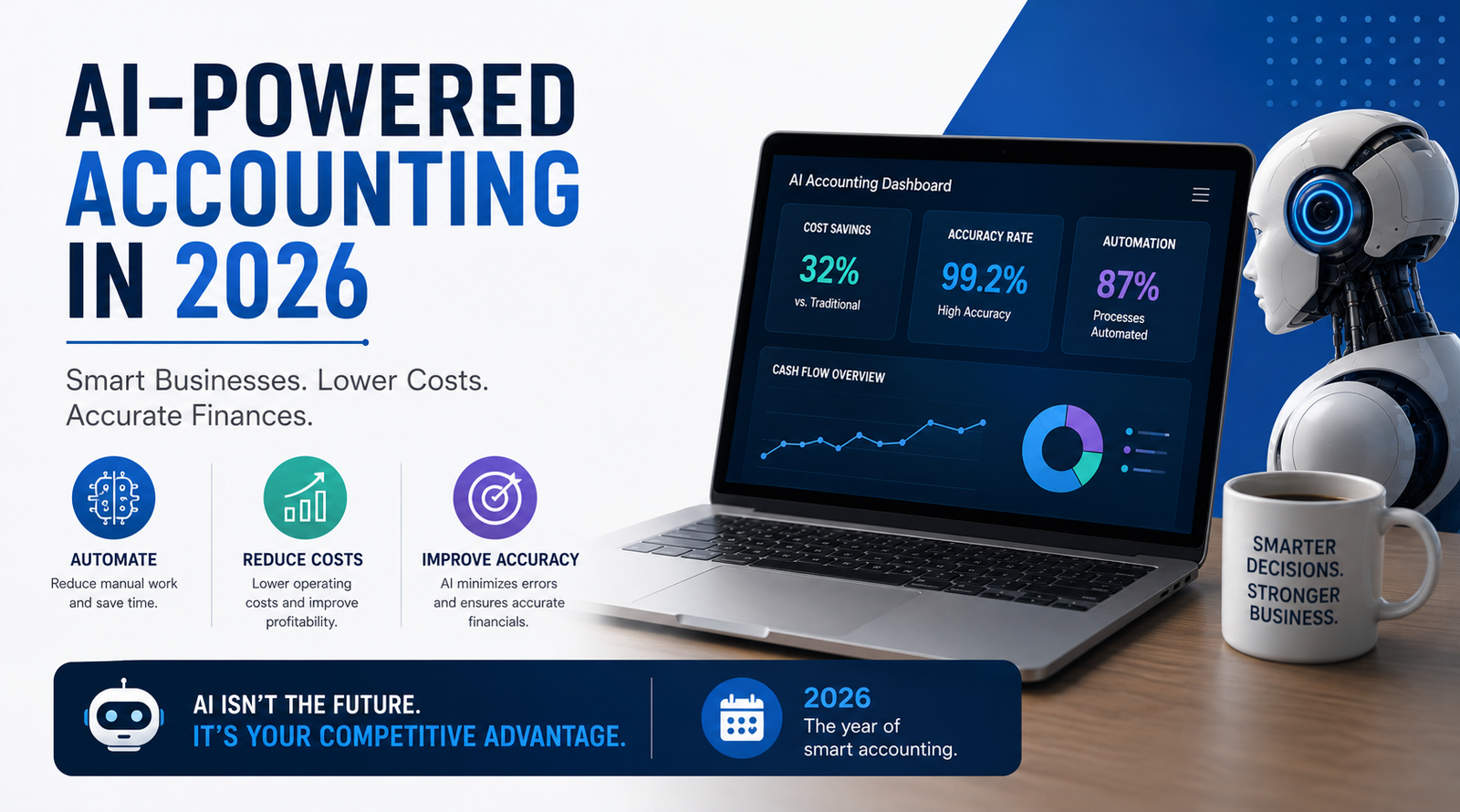
AI-powered accounting uses technologies such as machine learning, intelligent document processing and automated workflows to complete repetitive financial tasks more efficiently.
Businesses can use it to:
- Extract information from invoices and receipts
- Categorise transactions
- Reconcile bank entries
- Identify unusual transactions
- Monitor receivables
- Prepare management reports
- Improve cash-flow visibility
- Reduce manual accounting work
However, AI should not be allowed to make important financial, tax or compliance decisions without professional review. Its output depends heavily on the quality of the underlying data, system configuration and internal controls.
The most effective model in 2026 is therefore not “AI instead of an accountant.” It is AI-supported accounting combined with qualified human judgment.
What Is AI-Powered Accounting?
AI-powered accounting refers to the use of artificial intelligence and automation within bookkeeping, reporting, reconciliation, compliance and financial-management workflows.
Traditional accounting software usually follows fixed rules. A user enters information, selects a ledger and generates a report. AI-enabled systems can go further by recognising patterns, reading documents, recommending classifications and identifying unusual transactions.
For example, an AI-enabled accounting system may:
- Read a supplier invoice.
- Extract the supplier name, GST details, invoice number and amount.
- Suggest the appropriate expense category.
- Compare the invoice with an existing purchase order.
- Check whether the invoice has already been entered.
- Flag inconsistencies for review.
- Prepare the transaction for approval.
The Institute of Chartered Accountants of India recognises that AI is changing accounting workflows by automating routine work and allowing chartered accountants to spend more time on strategic and analytical responsibilities. ICAI’s AI resources also demonstrate use cases involving compliance automation, MIS reporting, financial analysis and document preparation. sses Are Adopting AI Accounting in 2026
Many growing businesses do not suffer from a lack of financial data. They suffer from data that is delayed, incomplete or difficult to interpret.
A business may have sales records in one application, bank information in another, GST data in spreadsheets and outstanding-payment details in email conversations. By the time this information is consolidated, management may already be working with outdated figures.
AI accounting automation addresses this gap by making financial processing faster and more continuous.
The broader adoption environment is also changing. In June 2026, ICAI reported that it had trained more than 50,000 members in artificial intelligence and developed over 150 GPT-based tools for professional use. This indicates that AI adoption is becoming part of mainstream professional-accounting development rather than remaining an isolated technology experiment. eport from Google and the India SME Forum, based on a survey of 3,249 MSMEs, estimated that wider AI adoption could unlock more than US$490 billion in economic value for Indian MSMEs. The report also associated digital-technology adoption with stronger growth and projected that AI could improve business profitability by 30% to 35%. These are ecosystem-level estimates rather than guaranteed outcomes for an individual company, but they illustrate why AI adoption has become a board-level issue for SMEs. ered Accounting Reduces Business Costs
AI does not reduce costs simply because software performs a task. Savings arise when automation removes repetitive work, prevents avoidable errors and gives decision-makers useful information sooner.
1. Automating Repetitive Data Entry
Manual invoice and receipt entry consumes hours that finance employees could spend on reconciliation, analysis and collections.
Intelligent document-processing tools can extract information such as:
- Invoice date
- Vendor name
- GSTIN
- Tax amount
- Total value
- Payment terms
- Purchase-order reference
The system can then suggest an accounting category and route the transaction for approval.
This does not eliminate the need for verification. It reduces the amount of information that must be typed manually.
2. Accelerating Bank Reconciliation
Traditional bank reconciliation requires employees to compare bank-statement entries with accounting records.
An AI-enabled system can recommend matches based on:
- Amount
- Date
- Customer or vendor name
- Invoice reference
- Historical payment pattern
- Transaction description
The finance team then reviews unmatched or uncertain transactions instead of checking every entry individually.
This shifts effort from routine matching to exception management.
3. Reducing Correction and Rework Costs
An accounting error rarely affects only one ledger.
An incorrectly recorded transaction can distort:
- GST calculations
- Expense classification
- Profit margins
- Cash-flow reports
- Outstanding balances
- Management decisions
- Tax computations
AI can flag duplicate invoices, unusual amounts, missing information and transactions that do not match historical patterns. Detecting the issue near the time of entry is usually less expensive than correcting several reports later.
4. Improving Receivables Management
Businesses frequently focus on revenue without monitoring how quickly that revenue becomes cash.
AI can help identify:
- Overdue customer balances
- Customers whose payment behaviour is deteriorating
- Invoices likely to be delayed
- Accounts requiring immediate follow-up
- Changes in average collection periods
This helps the business prioritise collections instead of sending identical reminders to every customer.
5. Making Finance Teams More Productive
Automation does not necessarily mean reducing the finance team. It can allow the same team to manage a larger transaction volume while spending more time on:
- Budgeting
- Cash-flow planning
- Cost analysis
- Margin review
- Vendor negotiations
- Management reporting
- Financial controls
The real gain is not merely fewer working hours. It is a better allocation of professional time.
How AI Improves Financial Accuracy
Automated Document Extraction
Manual typing creates opportunities for transposed digits, missed tax amounts and incorrect invoice references.
Document-extraction systems can capture the original information directly from source documents. Employees only need to review fields that the system marks as uncertain.
Duplicate and Anomaly Detection
AI systems can compare new transactions against historical records and identify:
- Duplicate invoice numbers
- Repeated payment amounts
- Unusual vendor activity
- Unexpected changes in expense levels
- Transactions outside normal business hours
- Payments inconsistent with prior patterns
These alerts do not prove that fraud or error has occurred. They help the reviewer decide where to investigate.
Continuous Reconciliation
Businesses that reconcile accounts only at month-end may discover problems several weeks after they occurred.
Automated reconciliation enables more frequent comparison among:
- Bank records
- Sales invoices
- Purchase records
- Payment gateways
- Expense platforms
- Accounting ledgers
More frequent reconciliation creates cleaner records and reduces the pressure associated with closing the books.
Consistent Transaction Classification
Humans may classify the same expense differently across different months or branches.
AI systems can learn from approved historical entries and recommend consistent classifications. This improves comparability across reporting periods.
Professional review remains necessary when a transaction is unusual, material or open to interpretation.
Real-Time Management Reporting
Management reports created from outdated records can create false confidence.
When transactions are processed and reconciled continuously, decision-makers can receive more timely information on:
- Revenue
- Expenses
- Gross margin
- Cash position
- Receivables
- Payables
- Inventory movement
- Budget variances
The benefit is not simply a faster report. It is the ability to act before a small financial issue becomes a major problem.
Traditional Accounting vs AI-Powered Accounting
| Activity | Traditional approach | AI-supported approach |
|---|---|---|
| Invoice entry | Manually typed | Data extracted and reviewed |
| Bank reconciliation | Entry-by-entry matching | Suggested matches and exception review |
| Expense coding | User selects every ledger | System recommends categories |
| Error detection | Periodic checking | Continuous anomaly alerts |
| Reporting | Prepared after closing | Updated more frequently |
| Receivables follow-up | Based on ageing report | Prioritised using payment patterns |
| Cash-flow planning | Historical spreadsheet model | Continuously updated forecasts |
| Accountant’s role | Processing and checking | Reviewing, interpreting and advising |
AI-powered accounting is not completely “hands-free.” Approval limits, access rights, review procedures and audit trails remain essential.
Practical AI Accounting Use Cases for Indian Businesses
Retail and E-Commerce
Retailers can use automation to reconcile orders, payment-gateway settlements, returns, discounts and bank deposits.
This is particularly valuable when transaction volumes are high but individual transaction values are relatively small.
Manufacturing
Manufacturers can use AI-supported systems to monitor:
- Raw-material costs
- Vendor price changes
- Inventory movement
- Production variances
- Outstanding purchase orders
- Product-level margins
A sudden increase in material consumption or vendor pricing can be highlighted for management review.
Professional-Service Firms
Consultants, agencies, architects and other service businesses can connect invoicing, project costs, employee expenses and collections.
This can reveal which clients or projects generate revenue but create weak margins or delayed cash flows.
Startups
Startups can use automated reporting to maintain cleaner records for:
- Investor discussions
- Due diligence
- Budget monitoring
- Cash-runway analysis
- Vendor management
- Statutory compliance
Clean, traceable data is especially important when an investor or lender asks for supporting records.
Growing Family Businesses
Family-managed businesses often depend heavily on spreadsheets and knowledge held by a small number of employees.
Accounting automation can help standardise processes, document approvals and make reporting less dependent on one person.
Can AI Support GST and Tax Compliance?
AI can support compliance preparation, but it should not be treated as an independent tax authority.
Potential uses include:
- Reading tax invoices
- Checking whether mandatory invoice fields are available
- Comparing purchase records with available tax data
- Identifying duplicate invoices
- Flagging inconsistent GST classifications
- Preparing exception reports
- Organising documents for return preparation
- Tracking filing and payment workflows
However, tax treatment may depend on facts, documentation, place of supply, eligibility conditions and changes in law. A software recommendation should therefore be reviewed by an appropriately qualified professional.
The system may identify a mismatch. It cannot always determine the legal or commercial reason behind it.
Risks Businesses Must Address Before Adopting AI Accounting
1. Poor-Quality Data
AI cannot correct every weakness in the source data.
If vendor masters are duplicated, opening balances are incorrect or transaction descriptions are inconsistent, automated output may also be unreliable.
Industry guidance for 2026 repeatedly identifies clean, structured data as a prerequisite for successful accounting automation. ive Reliance on Automated Suggestions
A recommendation can look confident and still be wrong.
Businesses should define which transactions can be processed automatically and which require mandatory review.
High-value, unusual, related-party and tax-sensitive transactions should receive stronger scrutiny.
3. Data Privacy and Confidentiality
Accounting systems may contain personal data, bank information, payroll records, customer details and tax documents.
India’s Digital Personal Data Protection Act establishes a legal framework for processing digital personal data for lawful purposes while recognising individuals’ right to protect their data. Businesses should evaluate data storage, access, retention and vendor-security practices before uploading information to any AI system. ccess Controls
Automation can increase risk when too many employees have unrestricted access.
Businesses should implement:
- Role-based permissions
- Multi-factor authentication
- Approval hierarchies
- Change logs
- Regular access reviews
- Secure backups
- Vendor-risk assessments
5. Lack of Explainability
A financial recommendation must be understandable enough to review and defend.
Research published in 2026 found that finance professionals treat accuracy and compliance as non-negotiable requirements. Explainability helps determine whether an AI system can be trusted and used responsibly. Technology Costs
Licence charges are only one component of implementation cost.
Businesses should also consider:
- Data migration
- Integration
- Employee training
- Customisation
- Cybersecurity
- Professional review
- Software upgrades
- Vendor dependence
- Error correction
Automation should be evaluated against measurable financial outcomes rather than adopted because it is fashionable.
A Seven-Step AI Accounting Implementation Plan
Step 1: Identify the Real Accounting Bottleneck
Do not begin by purchasing a tool.
First identify the process causing the most difficulty:
- Invoice entry
- Bank reconciliation
- Receivables
- Expense claims
- Reporting
- Cash-flow forecasting
- GST data preparation
A focused implementation is easier to measure and control.
Step 2: Review Existing Data Quality
Check:
- Chart of accounts
- Customer and vendor masters
- Opening balances
- Duplicate records
- Tax classifications
- Bank data
- Supporting documents
- Approval workflows
Automation should follow data cleaning, not replace it.
Step 3: Document the Current Workflow
Map who creates, reviews, approves and records each transaction.
This reveals control gaps that could otherwise be transferred into the new system.
Step 4: Choose a Limited Pilot
Select one workflow, branch or transaction category.
Run the pilot long enough to compare:
- Processing time
- Error rate
- Exception volume
- Employee effort
- Reporting speed
- User adoption
Step 5: Set Human-Review Rules
Define which entries may be automatically processed and which need approval.
Possible review triggers include:
- Amount above a specified limit
- New vendor
- Duplicate invoice number
- Missing GST details
- Unusual ledger classification
- Related-party transaction
- Material journal entry
Step 6: Train Employees
Employees need to understand both what the system can do and where it may fail.
Training should cover:
- Reviewing AI suggestions
- Correcting classifications
- Protecting confidential information
- Reporting suspected errors
- Maintaining supporting documents
- Following approval controls
Step 7: Measure and Improve
Review the system monthly during the initial phase.
Do not measure success solely by the number of automated transactions. Measure whether the business receives cleaner records, faster reporting and better decisions.
Metrics to Measure the Return on Accounting Automation
Track a baseline before implementation and compare it with post-implementation performance.
| KPI | What it reveals |
|---|---|
| Cost per transaction | Processing efficiency |
| Hours spent on data entry | Manual workload reduction |
| Reconciliation completion time | Closing efficiency |
| Number of corrected entries | Data-quality improvement |
| Duplicate-payment incidents | Control effectiveness |
| Days sales outstanding | Receivables performance |
| Report preparation time | Management visibility |
| Forecast versus actual cash flow | Forecast reliability |
| Exception resolution time | Team responsiveness |
| Compliance-data mismatches | Record consistency |
A successful system should improve several of these metrics without weakening controls.
Will AI Replace Chartered Accountants?
AI is more likely to change the accountant’s role than eliminate it.
Technology can process large transaction volumes, detect patterns and produce draft reports. It cannot independently accept professional responsibility, understand every commercial context or replace judgment in complex tax and financial matters.
ICAI’s own AI initiatives position technology as a means of streamlining professional work and enabling chartered accountants to focus on higher-value activities. countant is therefore likely to spend less time typing transactions and more time on:
- Reviewing exceptions
- Interpreting reports
- Evaluating tax implications
- Strengthening controls
- Planning cash flow
- Supporting management decisions
- Advising on financial risk
For business owners, this means the value of professional accounting shifts from record creation to financial clarity and informed decision-making.
How CA Rohit Jain Can Support Technology-Led Financial Management
Adopting accounting technology without first improving the underlying financial process can create faster—but not necessarily better—results.
CA Rohit Jain serves businesses and individuals in Chandigarh through chartered accountancy, taxation, GST filing, income-tax return filing, compliance, audit and business-management consulting. lly guided transition can help a business:
- Review its current accounting workflow
- Improve ledger and master-data quality
- Establish approval and review controls
- Identify suitable automation opportunities
- Strengthen GST and tax documentation
- Develop more useful management reports
- Monitor implementation results
- Maintain human oversight over critical decisions
Conclusion
AI-powered accounting is becoming a practical financial-management tool for businesses of different sizes.
Its most valuable contribution is not the complete removal of human involvement. It is the ability to process routine information faster, detect exceptions earlier and give management more timely financial visibility.
Businesses should approach adoption in a disciplined sequence:
- Clean the data.
- Fix the process.
- Automate a defined workflow.
- Establish human-review controls.
- Protect confidential information.
- Measure business outcomes.
- Improve the system continuously.
Businesses in Chandigarh exploring accounting automation should begin with a professional review of their existing records, controls and reporting requirements. CA Rohit Jain can assist in building an accounting and compliance process that combines efficient technology with responsible professional oversight.
FAQ Section
1. What is AI-powered accounting?
AI-powered accounting uses technologies such as machine learning and intelligent document processing to automate data extraction, transaction classification, reconciliation and financial reporting. Human review is still required for complex, material or compliance-sensitive transactions.
2. How does AI reduce accounting costs?
AI reduces the time spent on repetitive tasks such as invoice entry, bank matching and report preparation. It may also reduce the cost of correcting duplicate entries, classification errors and delayed reconciliations.
3. Can small businesses use AI accounting?
Yes. Small businesses can begin with a limited workflow such as invoice capture, expense categorisation, receivables monitoring or bank reconciliation. A focused pilot is generally safer than automating the entire finance function at once.
4. Is AI accounting more accurate than manual accounting?
AI can improve consistency and detect patterns that may be missed during manual processing. However, its accuracy depends on data quality, system configuration and professional review. It should not be treated as error-proof.
5. Can AI prepare GST returns automatically?
AI can organise invoices, identify mismatches and prepare data for GST compliance. Final tax treatment and return filing should be reviewed because eligibility, classification and place-of-supply questions may require professional judgment.
6. Will AI replace accountants and chartered accountants?
AI will automate parts of transaction processing, but accountants will remain important for review, interpretation, tax advice, financial controls and professional accountability. ICAI’s AI initiatives similarly focus on augmenting professional work. ancial data safe in an AI accounting system?
Safety depends on the vendor, hosting environment, access controls, encryption, backup policy and employee practices. Businesses should complete a privacy and cybersecurity assessment before sharing financial or personal data with a platform.
8. How should a business start implementing AI accounting?
Begin by identifying one repetitive accounting bottleneck. Clean the relevant data, document the existing process, run a controlled pilot, establish human-review rules and compare measurable results with the previous process.