TL;DR
GST compliance is increasingly driven by connected data rather than isolated return filing.
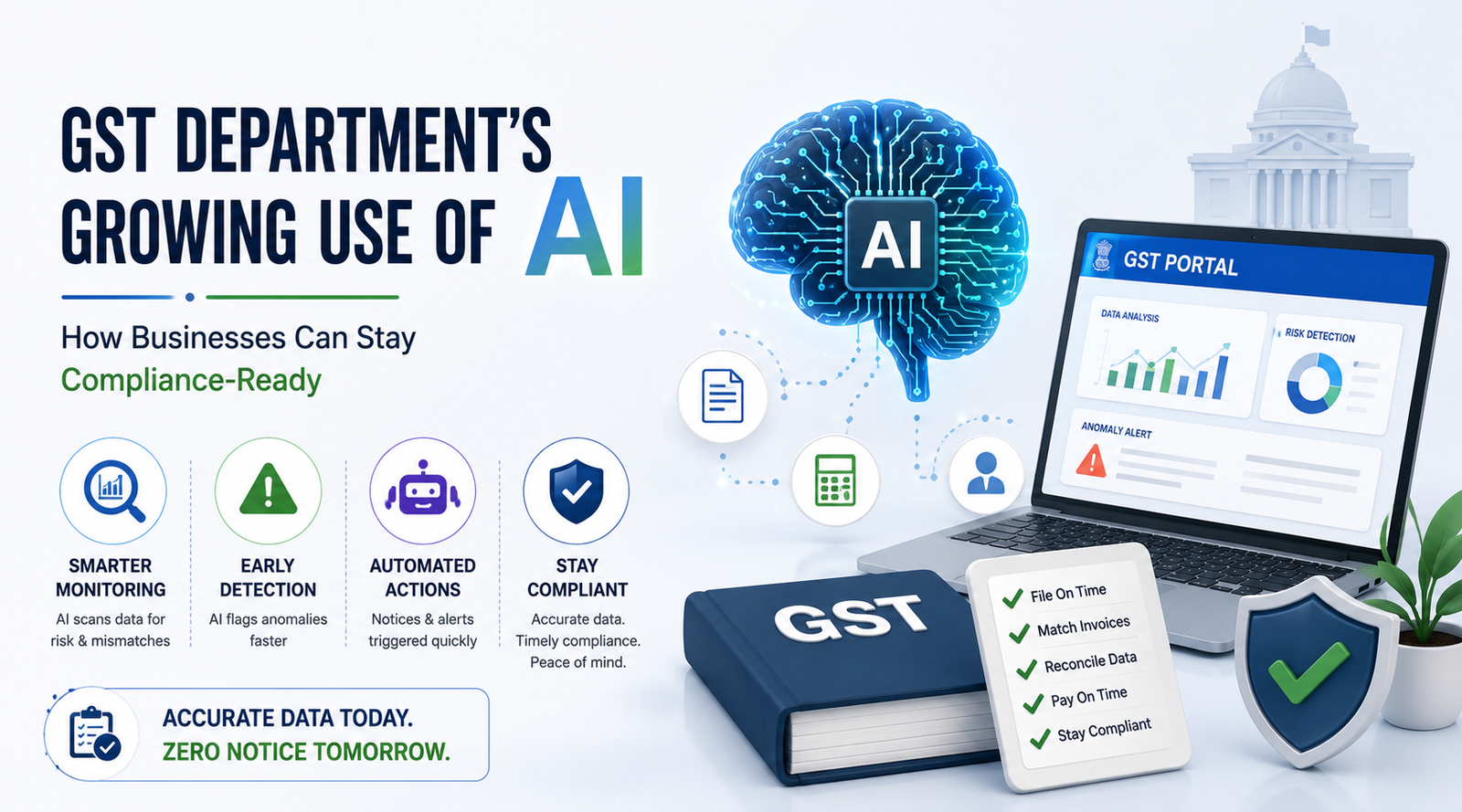
The GST ecosystem can compare information across outward-supply returns, tax payments, purchase data, input tax credit, e-invoices, e-way bills and taxpayer history. AI and advanced analytics make it easier to identify unusual patterns, repeated mismatches and transactions that require further verification .
.
For businesses, this does not mean that every mismatch proves wrongdoing. Genuine timing differences and clerical errors can occur. However, companies must be able to identify, document and explain them.
The safest approach is to:
- Reconcile GST data every month
- Validate invoices before filing
- Monitor vendor compliance
- Review input tax credit eligibility
- Match e-invoices and e-way bills with books
- Maintain supporting documents
- Conduct periodic CA-led GST reviews
GST Scrutiny Is Becoming More Data-Driven
GST compliance has moved far beyond the days when authorities depended primarily on manual inspection of individual returns.
Today, large volumes of digital information are generated through:
- GST registrations
- GSTR-1
- GSTR-3B
- GSTR-2B
- E-invoices
- E-way bills
- Tax payments
- Refund applications
- Amendments
- Supplier and customer filings
These systems create connected data trails.
When one business reports a B2B sale, that information affects the recipient’s purchase and input tax credit records. When an e-invoice is generated, its invoice number, taxable value, GST rate and recipient details can be compared with return data. When goods move under an e-way bill, the movement record can be compared with invoices and reported turnover.
As analytical capabilities improve, businesses can no longer treat each GST return as a separate compliance task.
Every filing must tell a consistent story.
What AI in GST Compliance Actually Means
AI in GST compliance does not necessarily mean that software independently decides whether a taxpayer is guilty of non-compliance.
In practice, AI, machine learning and advanced analytics may assist the system in:
- Identifying unusual filing patterns
- Comparing large datasets
- Highlighting high-risk transactions
- Detecting abnormal ITC behaviour
- Finding invoice-network relationships
- Prioritising cases for verification
- Identifying repeat mismatches
- Monitoring changes in taxpayer behaviour
A risk flag may lead to further verification. The business must then provide records, reconciliations or explanations.
This distinction is important. An anomaly is not always a violation. But an unexplained anomaly can become a compliance problem.
Data Sources That Can Be Cross-Checked
A modern GST review may involve more than one return.
| Data Source | Possible Comparison |
|---|---|
| Sales register | GSTR-1 and e-invoice data |
| GSTR-1 | GSTR-3B outward-tax liability |
| Purchase register | GSTR-2B and vendor invoices |
| E-invoice records | GSTR-1 and books |
| E-way bills | Invoices, dispatch records and turnover |
| Credit notes | GSTR-1 amendments and customer records |
| Bank records | High-value receipts and reported sales |
| Vendor filings | Recipient’s ITC claims |
| Tax ledgers | Liability discharged through cash and credit |
| Annual financials | Aggregate turnover reported under GST |
Businesses should therefore maintain consistency not only within GST returns but also between GST records and financial accounts.
Compliance Patterns That May Attract Attention
GSTR-1 and GSTR-3B Differences
GSTR-1 reports outward supplies, while GSTR-3B records the summary liability and tax payment.
Differences can arise because of:
- Missed invoices
- Wrong reporting periods
- Incorrect amendments
- Credit-note errors
- Classification mistakes
- Manual data-entry errors
- Incomplete e-invoice integration
A small timing difference may be explainable. A recurring or material difference requires immediate review.
Businesses should reconcile outward supplies before filing GSTR-3B instead of relying only on auto-populated values.
Unsupported or Irregular ITC Claims
Input tax credit is one of the most closely monitored areas under GST.
Potential concerns include:
- ITC claimed without invoice reflection
- Duplicate credit
- Credit on blocked expenses
- Vendor GSTIN mismatch
- Credit claimed in the wrong period
- ITC retained despite supplier-related issues
- Credit claimed without receipt of goods or services
- Missing proof of payment or business use
A business should not assume that an invoice in its accounting software automatically establishes ITC eligibility.
Eligibility, document validity, supplier reporting and the nature of the expense must all be reviewed.
E-Invoice and Return Mismatches
Where e-invoicing applies, businesses must ensure that invoice data generated through the Invoice Registration Portal matches:
- The invoice issued to the customer
- Accounting records
- GSTR-1
- Credit or debit notes
- E-way bill data, where relevant
Common problems include:
- Wrong customer GSTIN
- Incorrect taxable value
- Duplicate document numbers
- Wrong place of supply
- Cancelled e-invoice not updated in books
- Invoice booked in a different return period
- Manual invoice issued without a valid IRN
A controlled invoice workflow is therefore essential.
E-Way Bill and Turnover Inconsistencies
E-way bills create a digital trail for the movement of goods.
Possible inconsistencies include:
- Significant e-way bill movement but low reported turnover
- Invoice value differing from e-way bill value
- Repeated cancellation patterns
- Goods movement without corresponding sales entry
- Incorrect vehicle or consignee information
- E-way bill generated under the wrong GSTIN
Businesses dealing in goods should reconcile e-way bills with dispatch registers, invoices and GSTR-1.
Unusual Vendor or Transaction Patterns
Analytics can examine relationships across suppliers and recipients.
Patterns that may require further explanation include:
- Large purchases from newly registered suppliers
- Sudden increase in ITC claims
- Repeated dealing with non-compliant vendors
- Circular-looking transaction patterns
- High credit claims relative to business activity
- Purchases inconsistent with the nature of the business
- Multiple suppliers sharing unusual common characteristics
This makes vendor onboarding and periodic vendor review part of GST risk management.
Repeated Amendments and Late Corrections
Corrections are permitted within the GST framework, but frequent amendments may indicate weak internal controls.
Repeated corrections can arise from:
- Incomplete monthly closing
- Poor invoice validation
- Wrong GSTIN capture
- Misclassification of supplies
- Late receipt of information
- Dependence on manual spreadsheets
Rather than treating amendments as a routine solution, businesses should identify the root cause and improve the process.
How Businesses Can Become Compliance-Ready
1. Build an Invoice-Level Control System
GST accuracy begins before return filing.
Every invoice should be checked for:
- Supplier or recipient GSTIN
- Invoice number and date
- Place of supply
- HSN or SAC
- Taxable value
- GST rate
- CGST, SGST or IGST treatment
- Reverse-charge applicability
- E-invoice requirements
- E-way bill requirements
Use maker-checker controls for high-value or unusual transactions.
2. Reconcile GST Every Month
A monthly GST closing should compare:
- Books vs GSTR-1
- GSTR-1 vs GSTR-3B
- Purchase register vs GSTR-2B
- E-invoices vs sales register
- E-way bills vs dispatch and sales data
- Credit notes vs customer ledgers
- Electronic credit and cash ledgers vs tax workings
Monthly reconciliation is more effective than waiting until the annual return or financial-statement finalisation.
3. Introduce Vendor Compliance Monitoring
The recipient’s ITC position may be affected by supplier behaviour.
Create a vendor-risk process that covers:
- GSTIN validation
- Filing consistency
- Invoice accuracy
- GSTR-2B reflection
- Pending mismatches
- Frequency of amendments
- Response to reconciliation queries
Segment vendors into low, medium and high-risk groups.
For important vendors, add GST-compliance clauses to contracts and define a process for unresolved ITC mismatches.
4. Strengthen E-Invoicing Controls
Where e-invoicing applies, businesses should:
- Integrate billing software with the IRP
- Restrict manual invoice creation
- Track rejected IRN requests
- Monitor cancellations
- Reconcile IRN data with books
- Review reporting timelines
- Preserve QR-code and IRN records
- Train billing and dispatch teams
E-invoicing should be treated as an operational control, not merely a tax-team responsibility.
5. Maintain an Explanation File
Not every mismatch can be eliminated immediately.
Businesses may have legitimate differences because of:
- Timing
- Customer amendments
- Vendor delays
- Credit-note disputes
- Imports
- Reverse charge
- Year-end provisions
- Branch transfers
- Accounting cut-off
Maintain an exception register explaining:
- Nature of mismatch
- Amount involved
- Relevant period
- Supporting documents
- Person responsible
- Corrective action
- Expected closure date
This makes notice response faster and more credible.
6. Conduct Quarterly GST Health Checks
A quarterly CA-led review should cover:
- Return-to-books reconciliation
- ITC eligibility
- Vendor-risk analysis
- E-invoice controls
- E-way bill consistency
- Reverse-charge liabilities
- Amendments
- Refund positions
- Tax-ledger balances
- Portal alerts and notices
Quarterly review helps prevent small errors from becoming annual exposures.
GST Compliance Readiness Checklist
| Control Area | Required Action | Frequency |
|---|---|---|
| Sales invoices | Validate GSTIN, rate and place of supply | Before issue |
| GSTR-1 | Match with sales register and e-invoices | Monthly |
| GSTR-3B | Reconcile liability with GSTR-1 and books | Monthly |
| GSTR-2B | Match with purchase register | Monthly |
| ITC | Review eligibility and blocked credit | Monthly |
| Vendors | Track filing and mismatch history | Monthly |
| E-invoices | Match IRN records with books | Monthly |
| E-way bills | Match movement with invoices | Monthly |
| RCM | Identify applicable expenses | Monthly |
| Documentation | Preserve invoices, contracts and proof | Ongoing |
| Exception register | Record unresolved mismatches | Monthly |
| GST health check | Conduct CA-led risk review | Quarterly |
What to Do When a GST Discrepancy Is Identified
Follow a controlled response process.
Step 1: Quantify the Difference
Identify the exact value, tax amount, GSTIN, invoice and period involved.
Step 2: Determine the Root Cause
Check whether the issue resulted from:
- Data entry
- Timing
- Vendor non-filing
- Wrong classification
- Duplicate entry
- Missed invoice
- Incorrect credit note
- Portal or integration issue
Step 3: Check the Permitted Correction Route
The correction may require an amendment, return adjustment, vendor action, accounting entry or payment.
Do not make changes without understanding the wider impact on the customer, vendor and tax liability.
Step 4: Preserve Supporting Records
Maintain:
- Invoice
- Contract
- E-mail correspondence
- Delivery proof
- Payment proof
- Reconciliation statement
- Corrective working
- Management approval
Step 5: Review Whether Similar Errors Exist
One discrepancy may indicate a system-wide issue.
Check other transactions involving the same:
- Vendor
- Customer
- GST rate
- Location
- Product
- User
- Accounting process
Step 6: Escalate Material Issues
Material or repeated differences should be reviewed by a GST professional before filing or responding to a notice.
How a CA Supports AI-Era GST Compliance
Technology can find differences. A Chartered Accountant helps determine what they mean.
A CA-led GST review can support businesses with:
- GSTR-1, GSTR-3B and GSTR-2B reconciliation
- ITC eligibility review
- Vendor mismatch analysis
- E-invoice and e-way bill review
- Reverse-charge assessment
- GST classification
- Notice-response preparation
- Representation before authorities
- Compliance process design
- Periodic risk assessment
For Chandigarh businesses, local professional support is particularly valuable when operations span Chandigarh, Mohali, Panchkula and nearby commercial centres with multiple vendors, customers or registrations.
Conclusion
The growing use of AI and data analytics in GST administration is reducing the distance between a transaction and its compliance trail.
Businesses should assume that invoices, returns, input tax credit, e-invoices, e-way bills and financial records can be compared. The practical response is not fear—it is stronger process discipline.
Monthly reconciliation, vendor monitoring, invoice controls, exception documentation and quarterly CA-led reviews help businesses detect errors before the system does.
6. FAQ SECTION
1. How is AI used in GST compliance?
AI and advanced analytics can help identify unusual filing patterns, compare connected datasets, detect recurring mismatches and prioritise higher-risk cases for verification. A system-generated risk flag may still require professional review and supporting evidence.
2. Can GST authorities detect invoice mismatches automatically?
Yes. Digital information from GSTR-1, GSTR-3B, GSTR-2B, e-invoices and e-way bills can be compared. Differences may arise legitimately, but businesses should reconcile and document them.
3. What transactions may trigger GST scrutiny?
Potential triggers include recurring return mismatches, unusual ITC claims, inconsistent e-invoice data, unexplained e-way bill activity, high-risk vendor relationships and frequent amendments.
4. How can businesses reduce the risk of GST notices?
Businesses should maintain accurate invoices, reconcile returns monthly, review ITC eligibility, track vendor compliance, match e-invoice and e-way bill data, and retain supporting documents.
5. Why is GSTR-2B reconciliation important?
GSTR-2B reconciliation helps compare purchase records with supplier-reported data. It supports accurate ITC claims and helps identify missing, duplicate, ineligible or incorrectly reported invoices.
6. Can a vendor’s non-compliance affect a buyer’s ITC?
Vendor-related filing or reporting problems can affect the buyer’s ability to substantiate or claim credit correctly. Businesses should monitor important vendors and follow up on missing invoices promptly.
7. How often should GST reconciliation be conducted?
Core GST reconciliation should be conducted monthly. Businesses with high transaction volumes, multiple GSTINs or complex supply chains may need more frequent exception monitoring.
8. What records should businesses keep for GST scrutiny?
Businesses should retain invoices, contracts, payment records, delivery proof, e-invoice data, e-way bills, return workings, reconciliation statements, vendor correspondence and explanations for material differences.