TL;DR
The Most Important 2026 Tax Changes
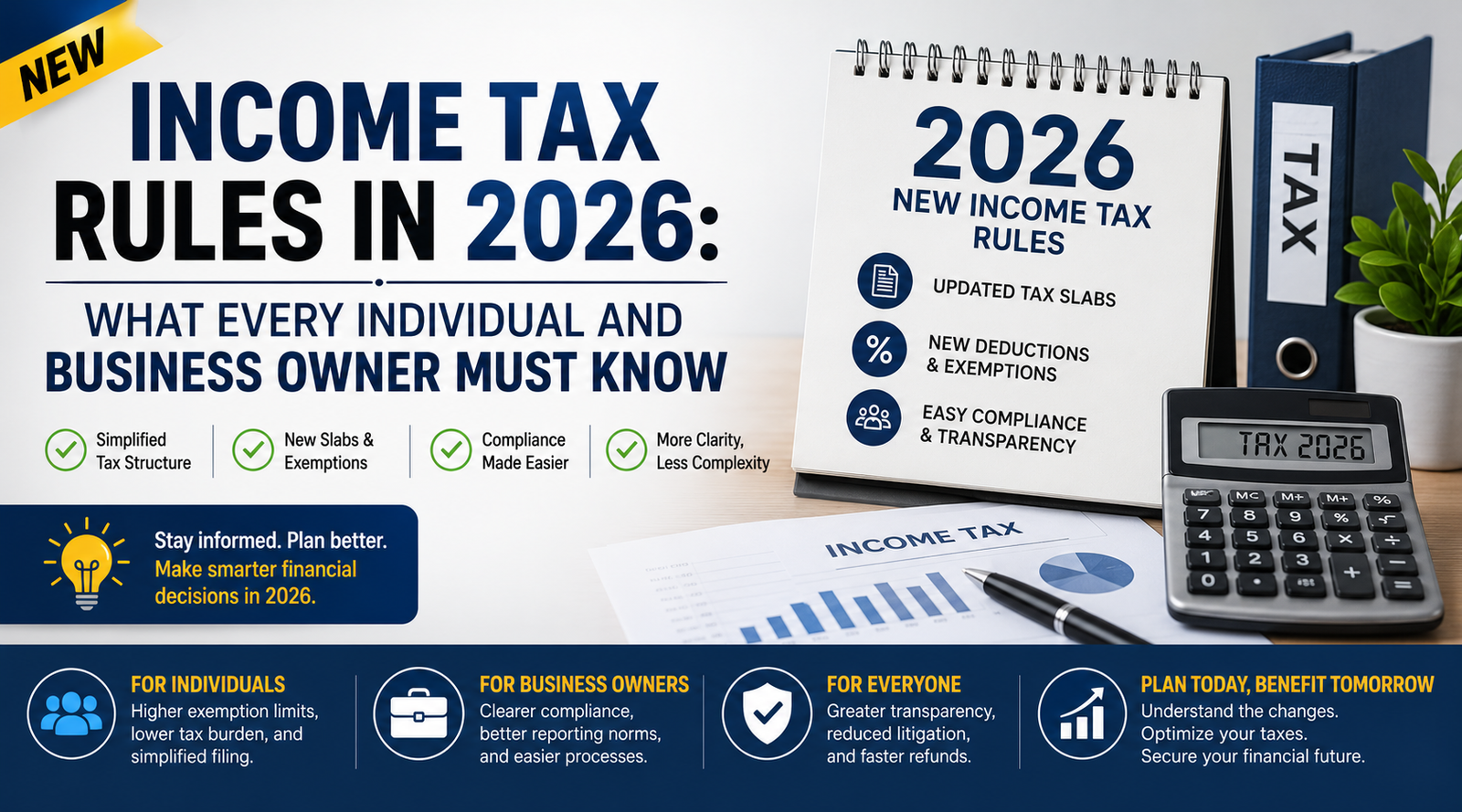
India entered a major income-tax transition on April 1, 2026, when the Income-tax Act, 2025 came into force.
Here is what taxpayers need to understand:
- The new Act applies to income earned from April 1, 2026 onward.

- The expression “Tax Year” now replaces the older concept of “Previous Year.”
- Returns for income earned between April 1, 2025 and March 31, 2026 are still filed for Assessment Year 2026–27 under the Income-tax Act, 1961.
- The new Act primarily simplifies and reorganises tax law; it did not itself introduce major changes to individual tax rates.
- The new tax regime continues as the default regime for eligible individual taxpayers.
- Under the new regime applicable to FY 2025–26 income, resident individuals may receive a rebate resulting in nil tax on normal income up to ₹12 lakh, subject to eligibility and exclusions.
- Salaried taxpayers may have no tax liability on salary income up to ₹12.75 lakh after the ₹75,000 standard deduction, where the applicable conditions are satisfied.
- ITR-1 and ITR-2 taxpayers generally continue with a July 31 filing timeline.
- Non-audit business cases have been moved to a later filing window, generally August 31.
- Payroll, TDS, advance-tax and accounting systems should now reference the Income-tax Act, 2025 for Tax Year 2026–27 transactions.
The most important practical lesson is this: do not treat AY 2026–27 and Tax Year 2026–27 as the same compliance period.
Why 2026 Is a Transition Year for Indian Taxpayers
The year 2026 involves two income-tax frameworks operating side by side.
Taxpayers filing their returns for income earned during FY 2025–26 must still use the old Assessment Year framework. At the same time, income earned from April 1, 2026 is governed by the Income-tax Act, 2025.
This overlap can create confusion for:
- Salaried individuals preparing Form 16 records
- Freelancers calculating advance tax
- Businesses deducting TDS
- Employers configuring payroll software
- Companies planning tax provisions
- Taxpayers selecting the correct payment category
- Professionals preparing returns for AY 2026–27
The Income Tax Department has clarified that AY 2026–27 and Tax Year 2026–27 represent separate obligations.
For income earned in FY 2025–26, the taxpayer files a return for AY 2026–27 under the earlier framework. For income earned during FY 2026–27, the new Tax Year framework applies, although the return for that income will ordinarily be filed in 2027.
Income-tax Act, 2025: What Changed on April 1, 2026?
The Income-tax Act, 2025 replaced the Income-tax Act, 1961 for income arising from April 1, 2026 onward.
The principal objective was to make direct-tax law clearer, shorter and easier to navigate. The government stated that the new legislation focused on textual and structural simplification rather than introducing major policy changes or changing tax rates merely through the new Act.
Tax Year Replaces Previous Year
The new Act introduces the expression “Tax Year.”
A Tax Year is generally the 12-month period within a financial year in which income is earned. Therefore, income earned between April 1, 2026 and March 31, 2027 belongs to Tax Year 2026–27.
This replaces the older “Previous Year” terminology.
The change is intended to reduce the confusion created by using one year for earning income and another “Assessment Year” for filing and assessment purposes.
Sections and References Have Changed
Many familiar tax provisions now appear under different sections or schedules.
For example, employers and payroll teams must update references used in:
- Investment declarations
- Salary tax calculations
- TDS working papers
- Employee communications
- Tax-policy documents
- Accounting and compliance software
A deduction that was commonly identified by an old section number may now appear under a new section or schedule in the Income-tax Act, 2025.
The underlying tax treatment may continue, but the legal reference can be different.
What Has Not Fundamentally Changed?
The new Act does not mean that every established income-tax rule has disappeared.
The following core obligations continue:
- Maintaining records
- Deducting and depositing TDS
- Paying advance tax where applicable
- Paying self-assessment tax
- Filing returns
- Reporting income accurately
- Responding to notices
- Preserving supporting documents
- Following tax-audit and other compliance requirements where applicable
The law has been reorganised, but taxpayers still need disciplined documentation and accurate reporting.
AY 2026–27 vs Tax Year 2026–27
This distinction is central to understanding the new income tax rules in 2026.
| Particular | AY 2026–27 | Tax Year 2026–27 |
|---|---|---|
| Income period | April 1, 2025 to March 31, 2026 | April 1, 2026 to March 31, 2027 |
| Governing law | Income-tax Act, 1961 | Income-tax Act, 2025 |
| Return filing period | Primarily during 2026 | Primarily during 2027 |
| Return terminology | Assessment Year | Tax Year |
| Tax payment reference | Old Act for FY 2025–26 liability | New Act for income and payments from April 2026 |
| Key action now | Prepare and file AY 2026–27 return | Maintain records and pay applicable tax under the new framework |
A taxpayer filing an ITR in July or August 2026 may therefore still be filing under the old Act, even though the new Act has already come into force for current-year income.
Income-Tax Slabs for Income Earned During FY 2025–26
The new tax regime remained the default regime for eligible individuals and certain other taxpayers for AY 2026–27.
New-Regime Slabs for AY 2026–27
| Total income slab | Tax rate |
|---|---|
| Up to ₹4,00,000 | Nil |
| ₹4,00,001 to ₹8,00,000 | 5% |
| ₹8,00,001 to ₹12,00,000 | 10% |
| ₹12,00,001 to ₹16,00,000 | 15% |
| ₹16,00,001 to ₹20,00,000 | 20% |
| ₹20,00,001 to ₹24,00,000 | 25% |
| Above ₹24,00,000 | 30% |
Health and Education Cess and surcharge may apply in addition to the basic tax, depending on the taxpayer’s circumstances and income level.
Nil Tax up to ₹12 Lakh Does Not Mean a ₹12 Lakh Basic Exemption
This point is frequently misunderstood.
Under the new regime, the basic nil-rate slab is ₹4 lakh. The effective nil-tax position up to ₹12 lakh for eligible resident individuals arises through a tax rebate.
It does not mean that every type of income up to ₹12 lakh is automatically exempt.
Special-rate income, such as certain capital gains, may not receive the same rebate treatment. Taxpayers with capital gains, virtual digital assets, foreign assets or other specialised income should calculate their liability separately.
Salaried Taxpayers and the ₹12.75 Lakh Figure
A salaried taxpayer eligible for a standard deduction of ₹75,000 may have no tax payable on gross salary income up to ₹12.75 lakh under the new regime, subject to the taxpayer’s income composition and eligibility.
Example:
| Particular | Amount |
|---|---|
| Gross salary income | ₹12,75,000 |
| Less: Standard deduction | ₹75,000 |
| Total income | ₹12,00,000 |
| Potential rebate under applicable conditions | Tax reduced to nil |
This example assumes normal slab-rate income and does not account for special-rate income or other adjustments.
Can Taxpayers Still Choose the Old Tax Regime?
Eligible taxpayers may still opt for the old regime, subject to the prescribed conditions.
The old regime may remain relevant for taxpayers claiming significant deductions or exemptions, including eligible:
- House rent allowance
- Home-loan interest
- Section 80C-type investments
- Medical-insurance deductions
- Donations
- Other qualifying deductions
However, a taxpayer should not select a regime based on one deduction alone. A comparative calculation should consider total income, deductions, capital gains, business income and future consistency requirements.
Individuals with business or professional income may face additional procedural conditions when switching between regimes.
ITR Filing Deadlines in 2026
Return deadlines depend on the taxpayer category and applicable form.
Based on the current 2026 framework:
| Taxpayer category | General due date for AY 2026–27 |
|---|---|
| Eligible ITR-1 and ITR-2 taxpayers | July 31, 2026 |
| Non-audit business or professional cases | August 31, 2026 |
| Taxpayers requiring audit | Generally later, subject to applicable provisions |
| Transfer-pricing cases | Generally November 30, subject to applicable provisions |
Taxpayers should verify the final deadline applicable to their specific category because extensions, notifications and form-related changes may affect compliance.
The August 31 timeline for non-audit business cases is particularly important for proprietors, professionals and other eligible taxpayers who previously associated all non-audit returns with July 31.
New Return-Filing and Compliance Developments
Extended Time for Revising Returns
Budget 2026 proposed allowing more time for revising returns, extending the revision window beyond December 31 and up to March 31, subject to payment of a prescribed nominal fee and the enacted provisions.
This can help taxpayers who discover an omission or reporting mistake after the earlier revision deadline.
However, taxpayers should not intentionally delay corrections. Waiting can affect:
- Refund processing
- Tax-credit matching
- Loan applications
- Financial statements
- Compliance certificates
- Notice risk
Updated Returns Continue Under a Unified Framework
The Income-tax Act, 2025 places original, belated, revised and updated-return provisions within a unified return-filing section.
An updated return can generally be used to disclose missed income and pay additional tax within the permitted window. It cannot ordinarily be used to:
- Increase a loss
- Reduce total tax liability
- Claim or increase a refund
- Convert a valid tax liability into a lower one
The updated-return window under the new framework can extend up to 48 months from the relevant statutory point, subject to conditions.
An updated return is a corrective-compliance tool—not a substitute for accurate and timely filing.
Updated Return After Reassessment Begins
Budget 2026 also introduced a proposal allowing taxpayers, in specified circumstances, to update a return even after reassessment proceedings have begun, subject to an additional tax burden.
This measure is intended to encourage voluntary disclosure and reduce prolonged disputes. Its use should be evaluated carefully because the financial and legal consequences depend on the stage and facts of the case.
What Salaried Individuals Must Do in 2026
Salaried taxpayers should complete the following checks before filing:
- Compare Form 16 with salary slips.
- Review Form 26AS.
- Review the Annual Information Statement.
- Verify interest from savings accounts and deposits.
- Report income from dividends and investments.
- Review capital-gain statements.
- disclose foreign assets or income where required.
- Compare the old and new tax regimes.
- confirm whether the correct ITR form applies.
- reconcile tax already deducted with the tax credit available.
ITR-1 is not suitable for every salaried taxpayer. Restrictions may apply where the person:
- Is a company director
- Holds unlisted equity shares
- Has certain capital gains
- Owns foreign assets
- Has signing authority in a foreign account
- Receives foreign-source income
- Has income exceeding the applicable ITR-1 limit
Selecting a simpler but incorrect form can make the return defective or incomplete.
What Freelancers and Professionals Must Do
Freelancers, consultants, doctors, lawyers, designers and other professionals should not treat total bank receipts as taxable profit without reviewing the nature of each receipt and expense.
They should:
- Reconcile invoices with bank receipts
- Record professional expenses
- Review TDS deducted by clients
- Maintain invoices and contracts
- Calculate advance tax
- Check GST implications separately
- Evaluate presumptive-tax eligibility
- Review whether books or audit requirements apply
- Distinguish personal and business expenditure
Presumptive taxation can simplify compliance for eligible taxpayers, but it does not automatically suit every professional. Actual expenses, turnover, profit levels and documentation requirements should be considered.
What Business Owners Must Do Under the New Act
Update Payroll and TDS References
For salary and other payments relating to Tax Year 2026–27, businesses should update:
- Payroll software
- TDS configurations
- Investment-declaration formats
- Employee tax communications
- Vendor tax-master data
- Internal compliance checklists
- Legal section references
The Income Tax Department has clarified that payroll documents for Tax Year 2026–27 should use the new Act’s references.
Continue Advance-Tax Compliance
Advance-tax obligations continue under the Income-tax Act, 2025.
Business owners should estimate current-year income using:
- Actual sales
- Gross margins
- Operating expenses
- Interest income
- Capital gains
- Other taxable receipts
- TDS already available
Advance tax should not be calculated using an outdated annual estimate when profit margins or revenue have changed significantly.
Strengthen Accounting Records
The introduction of a simplified Act does not reduce the need for evidence.
Businesses should preserve:
- Sales invoices
- Purchase invoices
- Bank statements
- Expense vouchers
- Agreements
- Loan records
- Asset registers
- Payroll records
- TDS challans and returns
- GST reconciliations
- Related-party records
- Supporting documents for deductions
A transaction may be genuine, but without proper documentation it may still become difficult to defend.
MAT Changes for Companies
Budget 2026 introduced significant Minimum Alternate Tax changes for companies.
The MAT rate was proposed to reduce from 15% to 14%, while MAT would move toward a final-tax model for companies remaining under the relevant old regime. Further MAT credit accumulation from April 1, 2026 was proposed to stop.
Existing MAT credit accumulated up to March 31, 2026 may continue to be available under prescribed conditions, with set-off restrictions applying when companies move to the new corporate-tax regime.
Companies with MAT credit should model the impact before choosing or changing their tax regime.
TDS, Advance Tax and Self-Assessment Tax Continue
The new Act does not remove the fundamental methods through which income tax is collected.
Taxpayers may still discharge liability through:
- Tax deducted at source
- Tax collected at source
- Advance tax
- Self-assessment tax
- Regular assessment demand
Business owners should pay particular attention to:
- Vendor TDS classification
- Employee TDS
- Property transactions
- Contract payments
- Professional fees
- Rent
- Interest payments
- Non-resident payments
A payment may create a TDS obligation even when the recipient ultimately has little or no final tax liability.
Seven-Step Tax Compliance Checklist for 2026
Step 1: Separate the Two Tax Periods
Complete the AY 2026–27 return using FY 2025–26 records while separately maintaining Tax Year 2026–27 records under the new Act.
Step 2: Reconcile Reported Information
Compare books and personal records with:
- Form 26AS
- AIS
- TIS
- Bank statements
- GST returns
- TDS certificates
- Investment statements
Step 3: Select the Correct Return Form
Do not choose ITR-1 or ITR-4 merely because it appears easier.
Step 4: Compare Tax Regimes
Prepare an actual old-versus-new-regime calculation.
Step 5: Update Business Systems
Revise payroll, TDS, tax-payment and accounting references for the Income-tax Act, 2025.
Step 6: Review Advance Tax Quarterly
Recalculate expected income instead of repeating the previous year’s payment amount.
Step 7: Obtain Professional Review
Seek advice where the return involves:
- Business income
- Capital gains
- Foreign assets
- Virtual digital assets
- Multiple properties
- High-value transactions
- Notice proceedings
- Tax audit
- Regime switching
- MAT credit
- Non-resident taxation
Common Mistakes to Avoid in 2026
- Treating AY 2026–27 and Tax Year 2026–27 as identical
- Applying the new Act retrospectively to FY 2025–26 income
- Assuming ₹12 lakh is the basic exemption limit
- Ignoring special-rate income while claiming rebate
- Filing the wrong ITR form
- Missing the August 31 business-return deadline
- Choosing a tax regime without comparison
- Failing to report bank interest
- Ignoring AIS mismatches
- Mixing personal and business expenses
- Using obsolete section references in payroll systems
- Delaying advance-tax calculations
- Assuming an updated return can be used to claim a higher refund
- Relying on software without reviewing source documents
How CA Rohit Jain Can Help
CA Rohit Jain provides taxation, income-tax filing, GST, accounting, compliance, audit and business-advisory services to individuals and businesses in Chandigarh .
Professional support can help taxpayers:
- Identify the correct return form
- Compare tax regimes
- Reconcile AIS, TDS and financial records
- Calculate advance tax
- Review business deductions
- Update compliance processes under the new Act
- Correct incomplete or inaccurate returns
- Respond to tax notices
- Plan tax positions before year-end
- Maintain defensible documentation
Conclusion
The most important income-tax development in 2026 is not simply a new slab or deduction. It is the transition from the Income-tax Act, 1961 to the Income-tax Act, 2025.
Individuals and business owners must manage two distinct responsibilities:
- File AY 2026–27 correctly for income earned during FY 2025–26.
- Maintain records and make tax payments under the new Tax Year 2026–27 framework for income earned from April 1, 2026.
The new law aims to simplify tax language, but tax outcomes still depend on correct classification, timely filing, reliable records and informed judgment.
Individuals, professionals and business owners in Chandigarh can approach CA Rohit Jain for a structured review of their return, tax regime, advance-tax position and compliance requirements under the 2026 framework. FAQ Section
1. What are the most important new income-tax rules in 2026?
The biggest change is that the Income-tax Act, 2025 became effective on April 1, 2026. It introduced the “Tax Year” concept, simplified the structure of tax law and changed many section references. Tax filing, TDS, advance tax and documentation obligations continue.
2. Is the Income-tax Act, 2025 applicable to AY 2026–27 returns?
Generally, no. AY 2026–27 relates to income earned during FY 2025–26 and remains governed by the Income-tax Act, 1961. The new Act applies to Tax Year 2026–27, covering income earned from April 1, 2026 onward.
3. What is the income-tax exemption limit in 2026?
Under the new regime for AY 2026–27, the nil-rate slab is ₹4 lakh. Eligible resident individuals may receive a rebate that reduces tax to nil on qualifying normal income up to ₹12 lakh. Therefore, ₹12 lakh is not the basic exemption limit.
4. Can a salaried person earn ₹12.75 lakh without paying tax?
A salaried taxpayer may have nil tax on gross salary of up to ₹12.75 lakh after the ₹75,000 standard deduction, provided total qualifying income is ₹12 lakh and the rebate conditions are satisfied. Special-rate income may change the result.
5. What is the ITR filing deadline for non-audit business owners in 2026?
The 2026 framework introduced a staggered timeline, with eligible non-audit business cases generally receiving an August 31 deadline for AY 2026–27. Taxpayers should verify the exact date applicable to their form and category before filing.
6. Can taxpayers still choose the old tax regime?
Eligible individuals may still opt for the old regime, subject to applicable conditions and procedures. Taxpayers with business or professional income should review the switching rules carefully before making a decision.
7. Do TDS and advance-tax rules continue under the new Act?
Yes. The basic obligation to discharge tax through TDS, TCS, advance tax and self-assessment tax continues. Payments connected with Tax Year 2026–27 must use the new Act framework.
8. What should businesses update after April 1, 2026?
Businesses should update payroll software, TDS configurations, investment declarations, tax-payment workflows, compliance checklists and legal references to align with the Income-tax Act, 2025.