TL;DR
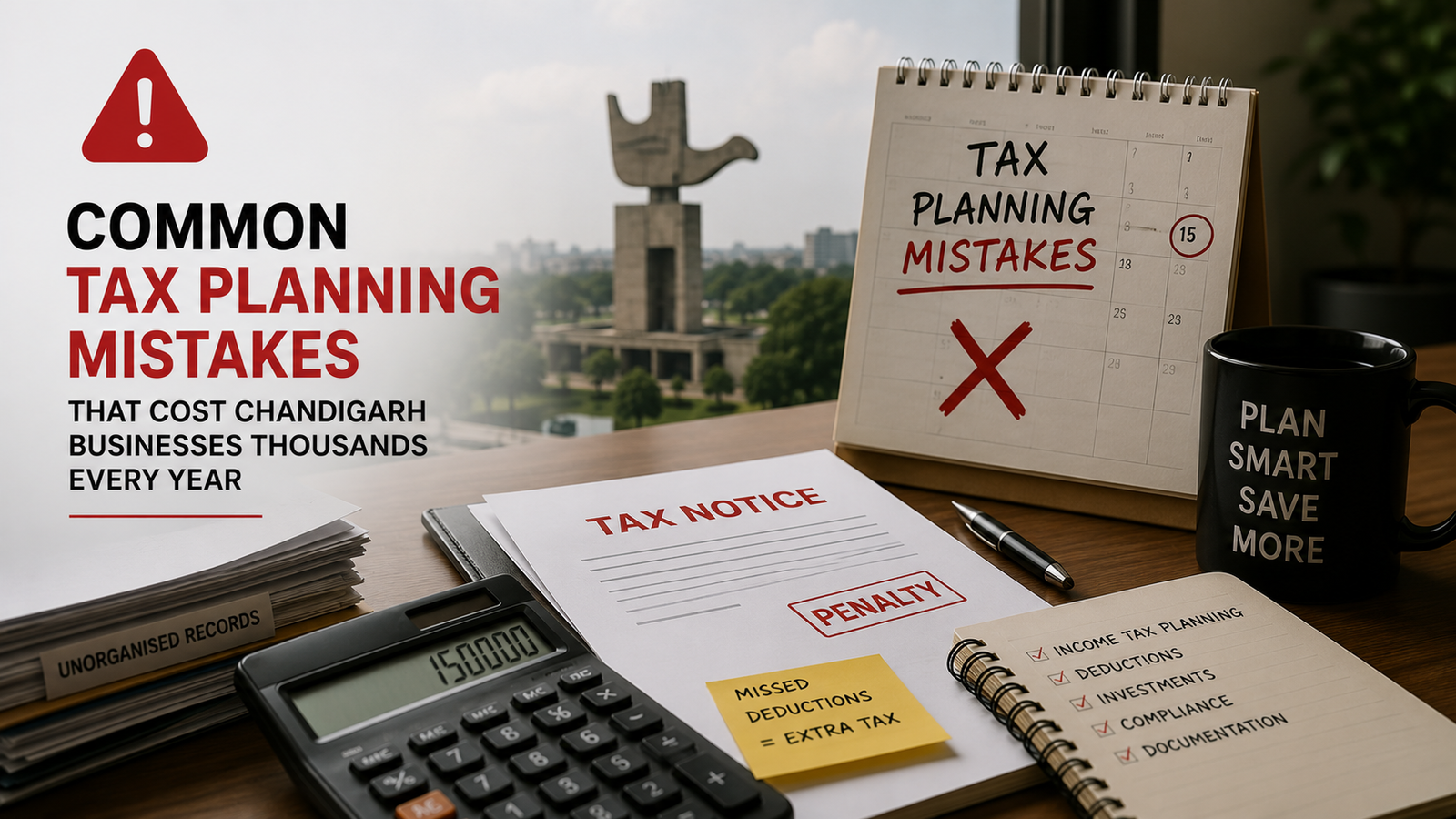
Most tax losses do not happen because businesses earn more profit. They happen because tax planning starts too late, records are incomplete, advance tax is miscalculated, TDS is missed, GST data does not match books, or major business decisions are taken without CA review.
For Chandigarh businesses, tax planning should be a year-round process. A structured tax plan helps reduce avoidable interest, penalties, disallowances, cash flow pressure and compliance notices.
Why Tax Planning Is Not a Year-End Activity
Many business owners think tax planning means calculating tax in March or filing returns before the due date. That is not real tax planning.
Real tax planning begins at the start of the financial year and continues every month. Every invoice, vendor payment, salary structure, loan, capital purchase, GST return, TDS deduction and cash transaction can affect tax liability.
A business that reviews tax only at year-end usually faces three problems:
- Too little time to correct errors
- Higher risk of missed deductions or disallowances
- Sudden cash flow pressure due to unpaid tax liability
For SMEs, startups, traders, consultants and service businesses in Chandigarh, proactive tax planning can directly protect profitability.
Mistake 1: Waiting Until March to Think About Tax
This is one of the most expensive mistakes businesses make.
By March, most business decisions are already done. Expenses are incurred, invoices are issued, payments are made, assets are purchased and compliance deadlines may already be missed.
Last-minute tax planning creates problems such as:
- Rushed investment decisions
- Incorrect expense booking
- Missed advance tax instalments
- Poor cash flow planning
- Incomplete documentation
- Higher interest liability
Better approach: review tax position quarterly. A CA-led quarterly review helps estimate profits, check tax liability, review GST/TDS compliance and plan payments before they become stressful.
Mistake 2: Not Estimating Advance Tax Correctly
Advance tax is a major area where businesses lose money through interest.
If tax liability is expected beyond the prescribed threshold, advance tax must be paid in instalments during the year. Businesses often miss this because they do not track profit regularly.
Common advance tax mistakes include:
- Not estimating quarterly profit
- Ignoring seasonal income spikes
- Forgetting non-business income
- Not considering capital gains
- Underestimating tax liability
- Paying tax only near year-end
For FY 2026–27, advance tax planning needs regular review of books, income, deductions and projected profitability. Presumptive taxation taxpayers may follow different advance tax timing, so classification must be reviewed carefully.
Mistake 3: Ignoring TDS and TCS Compliance
TDS errors can become costly because they affect both the payer and recipient.
Businesses may need to deduct TDS on payments such as:
- Professional fees
- Contractor payments
- Rent
- Interest
- Commission
- Salary
- Certain purchases or specified transactions
Common TDS mistakes include:
- Not deducting TDS
- Deducting at the wrong rate
- Deducting but not depositing on time
- Filing incorrect TDS returns
- Not issuing TDS certificates
- PAN mismatch in TDS returns
TDS and advance tax are both important collection mechanisms, and timely compliance helps avoid interest, penalties and mismatch issues.
Mistake 4: Mixing Personal and Business Expenses
Many small businesses lose tax efficiency because personal and business expenses are mixed.
Examples include:
- Personal travel booked as business travel
- Family expenses paid from business account
- Personal vehicle expenses without business justification
- Unsupported cash withdrawals
- Mixed-use phone and internet bills without proper allocation
This creates two risks. First, genuine business expenses may not be properly documented. Second, personal expenses claimed as business expenses may be disallowed during scrutiny.
Better approach:
- Maintain separate business bank accounts
- Keep proper invoices
- Define expense approval rules
- Record owner withdrawals separately
- Keep business-purpose documentation
Clean separation improves both tax planning and audit readiness.
Mistake 5: Poor Bookkeeping and Missing Documents
Tax planning fails when bookkeeping is weak.
A business may be eligible for deductions, but without proper records, claims become risky. Missing invoices, vague expense entries, cash payments without proof and unreconciled ledgers can increase taxable income.
Poor bookkeeping can lead to:
- Disallowed expenses
- Wrong profit calculation
- GST mismatch
- TDS mismatch
- Inaccurate advance tax
- Audit queries
- Weak loan documentation
A monthly bookkeeping review is one of the simplest ways to prevent tax leakage.
Important records to maintain:
- Sales invoices
- Purchase bills
- Expense vouchers
- Bank statements
- GST returns
- TDS challans
- Salary records
- Loan statements
- Fixed asset invoices
- Agreements and contracts
Mistake 6: Claiming Deductions Without Proper Eligibility
Every deduction is not automatically available to every business.
Businesses often make mistakes while claiming:
- Depreciation
- Preliminary expenses
- Interest expense
- Employee welfare expenses
- Travel expenses
- Repairs and maintenance
- Bad debts
- Donations
- Professional fees
- Capital vs revenue expenditure
Some expenses may be deductible, but only if properly classified and supported. For example, certain preliminary expenses may be deductible over a period subject to conditions.
The mistake is not claiming deductions. The mistake is claiming them without verifying eligibility, documentation and tax treatment.
Mistake 7: Ignoring GST and Income Tax Turnover Mismatch
GST data and income tax data should tell a consistent financial story.
Problems arise when:
- GST turnover differs from books
- Sales invoices are missed
- Credit notes are not adjusted correctly
- Advances are treated inconsistently
- Exempt and taxable sales are mixed
- GSTR-1 and books do not match
- Income tax return turnover differs from GST returns
GST reporting errors can include underreporting sales, incorrect purchase reporting, transaction misclassification and wrong reporting periods.
For businesses in Chandigarh, GST-income tax reconciliation should be done before finalising accounts and filing returns.
Mistake 8: Not Reviewing Cash Transactions
Cash transactions need careful review because tax laws place restrictions and reporting requirements on certain cash payments, receipts and loans.
Common mistakes include:
- Large cash expenses without proper proof
- Cash payments to vendors above permitted limits
- Cash loans or repayments
- Unexplained cash deposits
- Poor cash book maintenance
- Personal cash mixed with business cash
Cash errors can increase scrutiny and may lead to disallowance or penalty exposure.
Better approach:
- Keep a daily cash book
- Prefer banking channels
- Avoid unsupported cash payments
- Maintain payment proof
- Review cash transactions monthly
Mistake 9: Choosing the Wrong Business Structure
The structure of a business affects taxation, compliance, liability, funding options and long-term planning.
Many businesses continue with an old structure even after growth.
For example:
- A proprietorship may become inefficient as turnover grows
- A partnership may need stronger documentation
- An LLP may suit professional or service businesses
- A private limited company may help with funding and scalability
- Multi-state operations may need better GST and accounting controls
Choosing or continuing the wrong structure can increase tax burden, reduce credibility and create compliance problems.
A CA can help review whether the current structure still fits the business goals.
Mistake 10: Not Taking CA Review Before Major Decisions
Major financial decisions should not be taken only from a commercial point of view. Tax impact must also be reviewed.
Businesses should consult a CA before:
- Buying major assets
- Taking or giving loans
- Changing business structure
- Opening a new branch
- Entering export/import transactions
- Hiring senior employees
- Raising funds
- Selling property or investments
- Entering high-value contracts
- Making large related-party payments
A decision that looks profitable may still create tax, GST, TDS or documentation issues if not reviewed properly.
Tax Planning Checklist for Chandigarh Businesses
| Area | What to Review | Frequency |
|---|---|---|
| Bookkeeping | Ledgers, invoices, expenses, bank reconciliation | Monthly |
| GST | GSTR-1, GSTR-3B, GSTR-2B, ITC | Monthly |
| TDS | Deduction, deposit, return filing, PAN details | Monthly/Quarterly |
| Advance Tax | Profit estimate and projected liability | Quarterly |
| Expenses | Eligibility, invoice proof, business purpose | Monthly |
| Cash | Cash book, deposits, withdrawals, limits | Monthly |
| Assets | Capitalisation, depreciation, documentation | Quarterly |
| Structure | Proprietorship, LLP, company suitability | Annual |
| Tax Return | Books, Form 26AS/AIS/TIS, GST turnover | Before filing |
| CA Review | Compliance risk and tax-saving opportunities | Quarterly |
Conclusion
Tax planning mistakes can quietly cost Chandigarh businesses thousands every year. The biggest risks usually come from late planning, weak bookkeeping, missed advance tax, TDS defaults, GST mismatches, unsupported expenses and decisions taken without professional review.
The solution is not complicated. Businesses need monthly accounting discipline, quarterly tax review and timely CA guidance.
A proactive tax plan helps protect cash flow, reduce compliance risk and improve financial decision-making.
CTA:
If your business wants to reduce avoidable tax costs, improve compliance and plan taxes more confidently, CA Rohit Jain can help with income tax consultancy, GST review, accounting, audit support and year-round tax advisory in Chandigarh.
FAQ SECTION
1. What are the most common tax planning mistakes businesses make?
The most common mistakes include late tax planning, missed advance tax, TDS errors, poor bookkeeping, unsupported expenses, GST mismatches and lack of CA review before major business decisions.
2. Why do businesses pay more tax than required?
Businesses often pay more tax because they miss eligible deductions, maintain poor records, classify expenses incorrectly, fail to plan cash flow or review tax liability only at year-end.
3. What happens if advance tax is not paid on time?
Delayed or short payment of advance tax may lead to interest liability. It can also create year-end cash flow pressure because the business has to pay a larger tax amount at once.
4. Can poor bookkeeping increase tax liability?
Yes. Poor bookkeeping can lead to missed deductions, disallowed expenses, GST mismatch, incorrect profit calculation and weak documentation during scrutiny or audit.
5. How do GST mismatches affect income tax?
GST turnover and income tax turnover should broadly reconcile. If there are unexplained differences between GST returns, books and income tax return data, the business may face questions or notices.
6. Why should businesses consult a CA for tax planning?
A CA helps review tax liability, deductions, GST, TDS, advance tax, documentation, business structure and compliance risks. This helps reduce avoidable costs and improves financial control.
7. Is year-round tax planning better than last-minute filing?
Yes. Year-round tax planning allows businesses to correct errors early, estimate tax liability properly, claim eligible deductions and avoid last-minute compliance pressure.