TL;DR
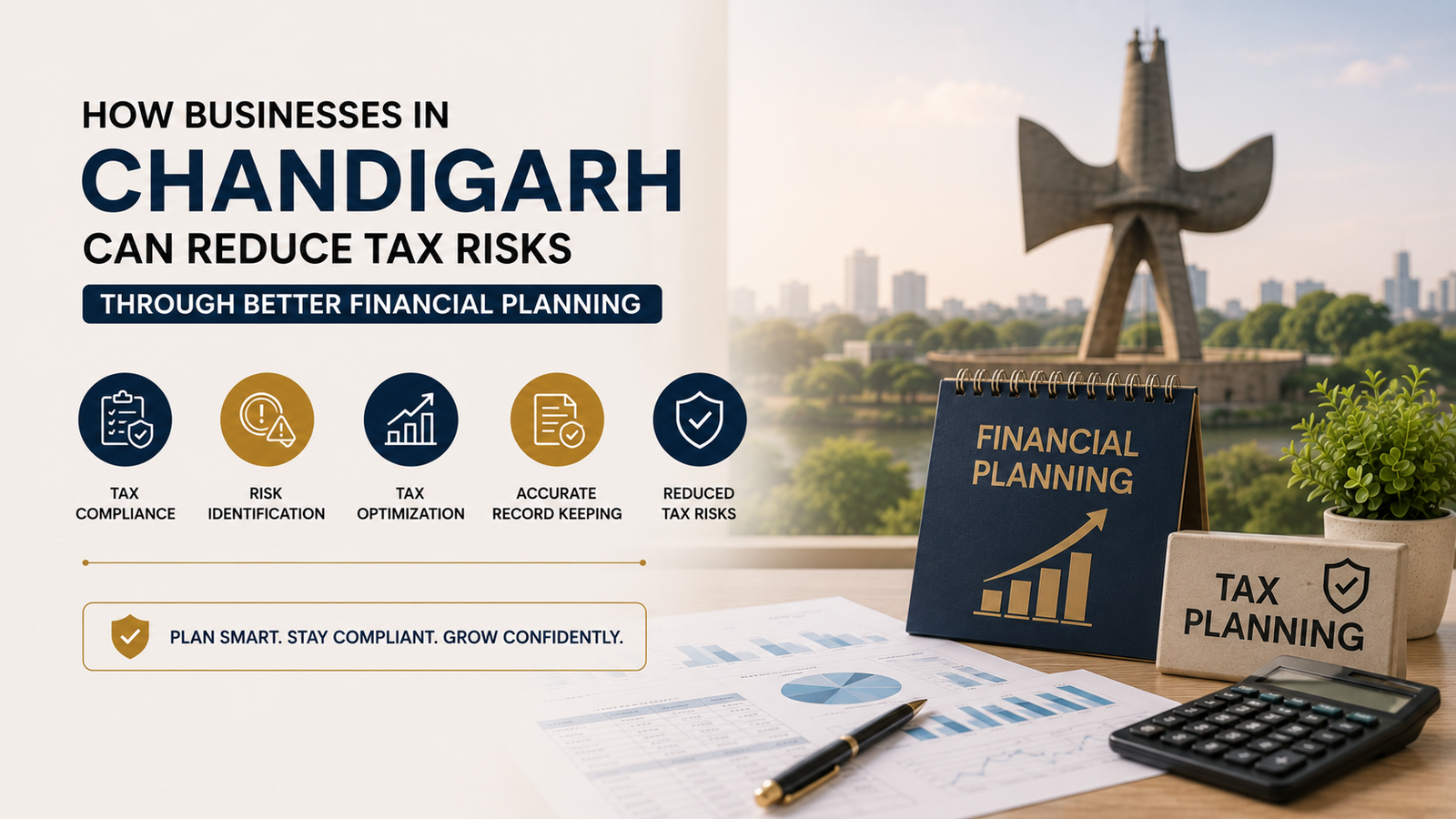
Businesses in Chandigarh can reduce tax risks by planning finances throughout the year instead of reacting during filing season. The most effective steps include monthly bookkeeping, GST reconciliation, TDS review, advance tax planning, expense documentation, cash flow forecasting and quarterly CA-led financial reviews.
Tax risk usually does not appear suddenly. It builds slowly through missed entries, wrong classifications, delayed filings, poor documentation and weak financial controls.
Why Tax Risk Is a Financial Planning Problem

Many business owners treat tax risk as a filing issue. In reality, most tax problems begin much earlier.
A wrong invoice, missed GST reconciliation, unpaid TDS, unsupported expense, delayed bookkeeping or poor cash flow plan can later become an income tax notice, GST mismatch, interest liability or penalty exposure.
Better financial planning helps businesses:
- Estimate tax liability early
- Avoid last-minute cash pressure
- Claim eligible deductions correctly
- Maintain clean records
- Reduce GST and TDS mismatches
- Prepare for audit or scrutiny
- Make better business decisions
For SMEs, startups and service businesses in Chandigarh, tax planning should be connected with accounting, GST, cash flow and compliance review.
What Creates Tax Risk for Businesses?
Tax risk usually comes from weak financial systems rather than one major mistake.
Common causes include:
- Books updated only at year-end
- GST returns filed without reconciliation
- GSTR-2B mismatches ignored
- TDS deducted late or not deposited
- Advance tax not estimated properly
- Personal and business expenses mixed
- Cash transactions not reviewed
- Missing invoices and agreements
- Wrong expense classification
- Difference between GST turnover and income tax turnover
- No quarterly review by a CA
Once these issues accumulate, correction becomes harder.
Financial Planning Steps That Reduce Tax Risk
1. Maintain Accurate Monthly Books
Clean books are the foundation of tax risk reduction.
Monthly accounting should include:
- Sales entries
- Purchase entries
- Expense records
- Bank reconciliation
- Customer ledgers
- Vendor ledgers
- Loan accounts
- Fixed asset records
- GST and TDS entries
- Payroll records
If books are updated only before filing, errors may remain hidden for months. Monthly books help identify gaps early and support better tax estimates.
For example, if expenses are wrongly classified as capital or revenue items, the tax impact can change. A monthly review reduces such errors before year-end.
2. Reconcile GST Before Filing Returns
GST mismatch is one of the most common tax-risk areas for Indian businesses.
Businesses should reconcile:
| Record | What to Check |
|---|---|
| Sales register | Invoice value, GSTIN, tax rate, place of supply |
| GSTR-1 | Outward supplies reported correctly |
| GSTR-3B | Tax liability paid correctly |
| GSTR-2B | Eligible input tax credit reflected |
| Books of accounts | Entries match return data |
| E-invoices | IRN and invoice values match, where applicable |
Filing GST without reconciliation can lead to ITC issues, notices and cash flow impact. GST portal changes and technical issues can also create compliance pressure, making early filing and review important.
3. Review TDS Applicability and Deposits
TDS compliance is often missed when payments are made in a hurry.
Businesses should review TDS on:
- Professional fees
- Contractor payments
- Rent
- Salary
- Interest
- Commission
- Certain purchase transactions
- Other specified payments
The risk is not only late deposit. Incorrect TDS can affect expense allowance, vendor reconciliation and Form 26AS/AIS matching.
A monthly TDS review should check:
- Whether TDS is applicable
- Correct section and rate
- PAN availability
- Timely deposit
- Quarterly return filing
- TDS certificate issuance
4. Plan Advance Tax Quarterly
Advance tax planning prevents year-end pressure.
Businesses should estimate:
- Quarterly profit
- Non-business income
- Capital gains, if any
- Deductions
- TDS already deducted
- Expected tax liability
- Cash available for tax payments
Tax planning helps reduce liability legally, improves cash flow and reduces financial risk.
A business that reviews advance tax quarterly avoids sudden March payments and interest exposure.
5. Separate Personal and Business Expenses
Mixing personal and business expenses creates tax risk.
Common examples include:
- Personal travel paid through business account
- Family expenses booked as business expenses
- Owner withdrawals not recorded properly
- Personal loans mixed with business funds
- Unsupported cash payments
Better process:
- Maintain separate business bank account
- Record owner withdrawals separately
- Keep invoices for business expenses
- Document business purpose
- Review related-party transactions
This improves audit readiness and reduces disallowance risk.
6. Maintain Strong Documentation
Tax risk increases when claims cannot be supported.
Businesses should maintain:
- Sales invoices
- Purchase bills
- Expense vouchers
- Agreements
- Bank statements
- Payment proofs
- GST returns
- TDS challans
- Payroll records
- Loan documents
- Fixed asset invoices
- Board resolutions, where applicable
Good documentation protects the business during notices, audits and assessments.
7. Review Cash Flow Before Tax Due Dates
Many businesses know tax is payable but do not plan cash flow for it.
A tax cash flow plan should include:
- GST payments
- TDS deposits
- Advance tax
- Income tax dues
- Professional tax/payroll-related dues, where applicable
- ROC and annual compliance fees
- Audit and filing costs
This avoids emergency borrowing and missed due dates.
8. Conduct Quarterly CA-Led Reviews
Quarterly reviews help reduce tax risk before it becomes expensive.
A CA-led quarterly review should cover:
- Profit and loss review
- Balance sheet review
- GST reconciliation
- TDS compliance
- Advance tax estimate
- Receivables and payables
- Cash flow forecast
- Expense classification
- Tax-saving opportunities
- Notice or portal alerts
For growing businesses, Virtual CFO support can also help convert accounting data into cash flow planning, profitability tracking and tax-risk management.
Tax Risk Reduction Checklist
| Area | Review Frequency | Risk Reduced |
|---|---|---|
| Bookkeeping | Monthly | Wrong profit, missed expenses |
| GST reconciliation | Monthly | ITC mismatch, notices |
| TDS review | Monthly/Quarterly | Interest, disallowance |
| Advance tax | Quarterly | Interest and cash pressure |
| Expense documents | Monthly | Disallowance |
| Cash flow | Monthly | Missed tax payments |
| Balance sheet | Quarterly | Hidden liabilities |
| CA review | Quarterly | Compliance and tax risk |
Common Mistakes Businesses Should Avoid
Mistake 1: Tax Planning Only in March
By March, most transactions are already complete. Quarterly planning gives more time to correct issues.
Mistake 2: Filing GST Without GSTR-2B Review
ITC should be checked against GSTR-2B before claiming. Vendor delays can affect credit.
Mistake 3: Ignoring TDS Until Return Filing
TDS should be reviewed at payment stage, not after the quarter ends.
Mistake 4: Poor Documentation
Even genuine expenses may be questioned if proof is missing.
Mistake 5: Not Matching GST and Income Tax Turnover
Turnover in books, GST returns and income tax filings should be reconciled before finalisation.
Mistake 6: No Professional Review
Software can record entries, but tax interpretation and risk review need professional judgment.
Internal Linking Suggestions
Use these internal links naturally:
- Tax consultancy in Chandigarh → Tax Consultancy page
- CA in Chandigarh → Homepage
- GST compliance services → GST Service page
- Accounting and bookkeeping services → Accounting page
- Virtual CFO services → Virtual CFO page
- Audit and assurance services → Audit page
- Representation services → Representation page
Conclusion
Businesses in Chandigarh can reduce tax risks by treating financial planning as a year-round discipline. Clean monthly books, GST reconciliation, TDS review, advance tax planning, proper documentation and quarterly CA-led reviews help prevent avoidable notices, penalties and cash flow pressure.
The goal is not aggressive tax saving. The goal is legally sound tax planning, accurate compliance and better financial control.
CTA:
If your business wants to reduce tax risks, improve GST/TDS compliance, plan advance tax and maintain cleaner books, CA Rohit Jain can help with tax consultancy, accounting, Virtual CFO and compliance advisory services in Chandigarh and Tricity.
6. FAQ SECTION
1. How can businesses reduce tax risks?
Businesses can reduce tax risks by maintaining monthly books, reconciling GST, reviewing TDS, planning advance tax, keeping proper documents and conducting quarterly CA-led financial reviews.
2. What causes tax notices for businesses?
Common causes include income mismatch, GST mismatch, TDS errors, unsupported expenses, delayed filings, cash transaction issues and differences between books and tax return data.
3. Why is financial planning important for tax compliance?
Financial planning helps businesses estimate tax liability, manage cash flow, avoid late payments, claim eligible deductions correctly and reduce compliance mistakes.
4. How does GST reconciliation reduce tax risk?
GST reconciliation ensures that sales, purchases, ITC, GSTR-1, GSTR-3B and GSTR-2B match properly. This reduces mismatch notices and wrong ITC claims.
5. What is advance tax planning?
Advance tax planning means estimating expected tax liability during the year and paying tax in instalments instead of waiting until year-end.
6. Why should businesses review TDS every month?
TDS should be reviewed monthly because deduction and deposit errors can lead to interest, penalties, expense disallowance and mismatch issues.
7. How can a CA help reduce tax risk?
A CA helps review books, GST, TDS, advance tax, documentation, deductions, cash flow and compliance risks before they become notices or penalties.