TL;DR
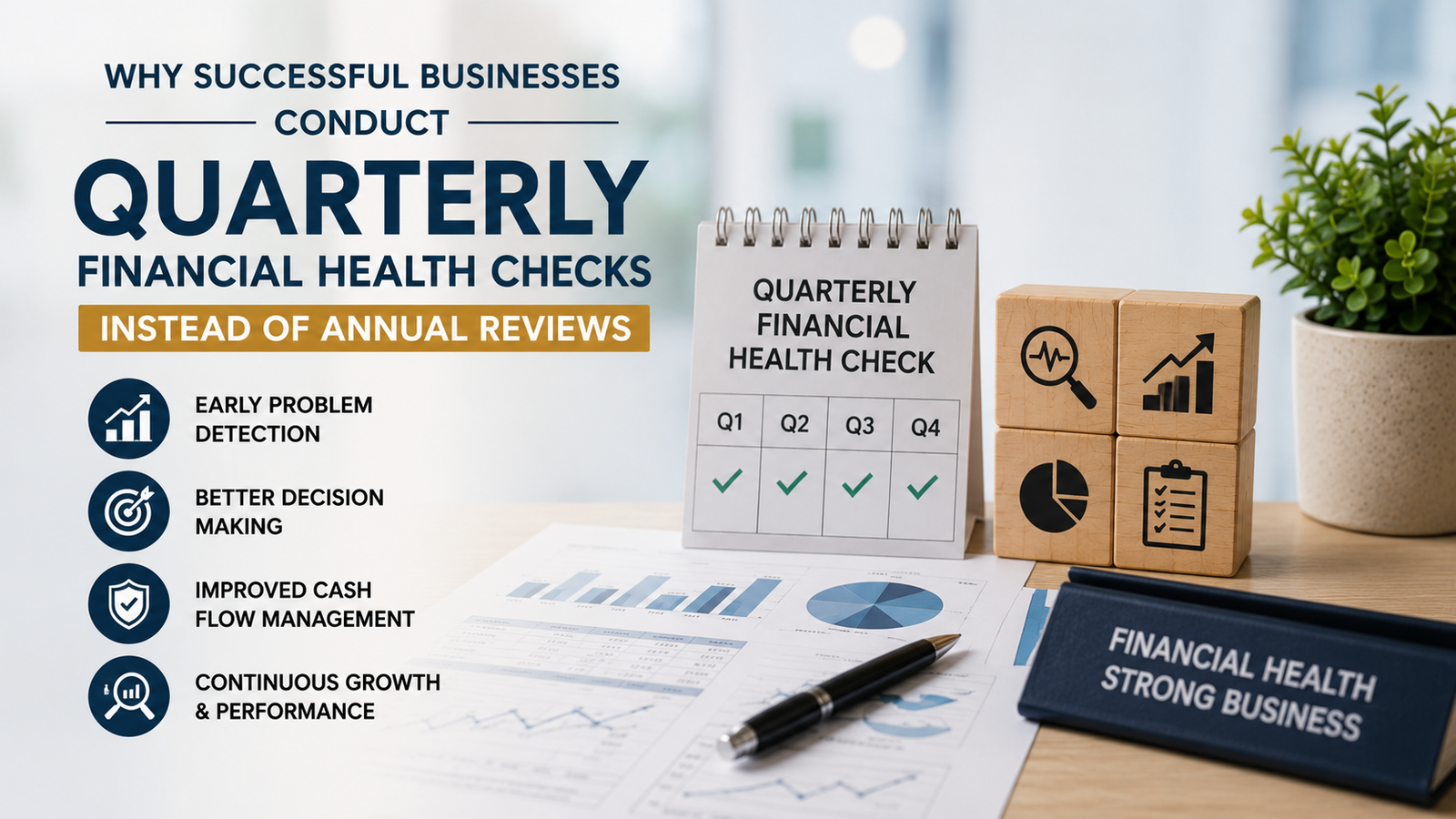
Successful businesses do not wait until year-end to understand their financial position. They conduct quarterly financial health checks to review cash flow, profitability, receivables, GST, TDS, tax planning, expenses, debt and business growth readiness.
Annual reviews are useful for statutory reporting, but they often identify problems too late. Quarterly reviews help business owners take corrective action while there is still time to protect profit, improve liquidity and reduce compliance risk.
Why Annual Financial Reviews Are No Longer Enough
Many businesses review their finances only at the end of the financial year. By then, most decisions have already been made. Expenses are already incurred, GST returns are already filed, receivables may already be overdue, and tax planning options may be limited.
This is why annual reviews often become reactive.
A quarterly financial health check gives business owners a practical control system. It helps them understand whether the business is healthy, under pressure, or moving toward risk.
For SMEs, this matters even more because cash flow and working capital can change quickly. The Economic Survey 2025–26 highlighted that around ₹8.1 lakh crore was stuck in delayed MSME payments, showing how seriously delayed receivables can affect liquidity and growth.
What Is a Quarterly Financial Health Check?
A quarterly financial health check is a structured review of a business’s financial position every three months.
It usually covers:
-
- Cash flow
- Cash flow
- Profitability
- Gross margin
- Receivables and payables
- GST and TDS compliance
- Advance tax position
- Expense trends
- Debt obligations
- Balance sheet strength
- Budget vs actual performance
- Growth readiness
A financial health check helps businesses assess performance through key financial metrics such as cash flow and profit margins, while regular checks improve control and help identify issues early.
In simple terms, an annual review tells you what happened. A quarterly review helps you decide what to do next.
Quarterly Review vs Annual Review: Key Difference
| Area | Annual Review | Quarterly Financial Health Check |
|---|---|---|
| Timing | Once a year | Every 3 months |
| Nature | Mostly reactive | Proactive |
| Cash flow visibility | Often delayed | Updated regularly |
| Tax planning | Limited time to act | Better time for correction |
| GST/TDS issues | Found late | Detected earlier |
| Expense control | Year-end analysis | Quarterly correction |
| Receivables | Often reviewed after delay | Tracked before pressure builds |
| Business decisions | Based on past data | Based on current performance |
| Best for | Statutory closing | Management control and growth |
What Successful Businesses Review Every Quarter
1. Cash Flow and Working Capital
Cash flow is the first sign of business health.
A company may show profit in books but still struggle with vendor payments, salaries, GST dues or loan EMIs. This usually happens when cash is blocked in receivables, inventory, advances or poorly planned expenses.
Quarterly review should check:
- Opening and closing bank balance
- Monthly cash inflow
- Monthly cash outflow
- GST and TDS payments
- Salary and vendor commitments
- Loan repayment schedule
- Emergency cash reserve
- Working capital gap
A strong quarterly review helps business owners answer a simple question: Do we have enough cash for the next 90 days?
2. Profit Margins and Cost Trends
Revenue growth is not always healthy growth.
A business may increase sales but still earn lower profit because costs are rising faster than income. Quarterly reviews help detect this early.
Review:
- Gross profit margin
- Net profit margin
- Direct cost movement
- Employee cost
- Rent and fixed overheads
- Marketing spend
- Finance cost
- Discount leakage
- Product/service-wise profitability
For example, if revenue increased by 20% but net profit increased only by 5%, the business needs to check pricing, vendor costs, staff productivity or overhead control.
3. Debtors and Delayed Payments
Delayed receivables are one of the biggest hidden risks for SMEs.
A business may issue invoices on time but collect payments late. This blocks working capital and creates pressure during tax payments, vendor payments and salary cycles.
Quarterly debtor review should include:
- Total outstanding receivables
- Debtors ageing: 0–30, 31–60, 61–90 and 90+ days
- High-risk customers
- Delayed payment pattern
- Follow-up status
- Credit terms
- Bad debt risk
A business that tracks receivables quarterly can act before overdue invoices become serious cash flow problems.
4. GST, TDS and Tax Position
Quarterly financial health checks should include compliance review.
Important checks include:
- GSTR-1 vs books
- GSTR-3B vs books
- GSTR-2B reconciliation
- Input tax credit eligibility
- TDS deduction and deposit
- TDS return filing
- Advance tax estimate
- Expense classification
- Tax audit applicability
- Notices or portal alerts
This is important because compliance errors often grow silently. If GST mismatch or TDS default is identified after 12 months, correction becomes harder and costlier.
5. Balance Sheet Strength
Many business owners look only at profit and loss. Successful businesses also review the balance sheet.
Quarterly balance sheet review should check:
- Loans and borrowings
- Debtors
- Creditors
- Inventory
- Fixed assets
- Capital introduced
- Owner withdrawals
- Statutory dues
- Advances
- Unsecured loans
A weak balance sheet can affect funding, bank loans, investor confidence and business valuation.
6. Budget vs Actual Performance
A quarterly review should compare planned numbers with actual performance.
Check:
- Expected revenue vs actual revenue
- Budgeted expense vs actual expense
- Planned profit vs actual profit
- Expected cash flow vs actual cash flow
- Projected GST/tax outflow vs actual liability
- Planned hiring vs actual payroll cost
This helps business owners understand where plans are working and where correction is needed.
7. Business Growth Readiness
A business should not expand only because sales are rising. Growth must be financially sustainable.
Quarterly reviews help assess:
- Can the business afford expansion?
- Is cash flow stable?
- Are margins strong enough?
- Are books updated?
- Are tax compliances clean?
- Are reports investor-ready?
- Can the business take a loan safely?
- Is the current structure suitable for scale?
This is where Virtual CFO support becomes valuable. A CA-led Virtual CFO review can convert accounting data into financial strategy.
Step-by-Step Quarterly Financial Health Check Framework
Step 1: Close Books Monthly
Quarterly review is only useful if books are updated.
Before review, ensure:
- Sales are recorded
- Purchases are entered
- Bank accounts are reconciled
- Expenses are classified
- GST data is updated
- TDS records are maintained
- Payroll entries are completed
Step 2: Prepare Core Reports
Prepare these reports:
- Profit and loss statement
- Balance sheet
- Cash flow summary
- Debtors ageing
- Creditors ageing
- GST reconciliation
- TDS compliance summary
- Budget vs actual report
- Loan and liability report
Step 3: Identify Financial Red Flags
Look for:
- Falling gross margin
- Rising expenses
- Delayed receivables
- Increasing debt
- GST mismatch
- TDS delay
- Negative cash flow
- High owner withdrawals
- Excessive inventory
- Low cash reserves
Step 4: Create an Action Plan
Each review should end with decisions.
Examples:
- Follow up with overdue customers
- Reduce low-value expenses
- Review pricing
- Correct GST mismatch
- Plan advance tax
- Renegotiate vendor terms
- Improve billing cycle
- Build cash reserve
- Prepare funding documents
Step 5: Review Progress Next Quarter
The next quarterly review should not restart from zero. It should track whether previous action items were completed.
Common Mistakes Businesses Make
Mistake 1: Treating Review as Only Accounting
A financial health check is not only about preparing statements. It is about understanding business performance and taking action.
Mistake 2: Reviewing Profit but Ignoring Cash Flow
Profit does not pay bills. Cash does. A business must review liquidity every quarter.
Mistake 3: Ignoring GST and TDS Until Filing Time
GST and TDS issues should be reviewed before they become notices or interest liabilities.
Mistake 4: Not Tracking Receivables Ageing
Delayed payments can weaken even profitable businesses.
Mistake 5: Not Using Reports for Decisions
Reports are useful only when they lead to action. Every quarterly review should end with clear next steps.
Conclusion
Successful businesses conduct quarterly financial health checks because they want control, not surprises.
Annual reviews are important, but they often reveal problems after the damage is done. Quarterly reviews help businesses identify cash flow gaps, margin pressure, debtor delays, GST/TDS risks and tax-planning issues early.
For growing businesses, this is the difference between reacting to problems and managing growth with confidence.
CTA:
If your business needs quarterly financial reviews, MIS reporting, cash flow analysis, GST reconciliation or Virtual CFO support, CA Rohit Jain can help you build a proactive financial health check system for sustainable growth in Chandigarh and Tricity.
FAQ SECTION
1. What is a quarterly financial health check?
A quarterly financial health check is a structured review of a business’s cash flow, profitability, receivables, liabilities, GST, TDS, tax position and overall financial performance every three months.
2. Why is quarterly financial review important?
Quarterly review helps businesses identify problems early, control expenses, improve cash flow, plan taxes, manage receivables and make better growth decisions before year-end.
3. What should be included in a business financial health check?
It should include profit and loss review, cash flow summary, balance sheet review, debtor ageing, creditor ageing, GST reconciliation, TDS status, tax planning and budget vs actual comparison.
4. Is annual financial review enough for small businesses?
Annual review is useful for statutory closing, but it is usually not enough for active business management. Quarterly reviews help detect problems earlier and support faster corrective action.
5. How does financial health check improve cash flow?
It improves cash flow by identifying delayed receivables, excess expenses, tax obligations, vendor payment pressure and working capital gaps before they become urgent.
6. Who should conduct a financial health check?
A financial health check should ideally be conducted by a CA, Virtual CFO or experienced finance advisor who can review both numbers and business implications.
7. How often should a business review its finances?
Businesses should review basic reports monthly and conduct a deeper financial health check every quarter. Growing businesses may need monthly MIS review.