TL;DR
Investors do not fund only ideas. They fund businesses that can prove traction, financial discipline, compliance readiness and scalable economics.
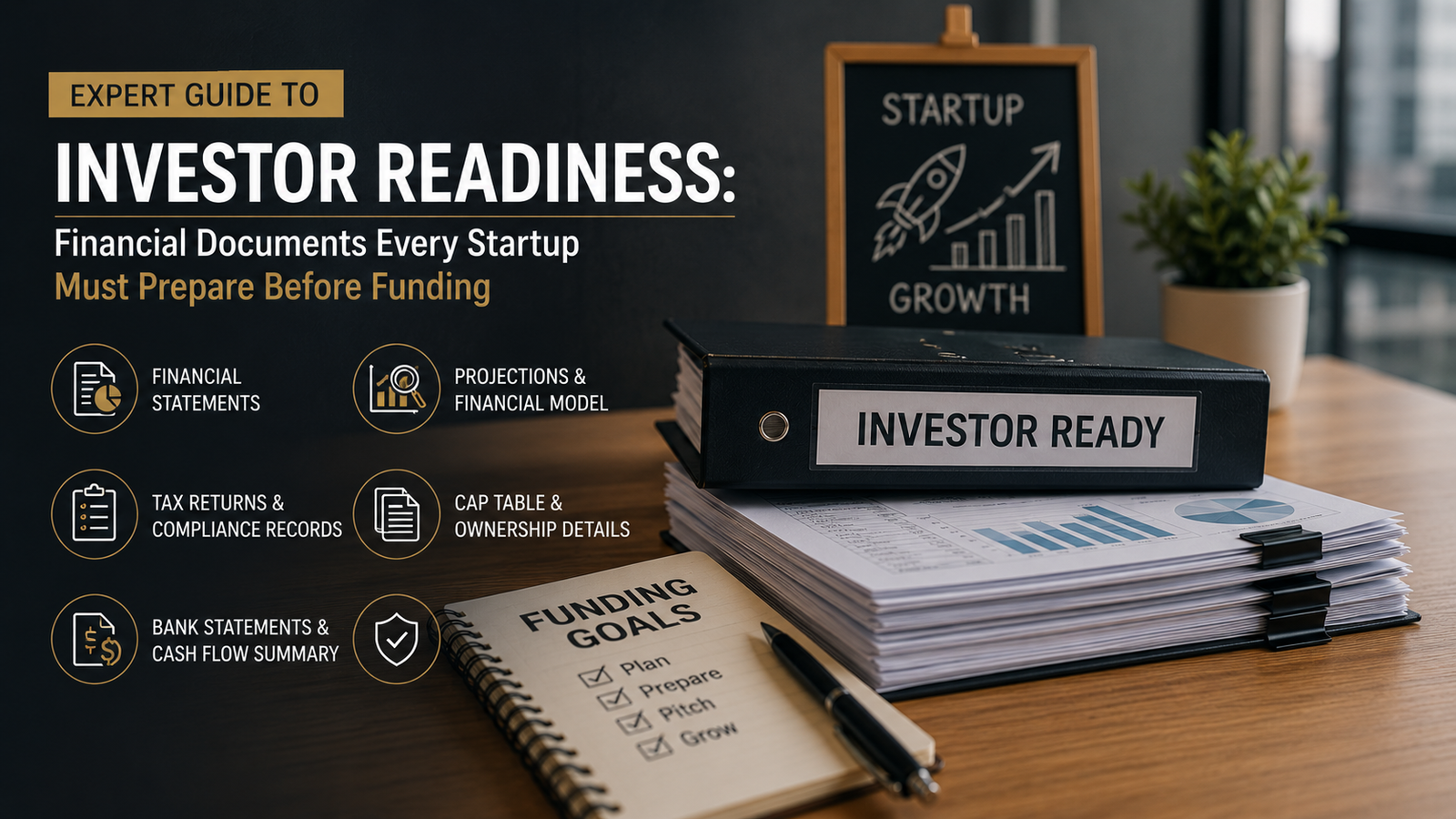
Before approaching investors, startups should prepare investor readiness financial documents such as financial statements, monthly MIS, bank statements, revenue breakdowns, expense reports, burn-rate calculations, financial projections, cap table, GST returns, income tax filings, debt schedules and a clean data room.
A strong pitch deck may start investor conversations, but clean financial documents help close them.
Why Investor Readiness Starts Before the Pitch Deck
Many founders spend weeks perfecting the pitch deck but ignore the financial back-end of the business. That creates problems later.
Once an investor shows interest, the next stage is due diligence. At this stage, investors verify whether the numbers, compliance records, ownership structure and business claims are reliable.
Investor due diligence in India commonly reviews areas such as legal structure, financials, IP, cap table, tax, HR, DPIIT status and commercial validation.
For startups, this means one thing clearly: fundraising readiness is not only a presentation exercise. It is a documentation exercise.
A startup with clean financial records gives investors confidence. A startup with missing GST returns, unclear revenue data, unreconciled bank accounts or a confusing cap table creates risk.
What Is Investor Readiness?
Investor readiness means a startup is financially, legally and operationally prepared for investor review.
An investor-ready startup can clearly show:
- How much revenue it earns
- Where revenue comes from
- How much cash it burns every month
- How long the current runway is
- Whether taxes and GST are compliant
- Who owns what percentage of the company
- Whether books match bank statements
- Whether projections are realistic
- Whether liabilities are properly disclosed
- Whether documents are organised in a data room
Investor readiness does not mean the startup must be profitable. Many funded startups are still loss-making. But the startup must be transparent, organised and financially explainable.
Financial Documents Investors Usually Review
1. Historical Financial Statements
Investors usually ask for historical financial statements to understand how the business has performed.
Prepare:
- Profit and loss statement
- Balance sheet
- Cash flow statement
- Notes to accounts, where available
- Trial balance
- Ledger summaries
- Auditor reports, where applicable
Due diligence checklists commonly include audited financial statements for the last 2–3 years, balance sheet, P&L, cash flow and notes to accounts.
For early-stage startups with limited operating history, founders should still prepare clean unaudited management accounts.
2. Monthly MIS and Management Accounts
Annual statements are not enough for investors. They also want to understand recent performance.
Prepare monthly MIS reports covering:
- Revenue
- Gross margin
- Net profit or loss
- Cash balance
- Burn rate
- Runway
- Customer acquisition cost
- Average revenue per customer
- Receivables
- Payables
- Budget vs actual performance
Monthly management accounts for the last 12–24 months are often requested because they show how founders actually monitor the business.
A strong MIS tells investors that the startup is not guessing. It is tracking performance.
3. Bank Statements and Reconciliations
Bank statements help investors verify revenue, expenses, funding inflows and cash position.
Prepare:
- Bank statements for all operating accounts
- Bank reconciliation statements
- Details of cash deposits, if any
- Founder contribution records
- Investment inflow records
- Loan receipts and repayments
- Major vendor payments
- Salary payments
Investors may ask for the last 12 months of bank statements for operating accounts.
If bank balances do not match books, investors may question the reliability of accounts.
4. Revenue Breakdown and Customer Data
Top-line revenue is not enough. Investors want to know the quality of revenue.
Prepare revenue breakdown by:
- Customer
- Product or service line
- Geography
- Channel
- Monthly cohort
- One-time vs recurring revenue
- B2B vs B2C revenue
- Existing vs new customers
A startup should also prepare:
- Top customer list
- Customer concentration risk
- Monthly recurring revenue, if applicable
- Churn rate, where applicable
- Sales pipeline
- Signed contracts or purchase orders
This helps investors understand whether revenue is repeatable, diversified and scalable.
5. Expense, Burn Rate and Runway Reports
For startups, profitability may not arrive immediately. That is why investors carefully review burn rate and runway.
Prepare:
- Monthly operating expenses
- Fixed vs variable costs
- Payroll cost
- Marketing spend
- Technology cost
- Rent and admin expenses
- Founder salary
- Consultant or contractor payments
- Monthly burn rate
- Runway calculation
- Cost reduction plan, if needed
Burn rate shows how much cash the startup spends every month. Runway shows how long the startup can operate before needing more capital.
A founder who knows burn rate and runway clearly earns more investor confidence.
6. Financial Projections and Business Model
Investors expect projections, but they do not expect fantasy numbers.
Prepare a financial model covering:
- Revenue projections
- Cost assumptions
- Gross margin
- Operating expenses
- Hiring plan
- Marketing spend
- Cash flow forecast
- Break-even point
- Funding requirement
- Use of funds
- Scenario analysis
A good model should include realistic assumptions. For example, instead of saying “we will grow 10x”, founders should explain what will drive growth: more sales team members, channel partners, marketing ROI, higher retention, product expansion or pricing improvement.
Financial projections for 3–5 years are commonly reviewed during fundraising due diligence.
7. Cap Table and Shareholding Records
A cap table shows who owns the company.
Prepare:
- Current shareholding pattern
- Founder shareholding
- ESOP pool, if any
- Past investment details
- Convertible instruments
- SAFE/CCD/CCPS details, if applicable
- Share transfer records
- Valuation history
- Dilution impact after proposed round
A messy cap table is a major red flag. Investors want clarity on ownership, rights and dilution.
The cap table should match MCA records, board approvals, shareholder agreements and investment documents.
8. Tax, GST and Compliance Documents
Tax and compliance records are a major part of investor readiness.
Prepare:
- Income tax returns
- GST registration certificate
- GSTR-1 filings
- GSTR-3B filings
- GSTR-2B reconciliation
- TDS returns
- TDS challans
- Form 26AS/AIS review
- Tax audit report, if applicable
- ROC filings
- AOC-4 and MGT-7/MGT-7A, where applicable
- Board resolutions
- Statutory registers
GST filings and income tax returns are commonly included in financial due diligence document lists.
If a startup is not compliant, investors may delay funding until issues are corrected.
9. Debt, Loans and Liabilities Schedule
Investors want to know what obligations already exist.
Prepare:
- Bank loans
- NBFC loans
- Founder loans
- Inter-corporate loans
- Credit lines
- Convertible notes
- Vendor dues
- Statutory dues
- Litigation or disputed liabilities
- Outstanding salaries or reimbursements
Debt schedules are commonly reviewed, including outstanding loans, founder loans, credit lines and convertible notes.
Hidden liabilities can damage investor trust.
10. Data Room Index
A data room is a structured folder containing all documents investors need during due diligence.
A clean data room saves time and reduces back-and-forth.
Recommended folder structure:
| Folder | Documents |
|---|---|
| Company | Incorporation certificate, MOA, AOA, PAN, TAN |
| Financials | P&L, balance sheet, cash flow, trial balance |
| Tax | ITR, GST, TDS, tax audit, notices |
| Cap Table | Shareholding, investment records, ESOP |
| Banking | Bank statements, reconciliations |
| Revenue | Customer contracts, invoices, sales reports |
| Legal | Agreements, licenses, disputes |
| HR | Employee contracts, payroll records |
| Funding | Pitch deck, financial model, use of funds |
| Compliance | ROC filings, board minutes, registers |
A complete data room demonstrates discipline and speeds up the funding process.
Investor-Ready Data Room Checklist
Before investor meetings, prepare:
- Pitch deck
- Financial model
- Historical financials
- Monthly MIS
- Bank statements
- Cap table
- GST returns
- Income tax returns
- TDS records
- ROC filings
- Customer contracts
- Vendor contracts
- Loan documents
- Founder agreements
- ESOP documents
- Board minutes
- DPIIT recognition, if applicable
- IP documents
- Payroll records
- Use-of-funds plan
Common Financial Red Flags That Delay Funding
Investors may slow down or pause a deal when they see:
- Unreconciled bank statements
- Mismatch between GST returns and books
- Missing tax filings
- Unclear founder loans
- No monthly MIS
- Inflated projections without assumptions
- High customer concentration
- Unclear cap table
- Poor expense classification
- Undisclosed liabilities
- Missing ROC filings
- Weak documentation of revenue contracts
A startup can fix many of these issues before fundraising with proper CA or Virtual CFO review.
How a CA or Virtual CFO Helps Startups Prepare
A CA or Virtual CFO helps founders convert messy records into investor-ready documentation.
Support may include:
- Financial statement preparation
- Monthly MIS reporting
- GST and TDS review
- Bank reconciliation
- Cap table review support
- Due-diligence file preparation
- Financial model review
- Burn-rate and runway analysis
- Compliance health check
- Investor reporting pack
- Funding documentation support
For Chandigarh startups, CA Rohit Jain can support investor readiness through startup/MSME consultancy, Virtual CFO services, accounting, GST, taxation, audit and corporate finance advisory.
Internal Linking Suggestions
Use these internal links naturally:
- Virtual CFO services in Chandigarh → Virtual CFO Services page
- Startup and MSME consultancy → Startup/MSME Consultancy page
- CA in Chandigarh → Homepage
- Accounting and bookkeeping services → Accounting page
- Corporate finance services → Corporate Finance page
- GST compliance services → GST page
- Audit and assurance services → Audit page
- Income tax consultancy → Income Tax page
Conclusion
Investor readiness is not created during the final week before a funding call. It is built through clean books, reliable MIS, compliant tax records, a clear cap table, realistic projections and an organised data room.
Startups that prepare financial documents early reduce due-diligence delays, build investor confidence and improve negotiation strength.
A strong pitch gets attention. Strong financial documentation builds trust.
CTA:
If your startup is preparing for angel, seed or Series A funding, CA Rohit Jain can help build investor-ready financial documents, MIS reports, compliance records, financial models and Virtual CFO support for a smoother fundraising process.
6. FAQ SECTION
1. What financial documents do investors ask for?
Investors commonly ask for financial statements, monthly MIS, bank statements, revenue breakdowns, expense reports, burn-rate calculations, financial projections, cap table, tax filings, GST returns and debt schedules.
2. What is investor readiness for startups?
Investor readiness means a startup is financially, legally and operationally prepared for investor review. It includes clean accounts, compliance records, cap table clarity, financial projections and an organised data room.
3. What is financial due diligence for startups?
Financial due diligence is the investor’s review of a startup’s financial records, revenue, expenses, cash flow, tax filings, liabilities, projections and compliance status before funding.
4. What should be included in a startup data room?
A startup data room should include incorporation documents, financial statements, tax records, GST filings, cap table, bank statements, contracts, legal documents, HR records, funding documents and compliance files.
5. Do startups need audited financial statements before funding?
Audited financial statements are useful and may be requested, especially for later funding rounds. Early-stage startups should at least maintain clean management accounts and properly reconciled financial records.
6. Why is a cap table important for investors?
A cap table shows ownership, dilution, past funding, ESOP pool and investor rights. Investors use it to understand control, founder stake and post-funding shareholding.
7. How can a Virtual CFO help with fundraising?
A Virtual CFO helps prepare MIS reports, financial models, burn-rate analysis, runway calculations, investor reporting packs, compliance records and due-diligence documents.