
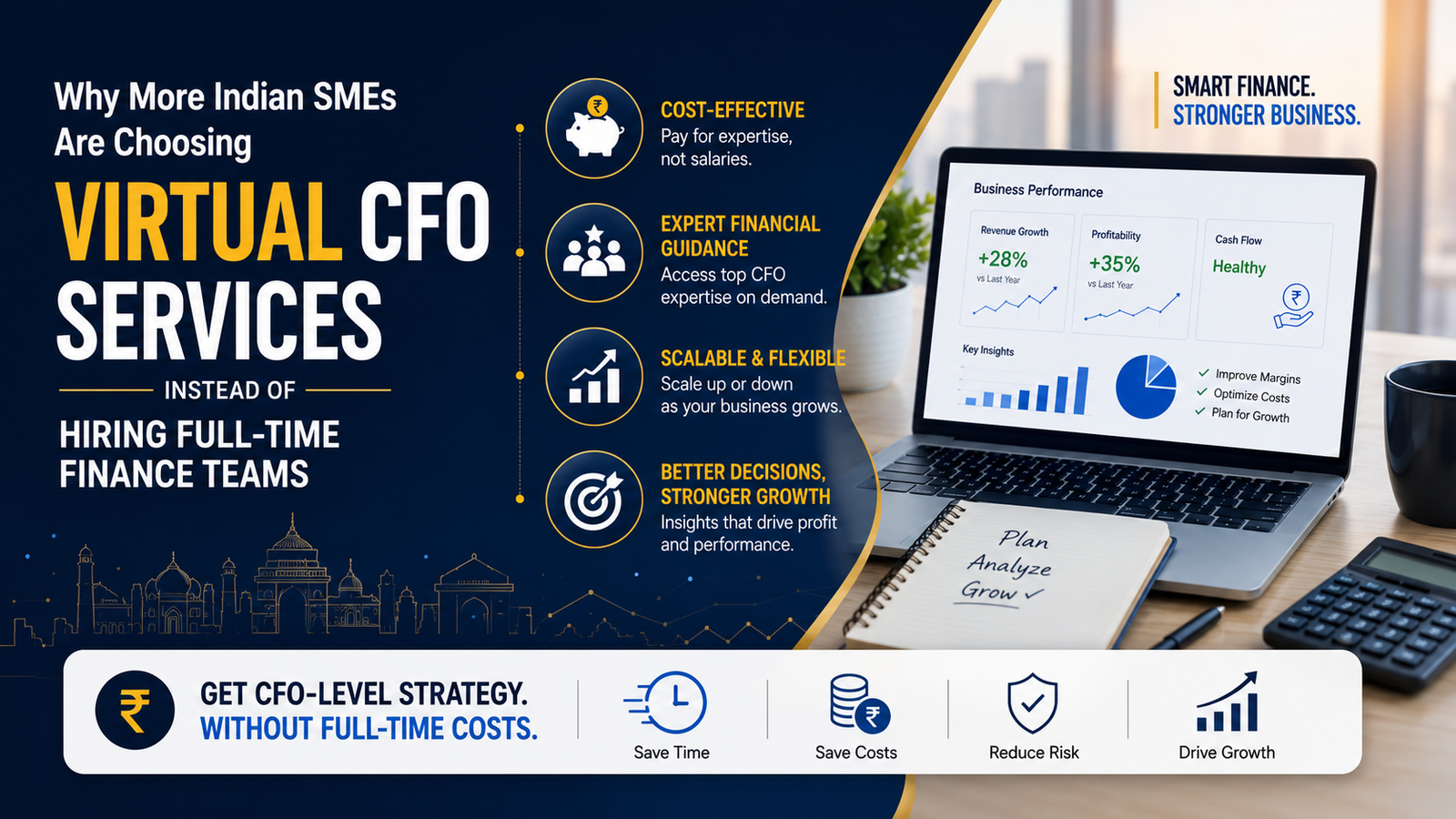
TL;DR
Why SMEs Are Moving Towards Virtual CFO Services
Many Indian small and medium-sized enterprises have outgrown basic bookkeeping but are not yet ready to bear the cost and complexity of building a complete in-house finance department.
Virtual CFO services address this gap by giving SMEs access to experienced financial leadership on a flexible or part-time basis.
A Virtual CFO can help a business with:
- Cash-flow planning

- Budgeting and forecasting
- Management information systems
- Profitability analysis
- Working-capital management
- Financial controls
- Lender and investor reporting
- Tax and compliance coordination
- Strategic financial decision-making
The model can be particularly valuable for growing businesses that need better financial visibility but do not require a senior finance executive at the office every day.
However, a Virtual CFO is not simply a remote accountant. Bookkeeping records transactions. A Virtual CFO interprets those records and helps management decide what to do next.
What Are Virtual CFO Services?
Virtual CFO services provide businesses with access to Chief Financial Officer-level guidance without requiring them to appoint a full-time CFO or immediately build a large internal finance department.
The word “virtual” does not mean that the service is entirely automated or handled only through software. It usually means that the financial expert works with the business on an outsourced, part-time or hybrid basis.
Depending on the scope, a Virtual CFO may work with:
- The business owner
- Internal accountants
- Bookkeepers
- Tax consultants
- Department heads
- Bankers
- Investors
- Auditors
- Legal and compliance professionals
The Virtual CFO examines the financial information generated by these functions and converts it into management insight.
For example, instead of merely reporting that receivables have increased, the Virtual CFO may identify:
- Which customers are delaying payments
- How the delay is affecting working capital
- Which invoices need immediate follow-up
- Whether credit terms should be revised
- How much cash may be available over the next 13 weeks
This strategic interpretation separates CFO support from routine accounting.
Why Financial Management Becomes More Complex as SMEs Grow
A small business may initially operate with basic accounting software, one accountant and direct involvement from the owner.
That structure may work when:
- The transaction volume is low
- The business has a small customer base
- Payments are predictable
- The owner approves every expense
- Inventory is limited
- There are few employees or branches
Growth changes the financial environment.
As an SME expands, it may need to manage:
- More customers and vendors
- Multiple bank accounts
- Employee reimbursements
- Inventory across locations
- Longer customer credit periods
- Business loans and repayment schedules
- GST and TDS obligations
- Department-level budgets
- New branches
- Capital expenditure
- Investor or lender reporting
- Product-wise profitability
- Working-capital pressure
India’s MSME sector contributes approximately 30% of the country’s GDP and more than 45% of exports, making better financial management within the sector economically significant.
The Economic Survey 2025–26 also described MSMEs as a backbone of India’s industrial economy. As these businesses become more formal and growth-oriented, their financial requirements extend beyond filing returns and maintaining ledgers.
The problem is that many SMEs reach this stage before they can justify a complete senior finance team.
Virtual CFO vs Accountant vs Full-Time Finance Team
These three functions are related, but they are not interchangeable.
| Financial role | Primary responsibility |
|---|---|
| Accountant or bookkeeper | Records transactions and maintains books |
| Tax or compliance professional | Handles returns, filings and regulatory requirements |
| Virtual CFO | Interprets financial data and advises management |
| Full-time CFO | Leads finance strategy as an internal senior executive |
| In-house finance team | Manages daily accounting, reporting, treasury and controls |
An SME may still need an accountant after hiring a Virtual CFO. In many cases, the Virtual CFO works with the existing accountant instead of replacing that person.
The key difference lies in the questions each role answers.
An accountant may explain:
- What was recorded?
- What amount is payable?
- Which return must be filed?
- Which invoice remains outstanding?
A Virtual CFO should also help answer:
- Why has the gross margin declined?
- Can the business afford a new branch?
- How much working capital will be required?
- Which products or customers generate the strongest contribution?
- Will the company face a cash shortage in three months?
- What financial information will a lender or investor require?
Why Indian SMEs Are Choosing Virtual CFO Services
1. Lower Fixed Employment Costs
Building a complete internal finance function involves more than one salary.
A business may need to account for:
- Recruitment costs
- Senior finance salaries
- Employee benefits
- Payroll taxes
- Office infrastructure
- Finance software
- Training
- Supervision
- Replacement costs
- Additional accounting and reporting staff
A Virtual CFO model allows the business to purchase an agreed level of financial expertise based on its current requirements.
The engagement may be structured around:
- A fixed monthly retainer
- Defined deliverables
- A specified number of review meetings
- A temporary growth or restructuring project
- Fundraising preparation
- Cash-flow intervention
- Periodic financial oversight
The precise fee varies significantly according to transaction volume, business complexity, locations, reporting needs and the provider’s involvement. The relevant comparison should therefore be based on the scope and outcomes, not merely the monthly fee.
2. Access to Senior Financial Expertise
Many SMEs can hire a junior accountant but cannot immediately justify a senior professional experienced in:
- Financial planning
- Working-capital management
- Business modelling
- Banking negotiations
- Internal controls
- Cost analysis
- Board reporting
- Fundraising
- Expansion planning
Virtual CFO services allow the business to access this expertise without waiting until it is large enough to create a full-time executive position.
Industry providers consistently position outsourced CFO support as a practical middle ground for businesses that need strategic financial leadership without the fixed cost of a full-time CFO.
3. Better Cash-Flow Management
A profitable business can still face a cash crisis.
Profit is an accounting result. Cash flow reflects whether the organisation has enough money available to pay employees, suppliers, lenders, taxes and operating expenses.
An SME may report profits while experiencing weak cash flow because:
- Customers pay late
- Inventory moves slowly
- Loan repayments are high
- Advance payments to suppliers increase
- Capital expenditure absorbs cash
- Tax liabilities were not planned
- Owner withdrawals are excessive
- Sales growth requires more working capital
A Virtual CFO can prepare rolling cash-flow forecasts and help management anticipate shortages before they become urgent.
A practical cash-flow framework may include:
- Opening bank balance
- Expected customer collections
- Payroll
- Vendor payments
- Loan instalments
- Tax payments
- Capital expenditure
- Minimum cash requirement
- Projected closing balance
This gives the owner time to accelerate collections, defer non-essential spending, negotiate vendor terms or arrange funding.
4. Reliable MIS and Performance Reporting
Many SMEs have accounting records but lack useful management reports.
A profit-and-loss statement prepared after several weeks may satisfy a reporting requirement but offer limited decision-making value.
A Virtual CFO can establish a management information system that tracks relevant indicators such as:
- Monthly revenue
- Gross margin
- Contribution margin
- Operating profit
- Department-wise expenditure
- Customer concentration
- Receivable ageing
- Inventory holding
- Payable cycle
- Cash conversion cycle
- Budget versus actual performance
- Product or branch profitability
The objective is not to create more reports. It is to give decision-makers the right information at the right frequency.
5. Budgeting and Financial Forecasting
Many owner-managed businesses make financial decisions using bank balances, sales expectations or intuition.
These inputs matter, but they do not replace a structured financial forecast.
A Virtual CFO can connect operational assumptions with financial consequences.
For example:
- How many additional employees can the business afford?
- What sales volume is required to support a new branch?
- What happens if customer collections are delayed by 30 days?
- How will a 5% raw-material increase affect margins?
- How much funding is needed for expansion?
- When will the company break even on new machinery?
Forecasts cannot predict every outcome perfectly. Their value lies in showing the likely financial effect of different decisions before money is committed.
6. Improved Lender and Investor Readiness
Banks and investors usually require more than a turnover figure.
They may examine:
- Historical financial statements
- Cash-flow projections
- Debt obligations
- Receivable ageing
- Customer concentration
- Profitability trends
- Tax compliance
- Business assumptions
- Promoter contribution
- Use of funds
- Repayment capacity
A Virtual CFO can help ensure that financial information is consistent, explainable and supported by records.
This does not guarantee funding. It improves the quality of the financial case presented to a lender or investor.
Startups and high-growth SMEs are among the business categories commonly identified as suitable for Virtual CFO support, particularly where fundraising, reporting and financial discipline are becoming more important.
7. Scalable Support During Growth
The financial needs of an SME change over time.
At one stage, it may only require:
- Monthly MIS
- Cash-flow review
- Budget monitoring
Later, it may need:
- Branch-level profitability
- Fundraising models
- Lender reporting
- Internal-control design
- Acquisition support
- Senior management dashboards
A Virtual CFO engagement can often expand or reduce according to the business stage.
This flexibility is useful for companies experiencing:
- Seasonal demand
- Rapid growth
- Temporary cash-flow stress
- New funding
- Business restructuring
- Geographic expansion
- A change in ownership
- Transition between finance leaders
8. Stronger Financial Controls
Growing businesses often remain dependent on informal approvals and owner supervision.
This can create weaknesses such as:
- One person creating and approving a payment
- Unrestricted accounting-system access
- Incomplete vendor verification
- Missing expense documents
- Unrecorded inventory losses
- Duplicate payments
- Weak customer-credit controls
- Delayed reconciliations
A Virtual CFO can help define:
- Approval limits
- Segregation of duties
- Payment workflows
- Bank-reconciliation responsibilities
- Vendor onboarding
- Expense policies
- Credit-control procedures
- Monthly closing processes
- Financial review calendars
Controls should match the size and risk of the organisation. An SME does not need a complicated corporate bureaucracy, but it does need sufficient checks to protect cash and financial information.
What Does a Virtual CFO Actually Do?
The scope should be agreed in writing because different providers use the term differently.
A practical Virtual CFO engagement may cover the following areas.
Financial Planning and Analysis
- Annual budgets
- Rolling forecasts
- Scenario modelling
- Break-even analysis
- Department budgets
- Expansion feasibility
Cash and Working-Capital Management
- Cash-flow forecasting
- Receivable monitoring
- Inventory analysis
- Vendor-payment planning
- Working-capital review
- Debt repayment planning
Management Reporting
- Monthly MIS
- KPI dashboards
- Budget variance analysis
- Profitability reports
- Branch or product analysis
- Management review meetings
Financial Controls
- Approval processes
- Monthly closure calendar
- Reconciliation framework
- Expense controls
- Access controls
- Finance-team responsibilities
Strategic Support
- Pricing analysis
- Business-model review
- Funding requirements
- Capital-allocation decisions
- Lender presentations
- Investor reporting
Compliance Coordination
A Virtual CFO may also coordinate with accountants and tax professionals to ensure that financial records support:
- GST compliance
- TDS compliance
- Income-tax filings
- Statutory reporting
- Loan covenants
- Financial reviews
However, the exact regulatory work should be handled by appropriately qualified professionals and clearly defined in the engagement.
Practical Example: SME Finance Before and After Virtual CFO Support
Consider a hypothetical Chandigarh-based distributor with annual revenue of ₹12 crore.
The business is growing, but management faces the following problems:
- Customer collections take 70–90 days.
- Inventory purchases are based on sales expectations rather than reorder analysis.
- Monthly accounts are finalised after six weeks.
- The owner approves almost every payment.
- Bank limits are frequently utilised.
- Product-wise profitability is unclear.
- Tax payments create unexpected cash pressure.
A Virtual CFO could introduce:
- A 13-week cash-flow forecast
- Weekly receivable follow-up reports
- Customer credit limits
- Inventory ageing analysis
- A monthly closing calendar
- Product-wise margin reports
- Payment approval levels
- Advance-tax and GST cash planning
- Monthly management-review meetings
After implementation, the business may not instantly become more profitable. However, the owner gains earlier visibility into cash shortages, slow inventory, overdue customers and low-margin products.
That visibility creates the opportunity to make better decisions.
Virtual CFO Services vs Full-Time Finance Team
| Evaluation factor | Virtual CFO model | Full-time finance team |
|---|---|---|
| Cost structure | Flexible or contracted | Fixed employment cost |
| Senior expertise | Available for defined scope | Available continuously |
| Daily physical presence | Usually limited | Generally available |
| Scalability | Scope can be adjusted | Hiring or restructuring required |
| Recruitment burden | Lower | Higher |
| Business knowledge | Builds over time | Deep day-to-day involvement |
| Independence | Greater external perspective | Embedded internal perspective |
| Transaction processing | Usually handled by internal team | Can be handled internally |
| Suitability | Growing SME with strategic finance needs | Larger or financially complex organisation |
| Best use case | Part-time financial leadership | Continuous executive finance management |
A Virtual CFO is not automatically better than a full-time team. It is better suited to a particular business stage.
When Does an SME Need a Virtual CFO?
A business should consider Virtual CFO support when several of the following signs appear:
- Revenue is growing but cash remains tight.
- Monthly financial statements arrive too late.
- The owner cannot explain changes in profit margins.
- Customer receivables are increasing.
- Inventory is growing faster than sales.
- The business is applying for a significant loan.
- Investors are requesting financial models.
- Different reports show inconsistent numbers.
- Compliance deadlines frequently create emergencies.
- Expansion decisions are being made without forecasts.
- The company has an accountant but lacks financial strategy.
- Department heads are not accountable for budgets.
- The owner spends excessive time supervising finance tasks.
The appropriate time is generally before a financial crisis, not after it.
When Is a Full-Time Finance Team the Better Choice?
A full-time CFO or larger internal finance department may be more suitable when the organisation has:
- High daily transaction complexity
- Multiple entities or international operations
- Significant treasury responsibilities
- Continuous fundraising or investor reporting
- Large internal teams
- Complex manufacturing or inventory operations
- Frequent mergers or acquisitions
- Strong regulatory requirements
- A need for daily executive-level finance leadership
Some businesses use a hybrid structure: an internal accounting team manages daily transactions while a Virtual CFO provides strategic oversight. As the company grows, the role may later transition into a full-time appointment.
How to Select the Right Virtual CFO Service Provider
1. Define the Problem First
Avoid starting with a vague request for “financial guidance.”
Identify whether the immediate requirement is:
- Cash-flow management
- Monthly MIS
- Profitability analysis
- Budgeting
- Fundraising
- Cost reduction
- Internal controls
- Finance-team restructuring
2. Evaluate Relevant Experience
Ask whether the provider has worked with businesses of a similar:
- Size
- Industry
- Transaction volume
- Ownership structure
- Growth stage
- Reporting complexity
3. Confirm Deliverables
A proposal should state:
- Reports to be prepared
- Review frequency
- Meeting schedule
- Responsibilities
- Required data
- Implementation timeline
- Exclusions
- Fees
- Confidentiality obligations
4. Assess Communication Quality
The provider should explain financial information in language that the management team can understand.
A technically correct report has limited value when decision-makers cannot interpret it.
5. Review Data Security
The business should evaluate:
- Who can access its information
- How documents are shared
- Whether access is role-based
- Where data is stored
- How passwords are managed
- What happens when the engagement ends
6. Avoid Unrealistic Guarantees
A responsible Virtual CFO should not guarantee:
- Funding approval
- A fixed profit increase
- Complete elimination of taxes
- Instant cash-flow improvement
- Error-free forecasts
The provider can strengthen decisions and financial systems. Commercial outcomes still depend on execution, customers, market conditions and management choices.
A Six-Step Virtual CFO Onboarding Process
Step 1: Financial Diagnostic
Review current books, reports, cash flow, working capital, loans, tax processes and controls.
Step 2: Data Reconciliation
Correct material inconsistencies in bank balances, customer accounts, vendor accounts, inventory and statutory records.
Step 3: Priority Setting
Agree on the first three to five financial problems to address.
Step 4: Reporting Framework
Create the monthly MIS, KPI dashboard, cash-flow forecast and review schedule.
Step 5: Control Implementation
Introduce approval limits, reconciliation responsibilities and financial closing procedures.
Step 6: Monthly Strategic Review
Compare actual performance with the budget and decide corrective actions.
The Virtual CFO model works best when management provides timely information and acts on agreed recommendations.
Common Misconceptions About Virtual CFO Services
“A Virtual CFO Will Replace Our Accountant”
Usually, no. The Virtual CFO relies on accurate bookkeeping and may guide or review the internal accounting team.
“Only Startups Need a Virtual CFO”
Established family businesses, distributors, manufacturers and professional-service firms can also benefit when financial complexity increases.
“Virtual Means the CFO Will Never Understand Our Business”
A strong provider should conduct regular management discussions, understand the operating model and review non-financial drivers such as sales volume, capacity and customer behaviour.
“The Service Is Only About Cost Cutting”
Cost control is one component. The broader purpose is to improve planning, financial visibility, decision-making and business resilience.
“Software Can Perform the Same Role”
Software can process and present data. It cannot independently resolve every commercial trade-off or accept responsibility for management decisions.
How CA Rohit Jain Can Support SMEs in Chandigarh
CA Rohit Jain is a chartered accountancy firm in Chandigarh offering taxation, auditing, GST, income-tax filing, compliance, strategic tax planning and business-management consulting services.
For SMEs that have outgrown basic accounting, a structured financial-advisory engagement can help management:
- Assess the current finance function
- Improve the quality of accounting data
- Prepare useful monthly MIS reports
- Monitor cash flow and working capital
- Establish budgets and forecasts
- Review business profitability
- Strengthen financial controls
- Coordinate tax and compliance planning
- Prepare financial information for lenders
- Develop a scalable finance roadmap
The scope should reflect the company’s size, complexity and existing internal team rather than applying the same package to every business.
Conclusion
Indian SMEs are not choosing Virtual CFO services merely because they want a less expensive accountant.
They are choosing the model because they need access to strategic financial thinking before they are ready to build a complete senior finance department.
A well-structured Virtual CFO engagement can help an SME answer essential questions:
- Where is the cash going?
- Which customers and products are profitable?
- Can the business afford its growth plan?
- How much funding will it require?
- Which financial risks need immediate attention?
- Are management decisions supported by reliable information?
Virtual CFO services are most effective when supported by accurate books, timely data, clear deliverables and active participation from management.
Growing businesses in Chandigarh can approach CA Rohit Jain for a review of their accounting, cash-flow, reporting and financial-management processes. The objective should be to build a finance function that is disciplined enough for today and scalable enough for the next stage of growth.
FAQ Section
1. What are Virtual CFO services?
Virtual CFO services provide part-time or outsourced senior financial leadership to a business. A Virtual CFO supports budgeting, cash-flow planning, management reporting, profitability analysis, financial controls and strategic decisions without necessarily joining the company as a full-time employee.
2. How is a Virtual CFO different from an accountant?
An accountant primarily records transactions, maintains ledgers and prepares financial information. A Virtual CFO interprets that information and helps management make decisions about cash flow, profitability, funding, budgets and business growth.
3. Why are Indian SMEs hiring Virtual CFOs?
Indian SMEs often need more advanced financial guidance as they grow but may not yet require a full-time CFO or a large finance department. Virtual CFO services provide flexible access to senior expertise while avoiding many fixed employment and recruitment costs.
4. Are Virtual CFO services cheaper than hiring a full-time CFO?
They can be more cost-efficient for SMEs because the business pays for a defined scope and level of involvement rather than a permanent senior position. However, the actual cost depends on transaction volume, complexity, locations, reporting requirements and the provider’s responsibilities.
5. What does a Virtual CFO do for a small business?
A Virtual CFO may prepare budgets, cash-flow forecasts, monthly MIS reports, profitability analysis and lender information. The role may also include working-capital management, internal-control design, finance-team supervision and strategic financial planning.
6. When should an SME hire a Virtual CFO?
An SME should consider Virtual CFO support when revenue is growing but cash remains tight, financial reports are delayed, margins are unclear, receivables are increasing or the business is preparing for loans, investors or expansion.
7. Can a Virtual CFO help a business obtain funding?
A Virtual CFO can improve funding readiness by preparing forecasts, financial models, management reports and supporting records. The service cannot guarantee loan or investment approval because the final decision remains with the lender or investor.
8. Does a Virtual CFO replace an internal finance team?
Not necessarily. Many businesses use a hybrid model in which internal accountants manage daily transactions while the Virtual CFO provides strategic oversight, reporting frameworks and management guidance.