
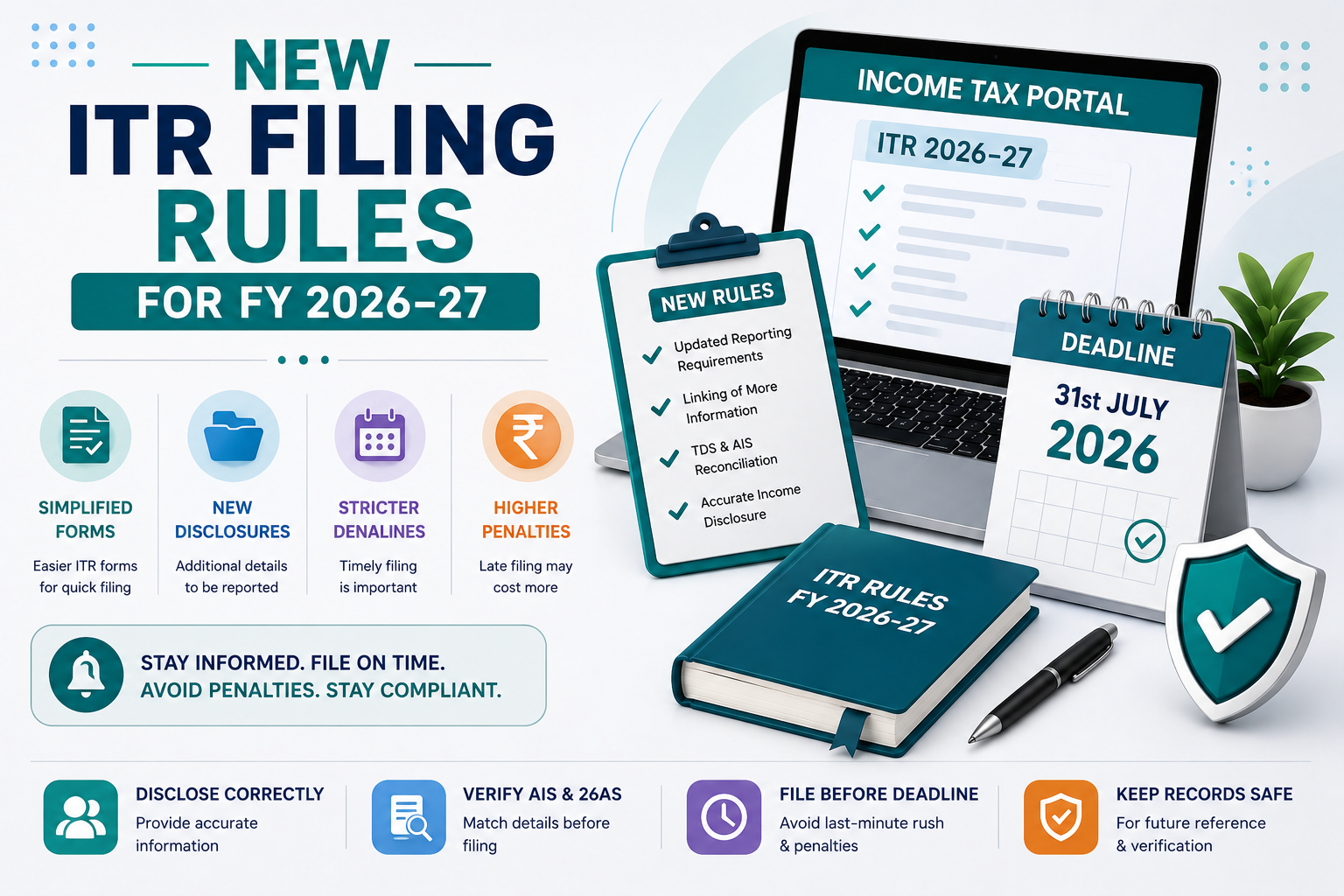
TL;DR
Income earned between 1 April 2026 and 31 March 2027 is governed by the Income-tax Act, 2025.
This period is officially referred to as Tax Year 2026–27 under the new framework. The return for this income will generally be filed in 2027 using new ITR forms prescribed under the Income-tax Rules, 2026.
The most important points taxpayers should know are:
- The Income-tax Act, 2025 applies from 1 April 2026.
- “Previous year” and “assessment year” are replaced by the simpler “tax year” concept for current income.
- Taxpayers must use new section references for income, deductions and TDS.
- Final ITR forms for Tax Year 2026–27 must be checked once officially notified.
- Non-audit business taxpayers may receive a different filing deadline from ITR-1 and ITR-2 taxpayers.
- Revised returns have a longer correction window under the new framework.
- Updated returns remain available subject to restrictions and additional tax.
- AIS, TIS, Form 26AS, bank interest and capital-gains data must be reconciled before filing.
First, Understand the FY, AY and Tax Year Difference
Taxpayers often confuse FY 2026–27 with AY 2026–27. They are not the same.
| Term | Income Period | Filing Period |
|---|---|---|
| AY 2026–27 | Income earned in FY 2025–26 | Return filed during 2026 |
| Tax Year 2026–27 | Income earned from 1 April 2026 to 31 March 2027 | Return generally filed during 2027 |
The return currently being filed in 2026 relates to income earned up to 31 March 2026 and remains governed by the Income-tax Act, 1961.
Income earned from 1 April 2026 onwards falls under the Income-tax Act, 2025.
This distinction is important because the applicable Act, section references, forms and filing framework are different.
The Income-tax Act, 2025 Now Governs Current Income
The Income-tax Act, 2025 came into effect on 1 April 2026.
One of its main objectives is to simplify the structure and language of Indian income-tax law. Instead of using separate terms such as “previous year” and “assessment year” for current income, the new Act uses the term “tax year”.
For taxpayers, the transition means:
- New section numbers
- New ITR forms
- New rule references
- Revised payroll and TDS mapping
- Updated tax-software configurations
- Concurrent operation of old and new compliance systems
The old Act has not disappeared completely. Returns, revisions, notices and assessments relating to income earned before 1 April 2026 continue under the Income-tax Act, 1961.
What Has Changed for Taxpayers in FY 2026–27?
1. New Act and New Section Numbers
Taxpayers will notice that familiar provisions now appear under different section numbers.
For example, deductions historically associated with Chapter VI-A or familiar sections such as Section 80C may be referenced through different sections and schedules under the Income-tax Act, 2025.
This does not automatically mean every deduction has disappeared. It means taxpayers, employers, payroll teams and tax professionals must use the correct new-Act references.
Tax-saving declarations submitted to employers for salary earned from April 2026 should therefore follow the new legal framework.
2. New ITR Forms Will Apply
Income earned during Tax Year 2026–27 will be reported through ITR forms prescribed under the Income-tax Rules, 2026.
The familiar ITR categories may continue in a revised format, but taxpayers should not assume that the disclosures, schedules or eligibility conditions will remain identical.
The final form should be selected only after checking:
- Residential status
- Salary or pension income
- Number of house properties
- Capital gains
- Business or professional income
- Presumptive income
- Foreign assets or foreign income
- Directorship or unlisted shares
- Agricultural income
- Income taxable at special rates
Taxpayers should avoid preparing their return using last year’s assumptions.
3. Filing Deadlines May Differ by Category
One important policy direction for Tax Year 2026–27 is the separation of due dates for different non-audit taxpayers.
Individuals eligible to use simpler individual-return forms, such as ITR-1 or ITR-2, are expected to continue with the standard July timeline.
Non-audit business taxpayers may receive an August deadline under the new framework. This could provide additional time to finalise business accounts without delaying simple individual returns.
However, the exact deadline applicable to a taxpayer should be verified when the government publishes the relevant return forms, rules and filing calendar for 2027.
Do not assume that every non-audit taxpayer has the same due date.
4. Longer Window for Revised Returns
A revised return allows a taxpayer to correct an omission or incorrect statement in an original or belated return.
The new framework extends the revised-return timeline from nine months to twelve months from the end of the relevant tax year.
This can give taxpayers additional time to correct errors, particularly where a belated return is filed close to the end of the original correction window.
A fee may apply when a revised return is filed beyond the earlier nine-month period. Taxpayers should therefore correct known errors as soon as possible rather than treating the extended window as the normal filing timeline.
5. Updated-Return Framework Continues
An updated return provides an additional opportunity to disclose omitted income after the normal original, belated or revised-return windows have closed.
Under the new framework, an updated return may generally be available within the prescribed extended period, subject to conditions.
An updated return cannot ordinarily be used simply to:
- Reduce tax liability
- Increase a refund
- Create an artificial loss
- Claim a benefit after withholding income earlier
Additional tax increases depending on how late the updated return is filed.
The framework also allows certain updated-return corrections involving a reduction in an earlier reported loss. Special rules may apply where reassessment proceedings have begun.
An updated return is therefore a voluntary-compliance mechanism, not a low-cost replacement for accurate filing.
6. TDS Reporting Moves to the New Act
Salary and other income arising from April 2026 are governed by the new Act’s TDS provisions.
Employers and deductors must update:
- Payroll calculations
- Investment declarations
- Deduction references
- TDS certificates
- Accounting software
- Return-mapping systems
Employees should check whether their employer has correctly considered:
- Chosen tax regime
- Eligible deductions
- Previous-employer income
- Other declared income
- Tax already deducted
- Perquisites and allowances
A mismatch at payroll stage can result in excess tax, short deduction or a year-end self-assessment-tax liability.
What Has Not Changed Significantly?
The new Act simplifies and reorganises the law, but it does not mean that the entire tax system has been replaced.
Several practical principles continue:
- Taxpayers must report income from all sources.
- TDS credit must match Form 26AS and AIS.
- Capital gains require transaction-level reporting.
- Business income must agree with books and applicable indirect-tax records.
- Foreign assets and overseas income require accurate disclosure.
- Late filing can affect loss carry-forward and other benefits.
- Returns must be verified after submission.
- Incorrect or incomplete returns can be treated as defective.
Taxpayers should focus on substance rather than assuming that simplified language means reduced reporting responsibility.
Income Tax Rates for FY 2026–27
The principal individual tax rates for Tax Year 2026–27 remain aligned with the rates already enacted under the new framework.
Taxpayers should calculate liability after considering:
- Applicable tax regime
- Normal slab income
- Special-rate income
- Rebate eligibility
- Surcharge
- Health and Education Cess
- TDS and TCS credits
- Advance tax
- Relief, where applicable
Tax rates alone do not determine the final liability.
Capital gains, lottery or gaming income, virtual digital assets and certain other categories may be taxed under special provisions. A taxpayer with multiple income types should not rely solely on a basic slab calculator.
Documents Taxpayers Should Maintain
Do not wait until the 2027 filing season to collect records.
Salaried Taxpayers
- Salary slips
- Form 16
- Previous-employer salary details
- Investment declarations
- Rent and HRA documents
- Home-loan certificate
- Deduction proofs
- Bank-interest statements
Business Owners and Professionals
- Books of accounts
- Sales and purchase records
- Expense invoices
- Bank statements
- GST returns
- TDS records
- Receivable and payable ledgers
- Fixed-asset register
- Loan statements
- Advance-tax challans
Investors
- Broker capital-gains statement
- Mutual-fund transaction report
- Dividend statement
- Demat statement
- Securities transaction details
- Virtual digital asset records
- Foreign investment records
Property Owners
- Rent agreement
- Rent received
- Municipal tax receipts
- Home-loan interest certificate
- Purchase and sale documents
- Improvement-cost evidence
- TDS records for property transactions
NRIs and Taxpayers with Foreign Connections
- Foreign bank statements
- Foreign tax documents
- Tax Residency Certificate
- Overseas income records
- Foreign asset details
- Double-taxation relief documents
- Remittance records
Step-by-Step ITR Preparation Framework
Step 1: Identify the Correct Tax Period
Confirm that the return relates to income earned from 1 April 2026 to 31 March 2027.
Do not confuse it with AY 2026–27.
Step 2: Classify Every Income Source
Prepare a list covering:
- Salary
- House property
- Business or profession
- Capital gains
- Interest
- Dividends
- Family pension
- Foreign income
- Virtual digital assets
- Other income
Step 3: Reconcile Information Statements
Compare your own records with:
- AIS
- TIS
- Form 26AS
- Form 16
- Form 16A
- Broker reports
- Bank certificates
- GST turnover, where applicable
Do not copy AIS blindly. Investigate duplicates, incorrect information or timing differences.
Step 4: Review the Tax Regime
Compare the available regimes based on actual income and eligible deductions.
The lower-looking slab structure is not automatically the better option for every taxpayer.
Step 5: Calculate Special-Rate Income Separately
Capital gains and other specially taxed income require separate calculation.
Ensure that:
- Holding period is correct
- Purchase cost is supported
- Improvement cost is documented
- Exemptions are eligible
- Loss set-off is correctly applied
Step 6: Reconcile Tax Credits
Verify:
- Salary TDS
- Non-salary TDS
- TCS
- Advance tax
- Self-assessment tax
- Foreign tax credit, where applicable
Resolve missing TDS with the deductor before filing wherever possible.
Step 7: Select the Final Notified ITR Form
Use only the form notified for Tax Year 2026–27 and confirm eligibility before submission.
Step 8: Review and Verify the Return
Check:
- Bank account
- Contact details
- Residential status
- Income schedules
- Deductions
- Tax credits
- Refund claim
- Foreign disclosures
- Loss carry-forward
- Verification status
A return is not complete until it is successfully verified.
Common Filing Mistakes to Avoid
Using the Wrong Tax Year
Selecting an incorrect year can result in an invalid or misplaced filing.
Choosing the Wrong ITR Form
A simpler form should not be used when the taxpayer has capital gains, business income, foreign assets or another disqualifying condition.
Ignoring AIS Differences
Unexplained differences may lead to automated communication or later verification.
Missing Interest Income
Savings-account, fixed-deposit, recurring-deposit and bond interest may be taxable even when TDS has not been deducted.
Claiming TDS Without Related Income
Tax credit and related income should generally be reported consistently.
Reporting Net Business Turnover Incorrectly
Business turnover should reconcile with books, bank records and GST information where applicable.
Treating Updated Returns as a Routine Correction Tool
Updated returns can involve substantial additional tax. Original and revised returns should be used accurately and on time.
Forgetting Return Verification
An unverified return may be treated as not filed.
Conclusion
The biggest change for FY 2026–27 is not simply a new ITR layout. It is the transition to a new income-tax framework.
Income earned from 1 April 2026 is governed by the Income-tax Act, 2025 and will be reported as Tax Year 2026–27. Taxpayers must prepare for new section references, new forms, category-based deadlines and revised correction mechanisms.
The safest strategy is to maintain records throughout the year, reconcile tax information regularly and confirm the final notified form and deadline before filing.
6. FAQ SECTION
1. Which Income-tax Act applies to FY 2026–27?
The Income-tax Act, 2025 applies to income earned from 1 April 2026 onwards. Earlier years and related proceedings continue to be governed by the Income-tax Act, 1961.
2. When will the ITR for FY 2026–27 be filed?
The return for income earned between 1 April 2026 and 31 March 2027 will generally be filed during 2027, subject to the notified due date applicable to the taxpayer.
3. Is FY 2026–27 the same as AY 2026–27?
No. AY 2026–27 relates to income earned during FY 2025–26. Income earned during FY 2026–27 is treated as Tax Year 2026–27 under the new Act.
4. Have the ITR forms for Tax Year 2026–27 been released?
Taxpayers should check the Income Tax Department portal for the final forms. The forms must be notified under the Income-tax Rules, 2026 before the 2027 filing season.
5. Has the tax slab changed for FY 2026–27?
The principal individual rates remain aligned with the rates already enacted under the new framework. Final liability depends on the tax regime, income type, rebate, surcharge and special-rate income.
6. Can a revised return be filed after the original due date?
Yes. A revised return may be filed within the prescribed correction window. The new framework provides a longer timeline, though a fee may apply when revision occurs after the earlier period.
7. What should taxpayers track from April 2026?
Taxpayers should track income, TDS, TCS, investments, deductible expenses, capital gains, bank interest, advance tax and foreign assets throughout Tax Year 2026–27.
8. Do taxpayers need to learn all the new section numbers?
Taxpayers do not need to memorise every section, but their payroll declarations, tax software and professional advice should use the correct provisions of the Income-tax Act, 2025.