
TL;DR
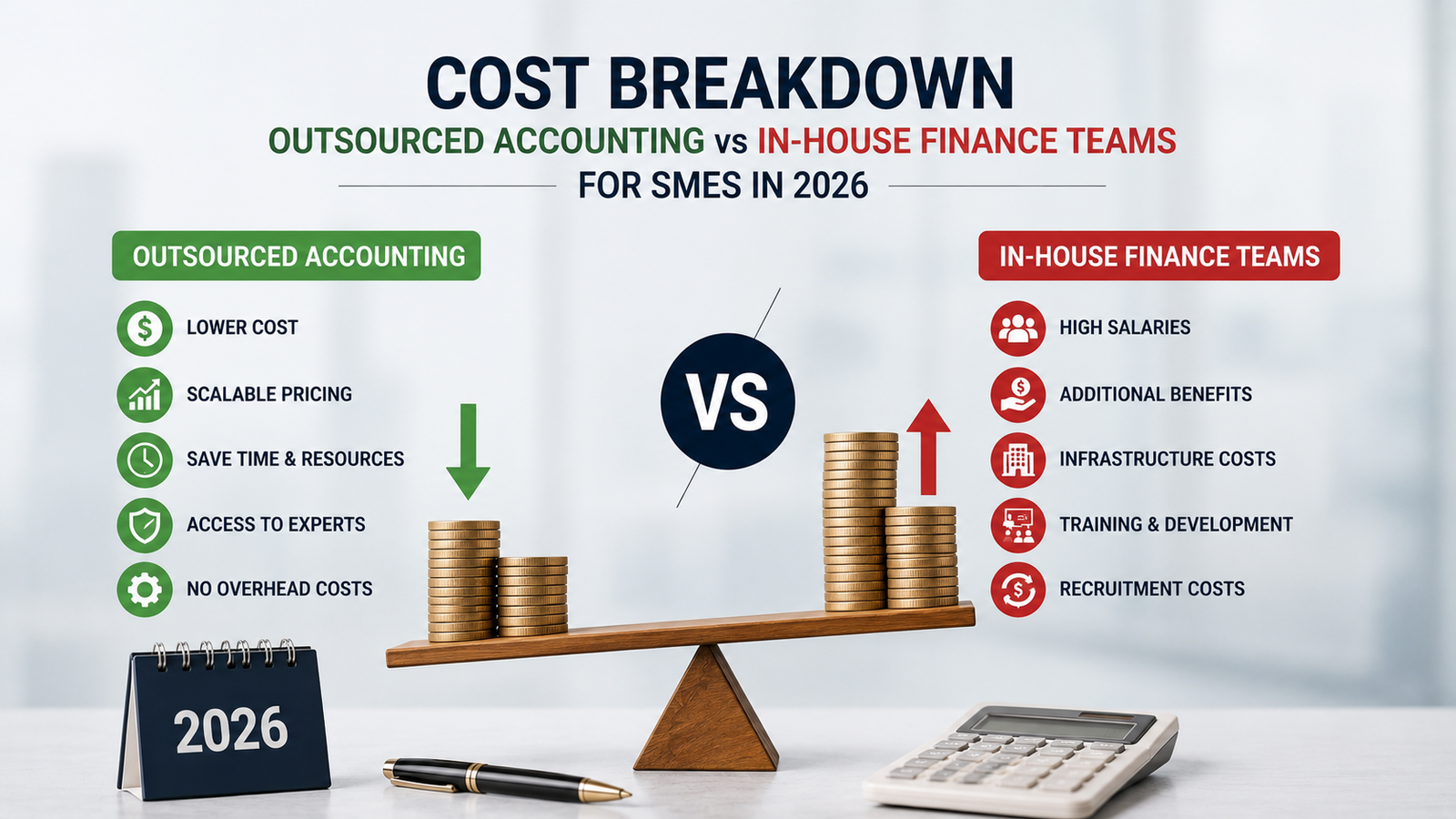
For many SMEs, outsourced accounting can be more cost-efficient than building a full in-house finance team, especially when the business needs bookkeeping, GST compliance, monthly reporting, payroll coordination, tax support and CA review without fixed salary burden.
An in-house finance team gives control and daily availability, but it also brings salary, hiring, training, software, supervision, attrition and compliance risk costs.
The best model for most growing SMEs in 2026 is not purely outsourced or purely in-house. It is a hybrid model: routine work supported by technology, outsourced CA-led review, and internal coordination where needed.
Why SMEs Need to Compare the Real Cost, Not Just Salary
Most business owners compare outsourced accounting with in-house finance by looking only at monthly salary. That creates an incomplete picture.
The real cost of finance includes:
- Salaries
 Employer benefits
- Hiring time
- Training
- Accounting software
- GST and TDS compliance review
- Management reporting
- Senior finance supervision
- Staff attrition
- Error correction
- Penalty risk
- Business owner time
For SMEs, finance is not only a back-office function. It affects tax planning, cash flow, vendor payments, receivables, GST credits, audit readiness and profitability.
If the finance system is weak, the business may lose money even when sales are growing.
What Is an In-House Finance Team?
An in-house finance team means the business directly hires employees to manage accounts, bookkeeping, billing, payments, reconciliations, payroll support, GST data and reporting.
A typical SME finance setup may include:
- Junior accountant
- Senior accountant
- Accounts executive
- Finance manager
- Payroll/accounting coordinator
- External CA for filings and audit
For a very small business, one accountant may handle everything. But as transactions grow, one person is rarely enough.
The challenge is that SMEs often hire a junior accountant and expect them to manage bookkeeping, GST, TDS, MIS, payroll, compliance and advisory. This creates dependency and increases error risk.
What Is Outsourced Accounting?
Outsourced accounting means the business assigns accounting, bookkeeping, reporting and compliance support to an external professional firm or CA-led team.
Depending on scope, outsourced accounting may include:
- Bookkeeping
- Bank reconciliation
- Sales and purchase accounting
- Expense recording
- GST data preparation
- GSTR-2B reconciliation support
- TDS working
- Payroll coordination
- MIS reporting
- Vendor/customer ledger review
- Monthly closing
- Financial statements
- CA review
- Virtual CFO support
CA Rohit Jain’s service mix includes accounting, bookkeeping, GST, audit, corporate finance and Virtual CFO services, making outsourced accounting suitable for SMEs that need both execution and professional review.
Cost Comparison Table: Outsourced vs In-House Finance
| Cost Area | In-House Finance Team | Outsourced Accounting |
|---|---|---|
| Monthly salary | Fixed salary cost | Fixed or flexible service fee |
| Hiring cost | Recruitment time and cost | No direct hiring burden |
| Training | Business must train staff | Provider brings process expertise |
| Software | Business pays separately | May use shared or recommended systems |
| Supervision | Owner/manager must review | CA-led review may be included |
| GST/TDS compliance | Needs expert oversight | Can be built into service scope |
| Scalability | Need more hires as work grows | Scope can increase gradually |
| Attrition risk | High dependency on staff | Lower dependency on one employee |
| Reporting quality | Depends on employee skill | Depends on service scope and review quality |
| Strategic finance | Usually missing unless senior hire | Can add Virtual CFO support |
Hidden Costs of an In-House Finance Team
1. Salary and Benefits
The visible cost of an in-house finance team is salary.
But salary alone is not the full cost. Businesses may also pay:
- Employer contributions
- Bonuses
- Leave salary
- Laptop and workspace cost
- Software access
- HR/admin time
- Replacement cost during attrition
A finance manager in India can cost significantly more than a junior accountant. Glassdoor’s June 2026 estimate shows average accounting and finance manager salary in India around ₹14.32 lakh per year, with a typical range from about ₹9.97 lakh to ₹18.68 lakh annually. This does not include every overhead a business may incur.
For SMEs, this fixed cost becomes heavy if the finance workload does not justify a full senior team.
2. Hiring and Training
Hiring finance staff is not only about posting a job.
The business must spend time on:
- Screening candidates
- Interviews
- Salary negotiation
- Onboarding
- Training on business process
- Explaining GST/accounting workflow
- Reviewing early mistakes
- Replacing staff if they leave
If the business owner personally supervises the accountant, that time has a cost.
3. Software and Technology
Modern finance teams need accounting software, cloud storage, payroll systems, billing tools, GST utilities and reporting dashboards.
Software costs may include:
- Accounting software subscription
- GST reconciliation tools
- Payroll software
- Cloud storage
- Data backup
- Cybersecurity controls
- User access management
If software is not set up properly, the business may still face errors despite paying for tools.
4. Supervision and Review
An accountant records transactions. But someone must review whether the records are correct.
This includes:
- GST reconciliation
- TDS applicability
- Expense classification
- Balance sheet review
- Vendor/customer ledgers
- Cash and bank reconciliation
- Profitability reports
- Audit readiness
If a business hires only a junior accountant, professional review is still needed. Without review, errors may remain hidden until filing, audit or tax notice stage.
5. Compliance Risk
Compliance mistakes can become more expensive than salary.
Common risks include:
- Wrong GST rate
- Missed ITC reconciliation
- Late GST return filing
- TDS deduction errors
- Incorrect expense booking
- Poor documentation
- Mismatch between books and returns
- Delayed financial statements
- Weak audit records
An in-house team without CA-level review can create hidden risk.
What Outsourced Accounting Usually Includes
Outsourced accounting services can be customised, but a strong SME package usually includes:
- Monthly bookkeeping
- Bank reconciliation
- Purchase and sales accounting
- GST working and reconciliation
- TDS working
- Monthly closing
- Accounts receivable tracking
- Accounts payable tracking
- Expense classification
- MIS reports
- Periodic CA review
- Compliance calendar support
- Audit coordination
- Tax planning inputs
- Virtual CFO add-on, where required
This allows SMEs to access a broader skill set without hiring separate people for every function.
When In-House Finance Makes Sense
In-house finance may be better when:
- The business has very high daily transaction volume
- Multiple departments need real-time finance support
- Inventory and billing operations are complex
- Internal approvals need constant coordination
- Data confidentiality requires tight internal control
- The business can afford a structured finance department
- There is a senior finance leader available internally
For example, a manufacturing business with daily inventory movement, multiple branches and high purchase volume may need internal accounts staff for daily operations. But even then, CA review and outsourced advisory may still be useful.
When Outsourced Accounting Delivers Better ROI
Outsourced accounting is often better for SMEs when:
- Transaction volume is moderate
- The owner wants lower fixed cost
- GST and TDS compliance need expert review
- Reports are delayed internally
- The business cannot hire senior finance talent
- Accounting errors are increasing
- Cash flow tracking is weak
- The business wants MIS without a full finance team
- Expansion is planned but finance systems are not ready
Outsourcing gives access to process, expertise and review without building a large internal department.
Best Model for SMEs: Hybrid Accounting + CA Review
For many SMEs in Chandigarh, the most practical model is hybrid.
A hybrid finance model may look like this:
| Function | Best Handled By |
|---|---|
| Daily invoice collection | Internal coordinator |
| Bookkeeping | Outsourced accounting team |
| GST reconciliation | CA-led team |
| TDS working | CA-led team |
| Payroll inputs | Internal HR/admin + outsourced review |
| MIS reporting | Outsourced accounting / Virtual CFO |
| Tax planning | CA |
| Audit readiness | CA + accounting team |
| Cash flow review | Virtual CFO |
This model gives the business daily operational control while keeping compliance and reporting under expert supervision.
Step-by-Step Decision Framework
Step 1: Calculate Current Finance Cost
Include:
- Salary
- Benefits
- Software
- Office cost
- Hiring cost
- CA filing fees
- Error correction cost
- Owner supervision time
This gives the real cost of in-house finance.
Step 2: Identify Finance Pain Points
Ask:
- Are books updated monthly?
- Are GST reconciliations accurate?
- Are MIS reports available on time?
- Is cash flow visible?
- Are payments and receivables tracked?
- Are tax filings stress-free?
- Is the business dependent on one accountant?
Step 3: Compare Service Scope, Not Just Price
A low-cost outsourced provider may only do data entry. A CA-led outsourced accounting setup can provide review, compliance and advisory.
Compare:
- Bookkeeping frequency
- GST support
- TDS support
- Reporting quality
- Review process
- Turnaround time
- Data security
- Technology use
- Escalation process
Step 4: Decide the Right Model
Choose:
- In-house only
- Outsourced only
- Hybrid model
- Outsourced accounting + Virtual CFO
- Internal accountant + CA review
For most SMEs, hybrid works best because it balances cost, control and expertise.
Conclusion
The choice between outsourced accounting and an in-house finance team should not be based only on salary. SMEs must compare total cost, reporting quality, compliance risk, scalability, supervision and business decision support.
In-house finance gives control, but it can become expensive and skill-dependent. Outsourced accounting provides flexibility, expert review and lower fixed overhead. For many SMEs in 2026, the best solution is a hybrid model supported by a CA-led team.
CTA:
If your business wants accurate books, GST reconciliation, MIS reporting, tax planning and cost-efficient finance support, CA Rohit Jain can help with accounting, bookkeeping, Virtual CFO and compliance services for SMEs in Chandigarh and Tricity.
6. FAQ SECTION
1. Is outsourced accounting cheaper than in-house accounting?
In many cases, outsourced accounting is cheaper because businesses avoid full-time salary, benefits, hiring, training, software and supervision costs. However, cost depends on transaction volume and service scope.
2. What is the cost of an in-house finance team?
The cost includes salaries, benefits, hiring, training, software, workspace, supervision and external CA review. A senior finance manager can cost several lakhs annually, excluding overheads.
3. What are the benefits of outsourced accounting for SMEs?
Outsourced accounting helps SMEs reduce fixed costs, improve accuracy, access expert review, manage GST/TDS compliance, receive timely reports and scale finance support as the business grows.
4. When should a business hire an internal accountant?
A business should hire internal accounting staff when daily transaction volume is high, operational coordination is constant, or finance support is needed inside the office every day.
5. Can outsourced accounting handle GST compliance?
Yes. A CA-led outsourced accounting team can support GST data preparation, reconciliation, GSTR-2B matching, ITC review and filing coordination.
6. Is outsourcing accounting safe for small businesses?
Outsourcing is safe when the business works with a trusted professional firm, defines scope clearly, uses secure data-sharing systems and maintains review controls.
7. What is better: in-house finance team or outsourced accounting?
For many SMEs, a hybrid model is best. Routine coordination can stay internal, while bookkeeping, GST, MIS, tax planning and review can be handled by an outsourced CA-led team.