TL;DR
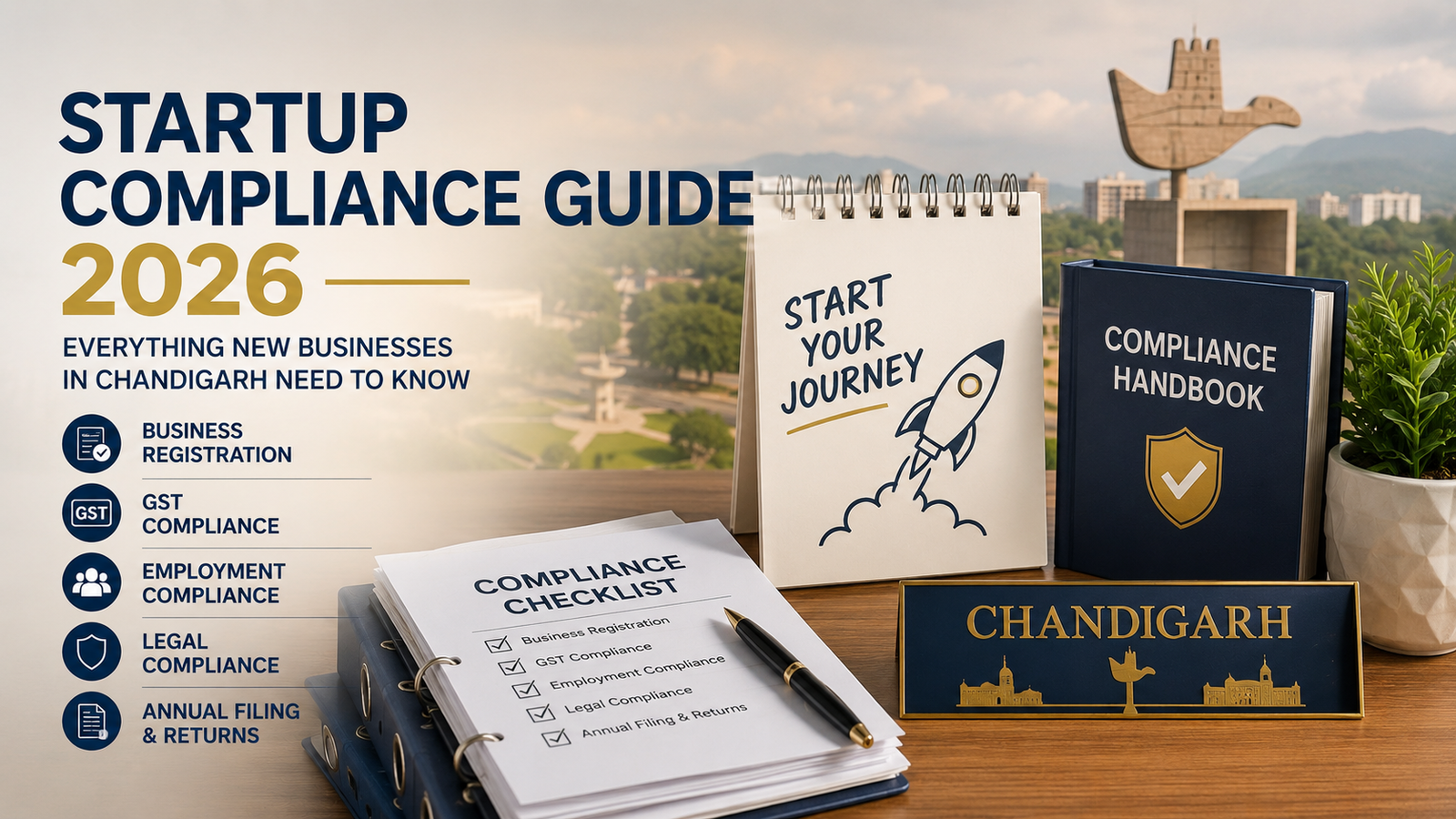
Startup compliance in Chandigarh is not limited to company registration. A new business must plan its legal structure, PAN, TAN, GST registration, accounting system, income tax, TDS, ROC filings, payroll, contracts, DPIIT recognition and investor documentation from the beginning.
The biggest mistake founders make is treating compliance as an afterthought. In 2026, clean records and timely filings are essential for credibility, funding, tax safety and sustainable growth.
Why Startup Compliance Matters from Day One
Many founders focus only on product, sales, hiring and marketing during the early stage. That is understandable, but ignoring compliance can become expensive later.

A startup may look small in the first few months, but every decision creates a compliance impact:
- Which structure should the business use?
- Should the startup register for GST?
- Is TAN required for TDS?
- Are contracts properly documented?
- Are books maintained monthly?
- Is the company filing ROC forms on time?
- Is investor documentation ready?
- Can the business claim Startup India benefits?
For new businesses in Chandigarh, compliance is not just a legal requirement. It is a growth foundation. Banks, investors, customers and vendors all trust businesses that maintain clean statutory records.
Startup Compliance Checklist for Chandigarh Businesses
1. Choose the Right Business Structure
The first compliance decision is choosing the right structure.
Common options include:
| Business Structure | Best For | Key Compliance Level |
|---|---|---|
| Proprietorship | Small individual businesses | Low |
| Partnership Firm | Small businesses with partners | Moderate |
| LLP | Professional/service businesses with limited liability | Moderate |
| Private Limited Company | Startups seeking funding, scale and credibility | Higher |
| OPC | Solo founder businesses needing corporate identity | Moderate |
A private limited company may be preferred for startups planning funding, ESOPs, investors or scalable operations. LLPs may suit service-based businesses that want limited liability with relatively simpler compliance.
The wrong structure can create tax, compliance and funding problems later. Before registration, founders should review ownership, liability, tax impact, investor plans and long-term goals with a CA.
2. Complete Business Registration
Once the structure is selected, complete registration properly.
For a private limited company, this may include:
- Name approval
- DSC for directors
- DIN-related compliance
- SPICe+ incorporation filing
- MOA and AOA
- Certificate of Incorporation
- PAN and TAN allotment
- Registered office documentation
For LLPs, compliance may include:
- Name reservation
- Digital signatures
- LLP incorporation filing
- LLP agreement
- PAN and TAN
- Registered office proof
A startup should ensure that founder names, shareholding, capital structure, registered office and business objects are correctly documented at the start.
3. Apply for PAN, TAN and Bank Account
PAN is essential for tax filings, bank accounts, invoices and financial transactions. TAN is required when the business deducts TDS.
Startups should also open a dedicated business bank account. Mixing personal and business transactions creates accounting confusion and weakens tax documentation.
Early finance setup should include:
- Business bank account
- PAN and TAN records
- Authorised signatory details
- Digital signature management
- Accounting software setup
- Invoice format
- Document storage system
This creates a clean base for future tax and compliance work.
4. Check GST Registration Applicability
GST registration is one of the most important startup compliance decisions.
In general, GST registration becomes mandatory when a business crosses prescribed turnover thresholds. Current GST guidance indicates that goods suppliers in most normal category states generally follow the ₹40 lakh threshold, while service providers generally follow the ₹20 lakh threshold. Some special category rules and compulsory registration cases may apply.
Startups should also review GST registration if they:
- Sell goods or services across states
- Sell through e-commerce platforms
- Need to issue GST invoices to B2B customers
- Want to claim input tax credit
- Provide taxable services
- Deal with corporate clients requiring GST invoices
GST compliance includes:
- GSTR-1
- GSTR-3B
- GSTR-2B reconciliation
- E-invoicing applicability review
- Input tax credit tracking
- Tax invoice compliance
- GST payment planning
A startup should not wait until turnover crosses the threshold if customers, contracts or business model require GST registration earlier.
5. Maintain Proper Books of Accounts
Accounting is not only for filing returns. It helps founders understand whether the business is actually profitable.
Startups should maintain:
- Sales register
- Purchase register
- Expense records
- Bank reconciliation
- Fixed asset records
- Loan records
- Founder contribution records
- Customer and vendor ledgers
- GST and TDS workings
- Payroll records
Poor bookkeeping creates problems during tax filing, funding rounds, bank loan applications and due diligence.
A monthly accounting process is better than year-end clean-up because errors are easier to correct early.
6. Track Income Tax and Advance Tax
Startups must plan income tax from the beginning.
Important areas include:
- Correct profit calculation
- Expense classification
- Depreciation
- Advance tax estimation
- Capital expenditure review
- Founder remuneration
- Director payments
- Related-party transactions
- Tax audit applicability
- ITR filing
If a startup becomes profitable, advance tax may apply. Waiting until year-end can create interest and cash flow pressure.
Startups should review tax position at least quarterly.
7. Manage TDS Compliance
TDS is often missed by new businesses.
Startups may need to deduct TDS on:
- Salary
- Professional fees
- Contractor payments
- Rent
- Commission
- Interest
- Certain high-value transactions
TDS compliance includes deduction, deposit, return filing and certificate issuance. If TDS is not handled correctly, expenses may face disallowance and the startup may incur interest or penalties.
A simple TDS tracker should be maintained from the first month.
8. Complete ROC and MCA Compliance
Private limited companies and LLPs must follow MCA/ROC compliance.
For private limited companies, annual compliance generally includes financial statement filing and annual return filing. AOC-4 is generally filed within 30 days of the AGM, while MGT-7 is generally filed within 60 days of the AGM.
Important company compliance may include:
- Board meetings
- AGM
- Statutory registers
- Financial statements
- Director disclosures
- Auditor appointment
- AOC-4 filing
- MGT-7 / MGT-7A filing
- ITR filing
- Event-based filings for changes
For LLPs, annual compliance generally includes LLP annual return and statement of accounts/solvency filings.
Startups should not ignore ROC filings even if there is no revenue. Compliance still applies once the entity is incorporated.
9. Apply for DPIIT Startup Recognition
DPIIT recognition under Startup India can help eligible startups access benefits such as tax benefits, easier compliance, IPR fast-tracking and related startup ecosystem support. Startup India states that eligible entities can apply for recognition to access these benefits.
Eligibility usually depends on factors such as:
- Entity type
- Age of incorporation
- Turnover limits
- Innovation, improvement or scalable business model
- Not being formed by splitting or reconstructing an existing business
Startup India currently states that recognised startups may be considered up to 10 years from incorporation, with separate deeptech recognition timelines in certain cases.
Founders should check eligibility and documentation before applying.
10. Prepare for Funding and Investor Due Diligence
If a startup plans to raise funds, compliance must be investor-ready.
Investors usually review:
- Incorporation documents
- Founder agreements
- Cap table
- Shareholding records
- Financial statements
- GST returns
- Income tax returns
- ROC filings
- Bank statements
- Contracts
- Intellectual property documents
- Payroll records
- ESOP documentation, if applicable
- Debt and liability details
A startup with weak compliance may face delayed funding, lower valuation or investor concerns.
Virtual CFO support can help startups prepare financial models, MIS reports, burn-rate tracking, runway analysis and due diligence documentation.
Startup Compliance Calendar 2026
| Compliance Area | What to Track | Frequency |
|---|---|---|
| Accounting | Books, bank reconciliation, invoices | Monthly |
| GST | GSTR-1, GSTR-3B, ITC reconciliation | Monthly/Quarterly |
| TDS | Deduction, payment, return filing | Monthly/Quarterly |
| Income Tax | Advance tax, ITR, tax audit review | Quarterly/Annual |
| ROC | AOC-4, MGT-7/MGT-7A, event filings | Annual/Event-based |
| LLP Compliance | Form 8, Form 11, ITR | Annual |
| Payroll | Salary, PF/ESI applicability, TDS | Monthly |
| DPIIT | Recognition and benefit eligibility | As applicable |
| Funding | MIS, financial model, due diligence files | Ongoing |
Common Startup Compliance Mistakes
Mistake 1: Registering the Wrong Business Structure
Founders often choose the cheapest or fastest structure without thinking about funding, liability, taxation or future scalability.
Mistake 2: Ignoring GST Until a Customer Demands It
GST should be reviewed based on turnover, business model, customer type and interstate supply. Delayed registration can create billing and compliance issues.
Mistake 3: Not Maintaining Books Monthly
Year-end accounting clean-up is risky. Monthly books help track cash flow, profitability and tax liability.
Mistake 4: Missing ROC Filings
Companies must file annual returns even if business activity is low or revenue has not started.
Mistake 5: Mixing Personal and Business Expenses
Founder expenses must be properly classified. Mixing personal and business payments weakens tax records.
Mistake 6: Not Creating Founder Agreements
When multiple founders are involved, ownership, roles, exits and decision rights should be documented early.
Mistake 7: Ignoring Investor Readiness
Many startups prepare compliance documents only when funding talks begin. This delays due diligence.
Mistake 8: Not Consulting a CA Early
A CA can help set up the correct structure, GST, accounting, tax, ROC and funding documentation from the beginning.
Conclusion
Startup compliance in 2026 requires more than registration. New businesses in Chandigarh need the right structure, GST planning, income tax review, TDS compliance, ROC filings, accounting discipline, DPIIT recognition review and investor-ready documentation.
The earlier a startup builds compliance discipline, the easier it becomes to scale, raise funds, manage cash flow and avoid penalties.
A CA-led compliance system helps founders focus on growth while ensuring that legal, tax and financial requirements stay under control.
CTA:
If you are starting or scaling a business in Chandigarh, CA Rohit Jain can help with startup registration, GST, accounting, ROC compliance, income tax, Virtual CFO support and investor-ready financial documentation.
FAQ SECTION
1. What compliances are required for startups in India?
Startups may need business registration, PAN, TAN, GST registration, accounting, income tax filing, TDS compliance, ROC filings, payroll compliance, contracts and investor documentation depending on structure and business activity.
2. Do startups need GST registration?
Startups need GST registration if they cross prescribed turnover thresholds or fall under compulsory registration categories. Some startups also register voluntarily to issue GST invoices and claim input tax credit.
3. Which business structure is best for a startup?
A private limited company is often preferred for startups planning funding and scale. LLPs may suit service businesses, while proprietorships may suit very small individual businesses. The best structure depends on goals, liability and tax planning.
4. What is DPIIT startup recognition?
DPIIT startup recognition is recognition under the Startup India initiative. Eligible startups can apply to access benefits such as tax benefits, easier compliance and IPR fast-tracking support.
5. What ROC filings are required for private limited companies?
Private limited companies generally need to file financial statements and annual returns with the ROC, commonly through forms such as AOC-4 and MGT-7/MGT-7A, along with event-based filings where applicable.
6. Do startups need to maintain books of accounts?
Yes. Startups should maintain proper books from day one. Clean accounts help with tax filing, GST compliance, cash flow tracking, bank loans, investor due diligence and audit readiness.
7. Why should startups hire a CA?
A CA helps startups choose the right structure, manage GST, income tax, TDS, ROC filings, accounting, compliance calendar, tax planning and funding documentation.